


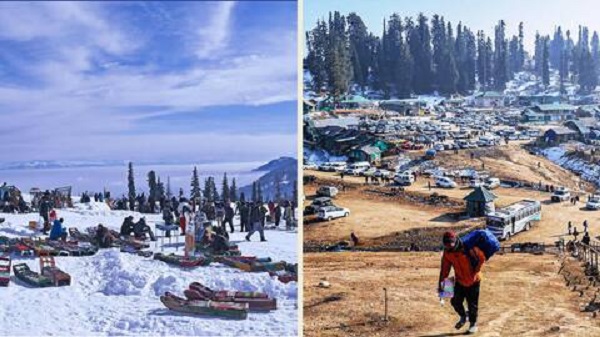
Kashmir, renowned for its picturesque landscapes and winter wonderlands, is facing an unusual challenge this season. Gulmarg, one of the region's main winter tourism attractions, has been bereft of snow, leading to a significant decline in tourist footfall and adversely impacting the business of ski resorts. This decline is not limited to Gulmarg alone but extends across Jammu and Kashmir and Ladakh, raising concerns about the region's climate, agriculture, and economy.
Government data reveals a substantial drop in tourist arrivals, with officials estimating at least a 60% decrease compared to the previous year. Gulmarg, a favored destination during the winter months, heavily relies on snow for skiing and other winter sports. The absence of snow has dealt a blow to the local economy, affecting businesses that depend on winter tourism.
The scarcity of snow in Gulmarg is part of a broader weather phenomenon affecting the entire region. Jammu and Kashmir, along with Ladakh, has experienced an unusual dry spell this winter. The India Meteorological Department reports an 80% rainfall deficit in December for Jammu and Kashmir, and a 100% deficit (no rainfall) in January so far. The lack of precipitation has far-reaching consequences beyond the tourism sector.
The decreasing trend in snowfall in the Himalayan region has been linked to various factors, including a decline in Western Disturbance events and a gradual rise in temperatures. Western Disturbances, crucial for winter precipitation in the area, have been showing a declining trend in recent years. Scientists suggest that climate change, coupled with the prevailing El Nino event in the eastern Pacific Ocean, may be additional factors influencing this year's remarkably low snowfall.
Winter precipitation in the Himalayan region is essential for the local climate, winter crops, horticulture, and the availability of water in streams and rivers. The decline in snowfall has both short-term and long-term implications. In the short term, the lack of snow can lead to forest fires, agricultural drought, and reduced crop production. The absence of a steady moisture source can result in an early spring, affecting the yield of winter crops.
Long-term consequences include a reduction in hydroelectricity generation, an increase in glacier melting, and adverse effects on drinking water supply due to minimal groundwater recharge. The local economy, heavily dependent on sectors like horticulture, faces challenges as key products like apples and saffron suffer from low yields in the absence of sufficient snowfall.
In conclusion, the declining trend in snowfall in Kashmir, especially in Gulmarg, is a cause for concern, not only for the winter tourism industry but for the overall well-being of the region's ecosystem. Addressing the challenges posed by changing weather patterns, climate change, and related factors is crucial for the sustainable development of Jammu and Kashmir. The region must consider adaptive strategies to mitigate the impact on tourism, agriculture, and the environment while working towards long-term solutions to address the broader issues affecting snowfall in the Himalayan region.






















Leave Your Comment