


The breaking India forces are always working to shatter Hindu unity so that they can wield political and bureaucratic authority to their advantage, destroying the nation socially, economically, and spiritually, and instilling servitude in each Bharatiya. The regular strategy they use is to split Hindus along caste lines. They develop false narratives to poison the minds of SC, ST, and OBC people, causing them to hate Hindus and Hindutva. They were partially successful and significantly destroyed the nation's fabric. It is time for "Bharat-making forces" to combat these false narratives and unify Hindus for the benefit of everybody.
Let us examine two false narratives that have been poisoning the brains of the SC and ST castes. 1. The Uniform Civil Code will abolish reservation. 2. Upper caste Hindus devised the system of castes and caste discrimination.
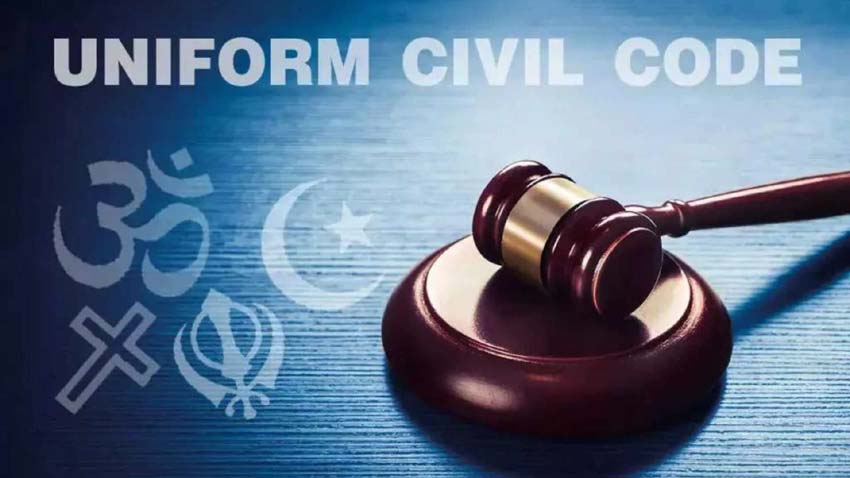
Uniform Civil Code : The concept of a uniform civil code refers to the establishment of a common civil code (marriage, adoption, inheritance, divorce, and so on) for all religions and social groups. In India now, there are numerous family laws; implementing a uniform civil code will bring harmony to the laws, resulting in efficiency and transparency. There are numerous advantages to having a standard civil code. Reservation is about equal opportunity; it is a sort of affirmative action offered to disadvantaged populations. Reservation is not related to the Uniform Civil Code. UCC is about religion, whereas Reservation is about social equality. Just consider, Islamic religion, They'll not be able to have four wives. They will be unable to discriminate against Muslim women. Islamic law will no longer apply in personal matters such as marriage. A Muslim girl will be unable to marry at the age of fifteen. They are unable to practice Triple Talaq and Nikah Halala. Muslim women will have the right to adopt. They will have equal rights to property. Mullas will lose their power as judges. All cases will be decided in court. These are all positive things. However, some Muslims may view these rules as anti-Islam and oppose them. They wish to live in prehistoric times. Despite criticism from some, UCC will have a positive impact on Muslim society.
Dr. Babasaheb Ambedkar's thought on UCC : “Uniform Civil Code for the citizens–The State shall endeavour to secure for the citizens, a Uniform Civil Code throughout the territory of India.” So states Article 44, which is one of the 16 Articles (from Article 36 to 51) enshrined in Part IV of our Constitution under the Directive Principles of State Policy.
Article 44 was introduced in the Constituent Assembly by Dr B R Ambedkar as draft Article 35, on November 23, 1948, and was unanimously passed on the same day.
However, during the discussion, a few Muslim members proposed amendments to add provisos, namely, "Provided that any group, section, community, or people shall not be obliged to give up its own personal law in case it has such a law, and, provided that the personal law of any community which is guaranteed by the statute shall not be changed except with the previous approval of the community." Discussions on these revisions lasted all day.
Dr. Babasaheb Ambedkar said in his reply: “I am afraid I cannot accept the amendments which have been moved to this Article. … My friend, Mr Hussain Imam, in rising to support the amendments, asked whether it was possible and desirable to have a uniform code of laws for a country so vast as this. Now I must confess that I was very much surprised at that statement, for the simple reason that we have in this country a uniform code of laws covering almost every aspect of human relationship. We have a uniform and complete Criminal Code operating throughout the country, which is contained in the Penal Code and the Criminal Procedure Code. We have the Law of Transfer of property, which deals with property relations and which is operative throughout the country. Then there are the Negotiable Instruments Acts, and I can cite innumerable enactments which would prove that this country has practically a Civil Code, uniform in its content and applicable to the whole of the country.”
This factual material clearly demonstrates that Dr. Babasaheb Ambedkar was devoted to establishing a Uniform Civil Code to ensure uniformity in civil conduct for all, with no intention to discard reservations. However, he was consistently challenged and stifled by those in positions of authority, as well as many members of parliament, who either refused to respect the constitution or sought opportunities to divide Hindus. Before making an opinion, the SC and ST communities should consider what Dr. Babasaheb Ambedkar said regarding UCC.
Who brought the Caste system? : The current caste system, in which caste is defined by birth, is not described in Vedic literature. The Vedic societal division of labor was originally known as varnashrama. The Bhagavad-gita (4.13) asserts that the varnashrama system is founded on guna (qualities) and karma (actions), or, in modern vernacular, attitudes and aptitudes, rather than birth.
According to the Chandogya Upanishad, Gautam Rishi designated Satyakama Jabali, a maidservant's son, to be a brahmana because he was unwaveringly truthful, which is the hallmark of a true brahmana. Suta Gosvami, Kanaka, Kanchipurna, Tukaram, Thiruvalluvar, Sura dasa, and Haridasa Thakura were all honored as saints, despite their birth in marginalized family.
A famous Vedic aphorism reiterates: janamana jayate shudra samskarad bhaved dvijah veda-pathanat bhavet viprah brahma janatiti brahmana
"Everyone is born a shudra, which means they are unqualified. Spiritual initiation transforms one into a new-born, meaning he begins his spiritual existence. By studying the Vedic scriptures, one can become a learned scholar. Only by realizing the absolute truth can one become a brahmana."
Shri Ranjiv Kurup, in his book, The History and Philosophy of Hindu writes with references, There is no “caste system” in India, other than the one imposed by the British. So you need to read British records to understand why and how they went about the process, starting with the first colonial census enumeration of 1871. [Risley 1891].
Most Indian’s still think the term refers to the ancient Indian tribes/communities, and use the term “caste” in lieu of “community”. “Caste” is Portuguese for “race”, a meaningless concept in the single-race India. The British also found “scriptural sanction” for “caste” in the Veda. Here’s the verse [RV10.90.12] and how it was interpreted by the British, as well as what it really means in Hindu traditions.
बराह्मणो. अस्य मुखमासीद बाहू राजन्यः कर्तः ।
ऊरूतदस्य यद वैश्यः पद्भयां शूद्रो अजायत ||
At the top of the hierarchy were the Brahmins who were mainly teachers and intellectuals and are believed to have come from Brahma's head. Then came the Kshatriyas, or the warriors and rulers, supposedly from his arms. The third slot went to the Vaishyas, or the traders, who were created from his thighs. At the bottom of the heap were the Shudras, who came from Brahma's feet and did all the menial jobs.
Here’s the true meaning: We get our most desirable qualities from the divine, namely wisdom, nobility, industry and facility. || RV 10.90.12||
Rashtriya Swayamsevak Sangh and Social Equanimity: Rashtriya Swayamsevak Sangh has been working from its founding to eliminate caste discrimination in the Hindu society. The efforts on the ground through various programs are remarkable. One of RSS's organizations, Vanavasi Kalyan Ashrams, works to improve the lives of SC, ST, and other tribes is the greatest example of serving with belonging and affection to uplift the poor and marginalised.
Sangh second Sarsanghchalak Golwalkar Guruji has made various efforts to bridge the gap based on caste discrimination. He launched several activities, institutions, organizations, and programs for the welfare of the poor and marginalized, as did by the other top Sangh leaders, and these efforts continue to this day. One of the examples.
Guruji’s biggest achievement at the VHP conference was to persuade the gathering to disown the varnashrama, or the caste system, and unanimously passed a resolution Hindavaha sadoraha, na Hindu patito bhavet (All Hindus are born out of the same womb (of Mother India). Therefore, they are brothers and no Hindu can be treated as untouchable. This was the biggest reformist push anybody could have imagined as the signatories included all the shankaracharyas who were firm believers in the caste system. To brand such a man as forcing ‘brahminical hegemony’ is most ill-informed criticism or deliberate propaganda. Golwalkar had earned the displeasure of Swami Karpatri, the founder-head of political party Ram Rajya Parishad, when he politely refused to propagate varnashrama as part of Hindu religion using RSS swayamsevaks.
In 1969, in Kerala, when asked if people who feel discriminated against could be given the sacred thread, he answers in the affirmative:
They should be given equal rights and footings in the matter of religious rites, in temple worship, in the study of Vedas, and in general in all our social and religious affairs. This is the only right solution for all the problems of casteism found nowadays in our Hindu society.
Let us build narratives that strengthen Bharat, rather than producing false narratives that would damage this magnificent nation.
(The content of this article reflects the views of writers and contributors, not necessarily those of the publisher and editor. All disputes are subject to the exclusive jurisdiction of competent courts and forums in Delhi/New Delhi only)
By Pankaj Jagannath Jayswal














Leave Your Comment