


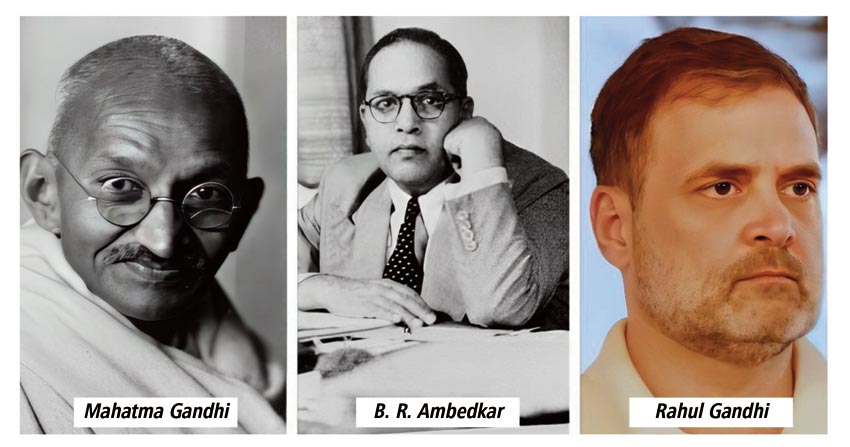
The Congress party will kick off its much-awaited ‘Jai Bapu, Jai Bhim, Jai Samvidhan Abhiyan’ on January 3, 2025, spanning across blocks, districts, and states. The campaign will culminate in a public rally at Mhow, Dr. B R Ambedkar’s birthplace, on January 26, marking the 75th anniversary of the Indian Constitution and the establishment of the Republic of India. As the Congress party grapples with diminishing political relevance, its latest effort to weave Mahatma Gandhi and Dr. B.R. Ambedkar’s legacies into a cohesive narrative under the "Jai Bapu, Jai Bheem Abhiyaan" reveals both ambition and desperation. The campaign aims to blend Gandhi’s philosophy of non-violence and rural development with Ambedkar’s vision of social justice and constitutional democracy. However, the historical discord between these two towering figures raises critical questions about the feasibility and authenticity of such a unifying narrative. Moreover, this initiative underscores Congress’ need to reassess its ideological and strategic foundations if it hopes to regain national prominence in 2025 and beyond.
Contrasting Legacies of Gandhi and Ambedkar
While Gandhi and Ambedkar both championed the cause of upliftment, their methods and ideologies were often at odds. Gandhi’s philosophy was rooted in spiritualism, emphasizing self-reliance, non-violence, and the preservation of traditional village systems. His approach to caste reform was gradual, advocating for the removal of untouchability but stopping short of demanding the abolition of the caste system itself.
In contrast, Ambedkar was a staunch critic of Gandhi’s paternalistic approach toward Dalits. For Ambedkar, caste was a deeply entrenched social evil that required systemic annihilation. He rejected Gandhi’s romanticization of the village as a bastion of morality, describing it instead as a hub of backwardness and caste oppression. Their ideological rift was epitomized in the Poona Pact of 1932, where Gandhi’s hunger strike forced Ambedkar to compromise on separate electorates for Dalits. This event left a lasting impression of mistrust between the two leaders and their followers.
How Congress and Its Leadership Mistreated Ambedkar and His Legacy
The Congress party’s historical relationship with Ambedkar is fraught with instances of neglect and mistreatment. Despite his pivotal role in drafting the Indian Constitution, Ambedkar often found himself sidelined by the Congress leadership. As India’s first Law Minister, Ambedkar faced resistance from Congress leaders on key policy matters, including the Hindu Code Bill, which aimed to reform Hindu personal laws and ensure gender equality. The lack of support for this progressive legislation led to Ambedkar’s resignation from the cabinet in 1951, a move that highlighted his disillusionment with Congress’ unwillingness to challenge entrenched societal norms.
Furthermore, the Congress’ upper-caste dominated leadership often viewed Ambedkar’s radical stance on caste abolition with suspicion, prioritizing electoral pragmatism over social justice. Post-independence, the party failed to adequately honor Ambedkar’s contributions, relegating him to the margins of India’s political memory. It was only decades later, under pressure from Dalit movements and political rivals, that Congress began to publicly acknowledge Ambedkar’s legacy. This belated recognition, however, often appeared as a token gesture rather than a genuine effort to embrace his vision of an egalitarian society.
The Political Calculus Behind Jai Bapu, Jai Bheem
The Congress’ attempt to merge these divergent legacies is less about historical reconciliation and more about electoral arithmetic. By invoking Gandhi, the party seeks to retain its traditional base among upper-caste Hindus and urban liberals. Simultaneously, aligning with Ambedkar aims to reclaim Dalit support, a voter bloc that has increasingly gravitated toward regional parties and the BJP under Narendra Modi’s social engineering strategies.This strategy is also a response to the BJP’s appropriation of both Gandhi and Ambedkar. While Modi’s government has extensively celebrated Gandhi through initiatives like Swachh Bharat Abhiyaan, it has also projected Ambedkar as a symbol of empowerment, leveraging his legacy to counter accusations of caste insensitivity. Congress’ Jai Bapu, Jai Bheem campaign appears to be an attempt to reclaim the narrative, but it risks oversimplifying the complex and often conflicting ideologies of its protagonists.
The Incoherence of the Unified Narrative
One of the fundamental challenges of the Jai Bapu, Jai Bheem campaign lies in reconciling the stark differences between Gandhi and Ambedkar’s philosophies. For instance, how can a campaign advocate for Gandhi’s ideal of harmonious caste coexistence while simultaneously championing Ambedkar’s call for caste annihilation? Such contradictions could dilute the campaign’s credibility among its target audiences, leaving both Gandhians and Ambedkarites unconvinced.
Moreover, the Congress’ lack of a coherent ideological position further complicates this endeavour. The party’s historical association with Gandhi is well-documented, but its relationship with Ambedkar has been tenuous at best. Ambedkar’s critical views of Congress’ upper-caste dominance and his eventual resignation from Nehru’s cabinet highlight the party’s historical failure to embrace his vision fully. Without addressing these historical realities, the Congress risks being accused of opportunistic appropriation.
Why Congress Needs to Go Back to the Drawing Board
The Jai Bapu, Jai Bheem Abhiyaan is symptomatic of a deeper malaise within the Congress party: the absence of a clear ideological anchor and a long-term strategy. While the BJP has successfully built a narrative of nationalism and development, the Congress appears to be grasping at straws, oscillating between secularism, socialism, and identity politics without a unifying framework. The party’s overreliance on its historical legacy rather than adapting to contemporary challenges has left it in a political limbo. Congress must recognize that token gestures, such as blending Gandhi and Ambedkar’s legacies, cannot substitute for a robust and coherent vision.
Instead of relying on past glories, the Congress needs to articulate a vision that resonates with modern India. This involves addressing pressing issues such as economic inequality, unemployment, and climate change, while ensuring social justice and inclusivity. It must also prioritize meaningful engagement with marginalized communities, not as a symbolic exercise but as a genuine effort to understand and address their concerns. Furthermore, the party’s leadership must embrace modernization, encouraging regional leaders and fresh faces to take the helm, thereby breaking its dependence on the Nehru-Gandhi dynasty. This would not only revitalize the party’s image but also make it more relatable to a younger, aspirational electorate.
The Congress also needs to craft a narrative that counters the BJP’s dominance effectively. Rather than reacting to the BJP’s strategies, it must set its own agenda, focusing on governance gaps, rising inequality, and social polarization. Additionally, the party’s organizational structure requires an overhaul to enhance efficiency and adaptability in a rapidly evolving political landscape. By addressing these systemic issues and aligning its ideology with contemporary realities, the Congress can aspire to reclaim its relevance on the national stage.
Conclusion
The Jai Bapu, Jai Bheem Abhiyaan reflects the Congress’ struggle to redefine itself in an era dominated by BJP’s electoral juggernaut. While the idea of uniting Gandhi and Ambedkar’s legacies may resonate with certain sections, its historical inaccuracies and ideological contradictions make it an unsustainable strategy. For the Congress to reclaim its status as a national force, it must go beyond symbolic campaigns and undertake a transformative journey of ideological clarity, grassroots engagement, and organizational reform. Anything less risks relegating the party further into the margins of India’s political discourse.

By Nilabh Krishna
(The content of this article reflects the views of writers and contributors, not necessarily those of the publisher and editor. All disputes are subject to the exclusive jurisdiction of competent courts and forums in Delhi/New Delhi only)















Leave Your Comment