


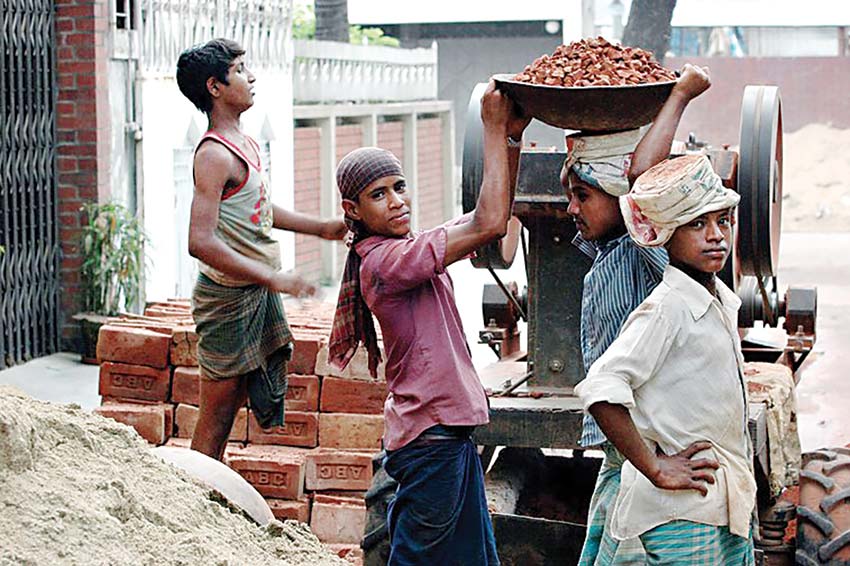
Child labour remains one of the gravest crime against humanity. Despite constitutional mandates, international conventions, and numerous welfare schemes, a mushroomed strength of vagabond kids is found in factories, fields, households, and markets. The prolonged existence of child labour reveals ingrained flaw in system leading to societal insensitivity, and a collective apathy that must be urgently addressed. Child labour remains a pressing concern in India, despite legal prohibitions and global commitments. Millions of children are pushed into work due to poverty, lack of education, and systemic failures. While laws exist, enforcement remains inconsistent, and socio-economic conditions continue to compel children to become part of the workforce. deep moral and legal paradox in the fight against child labour: when a child, full of life and curiosity, engages in labour not out of coercion but from a perceived necessity or agency yet in complete contradiction to law and child rights.
Causes of Child Labour
Poverty is the most immediate cause of child labour. Families struggling for survival often see children as supplementary wage earners.
Poor infrastructure, inadequate teacher availability, high dropout rates, and unaffordable schooling push children towards work rather than classrooms.
A large proportion of child labour occurs in the informal sector, where laws are easily flouted and inspections are rare.
In some communities, child labour is seen as a part of growing up or a tradition, especially in family-run businesses or agriculture.
Displaced families or migrant labourers often have no safety nets, resulting in children being roped into work for family survival.

Indian Laws Governing Child Labour
(a) Constitution of India,
(b) Child and Adolescent Labour (Prohibition and Regulation) Act, 1986 (Amended in 2016),
(c) Right of Children to Free and Compulsory Education Act, 2009 (RTE Act),
(d) Factories Act, 1948
(e) Bonded Labour System (Abolition) Act, 1976
International Legal Frameworks
(a) ILO Conventions
India has ratified both.
(b) United Nations Convention on the Rights of the Child (UNCRC),

Failure of the Governmental System
Weak Implementation of Laws:
Though laws like the Child Labour (Prohibition and Regulation) Act, 1986 exist, enforcement is weak. Inspections are inadequate and punitive measures for violators are minimal or delayed.
Corruption and Collusion:
In many cases, enforcement agencies are either indifferent or complicit with employers of child labourers, especially in industries like textiles, fireworks, mining, or domestic work.
Insufficient Rehabilitation Mechanisms:
Even when children are rescued, there are inadequate rehabilitation, vocational training, and integration efforts. Most often, they relapse into labour due to lack of alternatives.
Compelling Poverty Conditions
Ground Reality and Challenges
Contradictions and Legal Gaps
Adolescent Labour: Non-hazardous work is allowed for 14–18-year-olds, yet there is poor regulation and monitoring.
Role of Education
Role of NGOs and Civil Society

Role of Child Welfare Departments
Lack of Sensitivity of the Public
Indifference and Inaction:
Society often turns a blind eye to children working in shops, homes, or eateries. Rather than intervening, the general public treats it as “normal” or unavoidable.
Demand-Side Ignorance:
Consumers often don’t question the supply chains of products they use due to low price factor whether carpets, garments, or firecrackers which are produced through child labour.
Low Awareness and Advocacy
There is minimal public discourse on the issue in mainstream media, schools, or public platforms, which leads to a lack of widespread awareness or empathy.
General Standards of Society
The prevalence of child labour is a reflection of broader societal attitudes and systemic neglect:
General Standards of Society
Gender discrimination further compounds the problem as girl children are often doubly exploited—as unpaid domestic help and as wage earners.
Solutions
Conclusion
Child labour is not merely a legal issue, it is a moral failure of the state and society. A child working is a future compromised, a law broken, and a conscience dulled. Eradicating child labour requires a multi-dimensional approach involving law, policy, education, economy, and above all, a collective awakening of public conscience. Strengthening district administration is crucial to converting laws into action, policies into impact, and societal indifference into accountability. Only then can we hope to build a nation where childhood is not lost in toil, but celebrated with learning, play, and hope.
By Dr (Lt Col) Atul Tyagi
(The content of this article reflects the views of writers and contributors, not necessarily those of the publisher and editor. All disputes are subject to the exclusive jurisdiction of competent courts and forums in Delhi/New Delhi only)















Leave Your Comment