


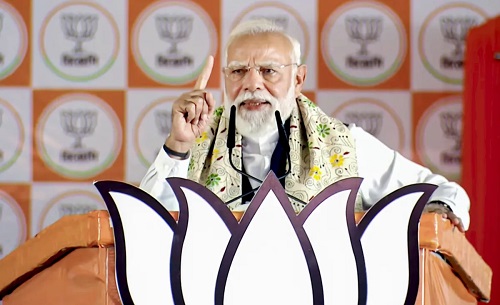
Prime Minister Narendra Modi on Thursday addressed a high-energy political rally in Asansol, asserting that the demand for political change in West Bengal has become “an indelible reality.” He claimed that the sentiment for change was resonating not just in Asansol but across the state, echoing through regions like Durgapur, Raniganj, Saltora, and Raghunathpur.
“This is the voice of every single person in Bengal,” the Prime Minister said, framing the upcoming electoral battle as a decisive moment for the state’s future.
In a sharp attack on the ruling Trinamool Congress (TMC), Modi alleged that there was a time when Hindus were threatened with violence through “red posters,” drawing a parallel with the current situation. He accused the TMC of perpetuating a similar climate of fear and intimidation.
“The people of Bengal want their land, faith, livelihoods, and their children’s future to remain secure,” he said, urging voters to treat April 23 as a “moment of decision.” He also asserted that just as the BJP has secured India’s western borders, it would ensure the security of the eastern frontier.
The Prime Minister accused the TMC government of ruling through fear over the past 15 years and “weaponising” intimidation against its own people. He drew comparisons with the earlier Left Front era, suggesting that the same tactics of control and coercion were being repeated.
Referring to recent tensions in Malda, Modi criticized TMC leaders for allegedly targeting central security forces like the CRPF. He warned that the electorate would respond strongly to such actions.
He further declared that a “true rule of law” would be established in Bengal after May 4, promising accountability for acts of violence and lawlessness.
Raising concerns over women’s safety, Modi cited incidents such as those linked to RG Kar Medical College and Hospital and developments in Sandeshkhali. He alleged that the TMC had consistently sided with perpetrators in such cases.
“The women of Bengal do not feel safe or secure,” he said, claiming that the state leads in acid attack cases and positioning the BJP as the only party committed to safeguarding women’s rights.
Highlighting the Centre’s development initiatives, Modi said the government had expanded medical facilities, including the ESI Hospital, despite obstacles from the state administration. He also pointed to major infrastructure and industrial projects aimed at boosting the region’s growth.
Among these, he cited investments exceeding ₹45,000 crore in steel plant expansion, the Durgapur-Haldia gas pipeline, and improved rail connectivity such as the Asansol-Bokaro train service. He added that the region has benefited from new semi-high-speed trains like Vande Bharat and Amrit Bharat.
Additionally, he noted ongoing modernization under the ‘Amrit Bharat Station Scheme,’ including upgrades at Andal Railway Station, and the commissioning of a Gati Shakti Cargo Terminal within the Asansol Division.
Framing the election as a larger struggle, Modi described it as an opportunity to “liberate” Bengal from what he termed “mafia rule.” He accused successive governments—from the Congress to the Left Front and now the TMC—of betraying the people and stalling the state’s progress.
“This election is about freeing Bengal from decades of broken promises,” he said, urging voters to place their trust in the BJP-led NDA for a new phase of governance and development.
The rally in Asansol marks a significant moment in the ongoing political contest in West Bengal, with the Prime Minister intensifying his campaign and sharpening his critique of the state’s ruling party ahead of crucial polling dates.





















Leave Your Comment