



Manoj Dubey
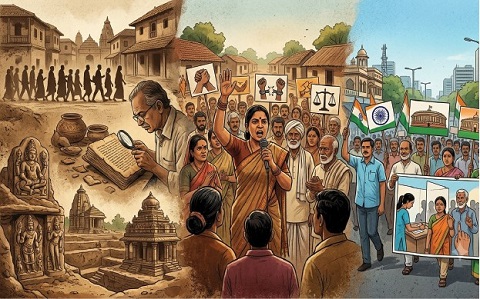
The Bhagavad Gita does not use the modern term "caste system" (jati), but it discusses varna, a social classification based on qualities (guna) and actions (karma). In Chapter 4, Verse 13, the Bhagavad Gita states: "Chaturvarnyam maya srishtam guna-karma-vibhagashah"
"The fourfold order was created by Me according to the division of qualities and actions. "This verse is often interpreted to mean that social roles should be determined by a person's character, abilities, and work rather than merely by birth. It does not clearly endorse the later hereditary caste system that developed in Indian society.
Outside this framework were communities later referred to as "Untouchables" or Dalits, who faced severe social discrimination. Over centuries, thousands of castes (jatis) and sub-castes emerged, determining a person's occupation, social status, marriage prospects, and access to resources.
British Era
The British administration significantly shaped the evolution of the caste system. Through censuses, legal classifications, and administrative policies, the British often treated caste as a fixed, rigid identity, thereby strengthening social divisions in many areas. Beginning with the late 19th-century censuses, the British categorised Indians by caste, making caste identities more formal and politically significant. The government used caste categories for recruitment, taxation, and governance. Certain communities were labelled as "martial races" and preferred for military service. Social discrimination was prevalent; lower castes and communities, then known as "Depressed Classes", faced restrictions on education, temple entry, access to public facilities, and employment opportunities.
Reforms
Social reformers such as Jyotirao Phule, B. R. Ambedkar, E. V. Ramaswami, and Mahatma Gandhi challenged caste discrimination and worked towards social equality. By 1947, when India gained independence, caste remained a powerful social institution, but reform movements and political mobilisation had created momentum for equality. Independent India's Constitution later abolished untouchability and provided reservations in government jobs, legislatures, and educational institutions for Scheduled Castes (SCs) and Scheduled Tribes (STs) to address historical disadvantages. This reservation was initially for ten years and has been extended at regular intervals.
Nehru strongly advocated a scientific and secular outlook. He viewed caste as a barrier to national unity and modernisation and promoted social reforms and inter-caste cooperation. Despite legal reforms, caste remained deeply entrenched, especially in rural India.
Caste and Politics
The caste system has profoundly shaped Indian politics, both before and after independence. Political parties often mobilise voters along caste lines because caste remains a salient social identity. Many parties select candidates based on a constituency's caste composition to maximise electoral support. From the 1960s onward, political participation expanded beyond traditionally dominant upper castes. The implementation of the Mandal Commission's recommendations in 1990 accelerated the political rise of Other Backward Classes (OBCs), leading to the emergence of new political leadership and parties.
Emergence of Caste-Based Parties
Several parties have drawn significant support from specific caste groups. The Bahujan Samaj Party (BSP) emerged from Dalit political movements. The Samajwadi Party (SP) has traditionally received strong support from sections of OBC communities. The Rashtriya Janata Dal (RJD) has the support of Muslims and Yadavs. Regional parties in many states have also relied on caste coalitions. Caste-based political movements have increased the representation of historically marginalised communities in legislatures, government services, and educational institutions. This is a corrective measure for centuries of exclusion. Caste considerations have influenced policies on reservations, welfare schemes, educational opportunities, and political representation. Debates over affirmative action remain a major feature of Indian politics. Urbanisation, education, economic development, and aspirations among younger voters have reduced the exclusive importance of caste in some areas. However, caste remains a significant factor in candidate selection, coalition-building, and voting behaviour across much of India.
Social Engineering
Social engineering in politics refers to the strategy of building electoral support by forging alliances among social groups based on caste, religion, class, region, or community interests. It has become an important electoral tool since the decline of single-party dominance and the rise of identity-based politics. Political parties seek to unite caste groups into a winning electoral coalition and to secure support from combinations of upper castes, OBCs, Dalits, and tribal communities. Parties broaden their social base by promoting leaders from different communities, addressing their concerns, and choosing candidates based on the demographic composition of constituencies.
Congress had the support of Dalits and upper-caste voters. The Bahujan Samaj Party, under Kanshi Ram and Mayawati, initially focused on Dalit mobilisation and later sought broader alliances with other communities. The Bharatiya Janata Party has worked to expand support among OBC, Dalit, tribal, and upper-caste groups across different states. Regional parties such as the Samajwadi Party and the Rashtriya Janata Dal have relied on combinations of caste and community support bases.
It increases political participation among previously underrepresented communities, improves representation in legislatures and government, and encourages parties to engage with diverse social groups. However, it reinforces caste and community identities rather than reducing them. At times, it diverts attention from governance, development, and policy issues, leading to polarisation and vote-bank politics.
Reservation Policy
Reservation seeks to address historical discrimination and social exclusion faced by Scheduled Castes (SCs), Scheduled Tribes (STs), and Other Backward Classes (OBCs). It provides opportunities to groups that have been disadvantaged for generations and ensures the participation of marginalised communities in government jobs, educational institutions, and elected bodies.
Reservation makes public institutions more representative of society. Access to education and employment helps individuals and families move out of poverty and improve their socio-economic status. It also helps reduce disparities in education, income, and employment opportunities across social groups. Greater representation of diverse communities can increase trust in democratic institutions and governance.
Reservation has played a significant role in expanding educational and employment opportunities for historically disadvantaged communities and in improving their representation. At the same time, concerns about merit, implementation, and long-term social impact continue to fuel debate. The challenge is to balance social justice, equal opportunity, and efficiency while ensuring that benefits reach those who need them most.
Conclusion
Caste has been both a source of political empowerment for historically disadvantaged groups and a basis for electoral mobilisation. Indian politics today reflects a combination of caste identities, economic interests, regional concerns, religion, leadership, and development issues rather than caste alone. Social engineering has become a defining feature of Indian electoral politics. It has helped many marginalised groups gain political representation, but it has also intensified identity-based political competition. The challenge for Indian democracy is to balance social representation with governance, economic development, and national cohesion. Now is the time to review (not abolish) the reservation policy. If a person has benefited from reservation, the next generation should not be eligible for this benefit. Ambedkar's constitutional vision was not to perpetuate caste hierarchy through the Constitution. It was to use the Constitution to protect people from caste discrimination and to provide disadvantaged communities with the means to achieve genuine equality.
Caste, as a social system, cannot be abolished merely by legislation because it is deeply rooted in social customs, traditions, and identities. India may not erase caste identity immediately, but it can progressively eliminate caste hierarchy, discrimination, and exclusion. Education, urbanisation, economic opportunities, inter-caste marriages, and social reform can gradually weaken caste consciousness. Political and religious leaders, civil society, and citizens must promote equality and fraternity. Unfortunately, all parties are pursuing vote-bank politics and trying to win elections. Candidates are fielded in line with the caste equation in constituencies, and campaigns are launched accordingly. The caste system is harmful because it divides society; we are all Indians first. This system is bad and must go, but it will never go.
(The content of this article reflects the views of writer and contributor, not necessarily those of the publisher and editor. All disputes are subject to the exclusive jurisdiction of competent courts and forums in Delhi/New Delhi only)




















Comments (5)
A
Beautiful topic Sir.
N
The highly academic article examines the evolution of the Indian caste system from its fluid, scriptural origins to its institutionalization under British rule, alongside the constitutional reforms created to address historical exclusion. It highlights how affirmative action and social engineering successfully empowered marginalized communities like SCs, STs, and OBCs, while critically analyzing how modern electoral strategies have entrenched caste identities into vote-bank politics. Ultimately, the author calls for a review of reservation policies and argues that lasting equality requires moving beyond political divisions toward education, economic growth, and social unity. Worth reading and contemplating.
S
Truly insightful and relevant in this present time…Praiseworthy and commendable!!
S
The article gives a true insight into the caste system prevalent in our country which is a bane. Laudable indeed!
S
Very good analysis