


Canadian Prime Minister Mark Carney is set to embark on a landmark visit to India on Thursday, marking a significant diplomatic reset between two nations whose relationship had been badly bruised by a high-profile espionage row.
Carney is expected to depart at 10 am local time (8:30 pm IST), with the visit concluding on March 2, after which the Canadian leader will travel onward to Australia and Japan. India is the first leg of the trip — beginning in Mumbai before moving to New Delhi — and it carries considerable weight both diplomatically and economically.
The visit does not come out of nowhere. It is the product of nearly a year of quiet, careful diplomacy aimed at reversing one of the most damaging episodes in modern Canada-India relations.
In September 2023, then-Prime Minister Justin Trudeau publicly accused the Indian government of orchestrating the killing of Hardeep Singh Nijjar, a Khalistani separatist leader, on Canadian soil — an allegation New Delhi swiftly and furiously denied. The fallout was severe. Canada expelled six Indian diplomatic officials, claiming agents linked to the Indian government had been running a campaign of violence, intimidation, and extortion against Canadian citizens. India responded in kind, and High Commissioners in both capitals were recalled.
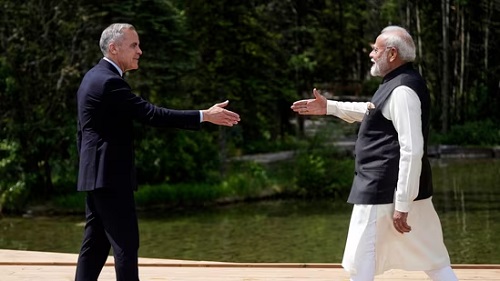
Ties began thawing only near the end of Trudeau's tenure, and it was Carney who quietly moved to turn the page. A meaningful first step came when Carney met Prime Minister Narendra Modi on the sidelines of the G7 Leaders' Summit in Kananaskis in June 2025. High Commissioners were subsequently reinstated in both capitals, and the two leaders met again at the G20 summit in Johannesburg in November, where Modi formally invited Carney to India. The two countries also announced plans to resume negotiations on a Comprehensive Economic Partnership Agreement, or CEPA — a trade deal that had been effectively frozen during the diplomatic crisis.
The agenda for Carney's India visit is ambitious. According to a release from the Canadian Prime Minister's Office, Carney and Modi will meet in Delhi and "focus on elevating and expanding the Canada-India relationship, with ambitious new partnerships in trade, energy, technology and artificial intelligence, talent and culture, and defence."
Carney will also meet with business leaders in both Mumbai and New Delhi to identify investment opportunities and forge new commercial partnerships between the two countries. The Canadian PMO has described the potential scope of deals as "immense."
Among the most consequential agreements expected to emerge from the visit is a deal to expand Canada's uranium shipments to India, according to Bloomberg, citing Dinesh Patnaik, India's High Commissioner in Ottawa. Canada is one of the world's largest uranium producers, and India's rapidly expanding civilian nuclear energy programme makes it a significant potential buyer — making the deal strategically meaningful for both sides.
Carney's India trip cannot be understood in isolation from the broader geopolitical context — and that context is dominated by the figure of Donald Trump.
Since returning to the White House, Trump has subjected Canada to an increasingly aggressive economic and rhetorical assault. He has threatened sweeping tariffs on Canadian goods, floated the provocative idea of Canada becoming "the 51st state," and even threatened 100 per cent tariffs over Canada's proposed trade arrangements with China. While a Supreme Court ruling temporarily deemed some of those duties illegal, the threat has not gone away, and the uncertainty has forced Ottawa to rethink its economic dependencies.
Carney's swing through India, Australia, and Japan is widely seen as a deliberate effort to diversify Canada's trade relationships and reduce its vulnerability to American economic pressure. These are stable, democratic, fast-growing partners with whom deeper ties serve Canada's long-term interests — and Carney has made no secret of the strategic intent behind the trip.
For India, the visit is an opportunity to welcome back a partner it had effectively placed in diplomatic deep freeze, and to signal that the relationship can move forward on a firmer, more businesslike footing. For Canada, it is a chance to unlock trade and investment flows with one of the world's fastest-growing major economies at a moment when the traditional anchor of its economic life — the United States — has become an unpredictable partner.
The personal chemistry between Carney and Modi, carefully cultivated over the past year, now needs to translate into tangible outcomes. If the uranium deal, CEPA negotiations, and AI and energy partnerships move from announcement to action, the visit will mark a genuine turning point. If they remain aspirational, the thaw risks stalling again.
Either way, Mark Carney's arrival in Mumbai on Thursday will be watched closely — in Ottawa, New Delhi, and Washington alike.



















Leave Your Comment