


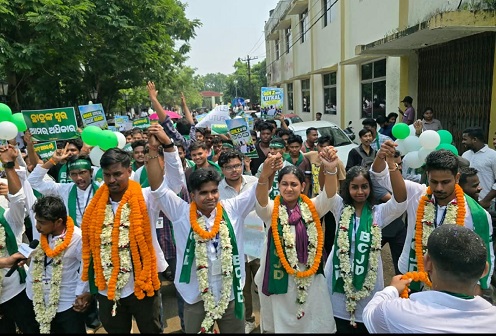
The Akhil Bharatiya Vidyarthi Parishad’s (ABVP) claimed victories in student union elections across Odisha have given the organisation fresh political momentum, with Union Home Minister Amit Shah interpreting the results as an endorsement of the ‘Nation First’ ideology. With ABVP reporting substantial gains in hundreds of colleges and representation across 13 universities, the results have become more than a campus-level electoral achievement. They have also intensified the debate over youth preferences, ideological competition and the Opposition’s ability to connect with students.
The Akhil Bharatiya Vidyarthi Parishad (ABVP) has claimed a significant breakthrough in student union elections across Odisha, reporting victories in more than 100 colleges and universities and a strong performance in key student leadership positions. The organisation has attributed its success to the support of students who, it argues, have rejected what it describes as the Opposition’s divisive politics in favour of a broader national outlook.
According to figures released by ABVP Odisha on X, the organisation contested or assessed its performance across 346 colleges and secured 208 president posts, 214 vice-president posts, 221 general secretary posts and 199 assistant general secretary posts. If verified, these numbers would indicate a substantial organisational presence across student bodies in the state, giving ABVP an opportunity to strengthen its campus networks and expand its engagement with young voters.
The results claimed by ABVP underline the importance of student politics as a space where ideological affiliations, local leadership and immediate campus concerns intersect. Student union elections may not directly predict the outcome of state or national elections, but they can offer insights into the organisational strength of political movements among younger generations.
Union Home Minister Amit Shah congratulated ABVP workers in Odisha, describing their performance as an indication of the youth’s preference for the ‘Nation First’ ideology. Referring to ABVP’s performances at Panjab University, Delhi University and 13 universities in Odisha, Shah argued that the results sent a wider message about the ideological choices of young Indians.
In his post on X, Shah said the victories demonstrated that the country’s youth were aligning themselves with the ‘Nation First’ approach rather than with forces he accused of spreading falsehoods, illusions and chaos. He also described the outcome as a response to what he called anti-national forces.
Shah’s statement gives the campus results a broader political significance. By connecting student elections in different parts of the country, he has presented ABVP’s claimed gains as evidence of a wider ideological trend rather than as isolated victories. For the BJP and its affiliated student organisation, the results offer an opportunity to reinforce the argument that nationalism remains a compelling political theme for young people.
ABVP’s challenge, now, will be to translate electoral success into tangible improvements in campus life. Winning student union positions creates expectations as well as opportunities. Students who have supported an organisation will expect it to represent their interests, raise grievances effectively and hold college administrations accountable. If ABVP can deliver on these responsibilities, its campus victories may provide a durable foundation for future growth. If it fails to do so, electoral momentum could prove temporary.
The results also pose questions for Opposition parties and student organisations that have struggled to match ABVP’s claimed performance in Odisha. Dismissing the outcome or attributing it entirely to political polarisation would offer little insight into the reasons behind the organisation’s success. A serious response would require a closer examination of its campus-level presence, cadre mobilisation, candidate selection and ability to maintain contact with students.






















Leave Your Comment