


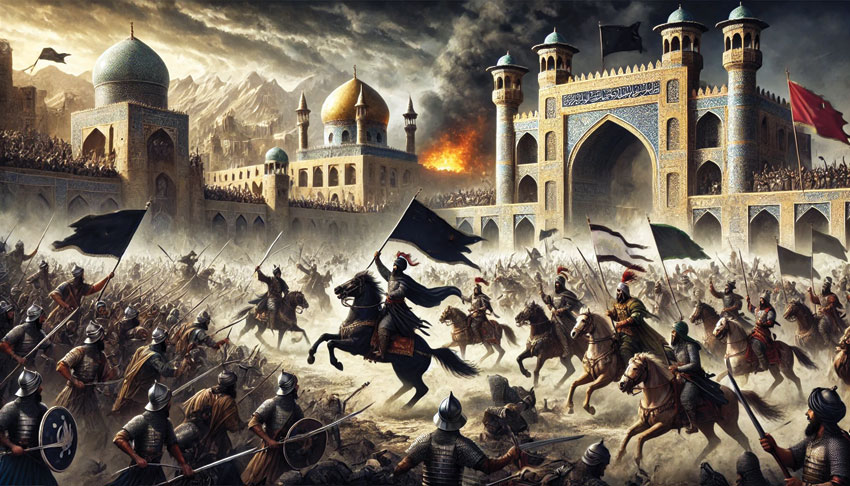
The temples we have listed—the Martand Sun Temple, the Rudra Mahalaya Temple, the Warangal Fort temple complex, the Somnath Temple, the Kashi Vishwanath Temple, Ramjanmabhoomi and Mathura Shahi Idgah Mosqueon the site of the Krishna Janmabhoomi temple—were all targeted, desecrated, and systematically destroyed by various Islamic invaders, primarily during the medieval period (11th to 17th centuries). The destruction was often followed by the construction of mosques using the temple's rubble and foundations, a practice intended to demonstrate political and religious dominance. The current controversies surrounding the Gyanvapi and Krishna Janmabhoomi sites in Varanasi and Mathura are direct continuations of this historical trauma.
Pattern of History :
These cases reflect a historical pattern where victorious armies, particularly from the Delhi Sultanate and Mughal periods, often destroyed prominent temples as a symbol of political supremacy and religious iconoclasm.
Archaeological Evidence: In many cases (like Kashi and Mathura), archaeological studies and historical accounts provide evidence of pre-existing temple structures.Following is a detailed breakdown of each site mentioned above:
Martand Sun Temple
(Anantnag, Jammu & Kashmir)
Historical Significance: Built around the 8th century CE by King Lalitaditya Muktapida of the Karkota Dynasty, it was one of the largest and most impres-sive temple complexes in India, dedicated to the Sun God Surya.
Destruction: It was destroyed on the orders of Sultan Sikandar Shah Miri (Si-kandar Butshikan - "the idol-breaker") in the early 15th century.
Current Status: It lies in ruins, but its sprawling complex and grand architec-ture, blending Gandharan, Gupta, and Chinese styles, remain a testament to its former glory. It is a protected monument by the Archaeological Survey of India (ASI).
Sarada Temple
(J&K, PoK)
Historical Significance: The Sarada Temple is not just an ancient ruin; it was one of the most important religious and educational centers in the Indian subcontinent for centuries. The temple is dedicated to the Hindu goddess Sarada (Sharada), a manifestation of Saraswati, the goddess of knowledge, wisdom, learning, and music.
Destruction: The area faced several invasions, particularly from Central Asia. While the exact timeline of destruction is debated, invaders like Sikandar Shah Miri (Sikandar Butshikan - the "Idol Breaker") in the 14th-15th centuries are known to have destroyed many Hindu and Buddhist temples in Kashmir, and Sarada likely suffered during this period.
Current Status: The current status of the Sarada Temple is a mix of archaeological ruin, a symbol of cultural longing, and a subject of recent developments.Today, the main temple structure is a crumbling ruin. The stone walls still stand, but the roof is completely gone. The sanctum sanctorum (garbhagriha) is empty. The entire complex is overgrown with vegetation. Despite its ruined state, the grandeur of its architecture is still evident. The temple follows the classic Kashmiri stone temple style.
Warangal Fort Temple Complex
(Warangal, Telangana)
Historical Significance: The capital of the Kakatiya dynasty (12th-14th centu-ries), the fort housed a spectacular temple dedicated to Shiva as Svayambhu. The iconic Kakatiya Thoranam (gateway) is a symbol of Telangana.
Destruction: The temple was destroyed by the armies of the Delhi Sultanate under Ulugh Khan (later Sultan Muhammad bin Tughlaq) after their victory in 1323 CE.
Current Status: The site is a vast field of ruins with scattered pillars, collapsed mandapas, and fragments of exquisite sculpture. The four grand thoranas still stand. It is a UNESCO World Heritage Site candidate.
Somnath Temple
(Prabhas Patan, Gujarat)
Historical Significance: One of the twelve most sacred Jyotirlinga shrines of Shiva. It was one of the wealthiest and most revered temples in India, plun-dered and destroyed multiple times throughout history.
Destruction: It was famously looted and destroyed by Mahmud of Ghazni in 1026 CE. It was rebuilt and destroyed again by subsequent rulers, including Alauddin Khalji's army in 1299 CE.
Current Status: The present temple is a result of reconstruction after India's independence in 1947, a project strongly supported by Sardar Vallabhbhai Pa-tel. It stands as a powerful symbol of resilience and rebirth.
Kashi Vishwanath Temple (Gyanvapi)
(Varanasi, Uttar Pradesh)
Historical Significance: Perhaps the most sacred Shiva temple, located in the holiest city of Hinduism, Varanasi.
Destruction: The original temple was destroyed by the Mughal Emperor Au-rangzeb in 1669 CE. He ordered the construction of the Gyanvapi Mosque on the site, using the temple's plinth and parts of its walls.
Current Status: This is an active and highly contentious site. A new Kashi Vishwanath temple was built adjacent to the mosque in the 18th century. The site is currently the subject of a major legal battle, with Hindu parties claiming the existence of Hindu relics within the mosque complex. A recent court-mandated survey has intensified the dispute.
Ramjanmabhoomi
(Ayodhya, Uttar Pradesh)
Historical Significance: Believed by Hindus to be the birthplace of Lord Rama.
Destruction: The Babri Masjid (Mosque of Babur) was built in the 16th century by Mir Baqi, a commander of the Mughal emperor Babur. Many Hindus believe it was constructed after demolishing a pre-existing temple marking the exact birthplace.
Current Status: The Babri Masjid was demolished by a large mob of Hindu ac-tivists in 1992, leading to nationwide riots. After a protracted legal battle, the Supreme Court of India in 2019 awarded the land for the construction of a Ram Temple. The grand new temple was inaugurated in January 2024. This is the most politically significant case of temple reclamation in modern Indian history.
Shahi Idgah Mosque
(Mathura, Uttar Pradesh)
Historical Significance: Adjacent to the Katra Keshav Dev Temple, it is be-lieved by Hindus to be the birthplace of Lord Krishna (Krishna Janmabhoo-mi).
Destruction: A grand temple was built at the site by the Bundela Rajput king Veer Singh Deo Bundela in the reign of Jahangir. It was destroyed by the Mughal Emperor Aurangzeb in 1670 CE, who built the Shahi Idgah Mosque on a portion of the land.
Current Status: The site is the focus of an active legal dispute, similar to the Gyanvapi case. Hindu groups have filed petitions in court seeking the re-moval of the mosque and full control of the land to build a new temple, ar-guing that the mosque was built on the ruins of the original temple.
Rudra Mahalaya Temple
(Siddhpur, Gujarat)
Historical Significance: A massive and magnificent temple built in the 10th-12th centuries by the Solanki kings, dedicated to Lord Shiva.
Destruction: It was severely damaged by armies of the Delhi Sultanate, starting with Alauddin Khalji's general, Ulugh Khan, in the 13th century and later dis-mantled by Sultan Ahmed Shah of Gujarat in the 15th century to build mosques in Siddhpur using its materials.
Current Status: Only the ruins of the temple remain, including a few grand pillars, toranas (gateways), and the sanctum of a smaller shrine. Parts of the temple's materials are visibly incorporated into nearby mosques.



















Leave Your Comment