


A day after the Modi government faced its first major legislative setback since 2014, political temperatures soared as the Centre launched a sharp counterattack against the opposition following the failure of the women’s reservation bill to clear the Lok Sabha.
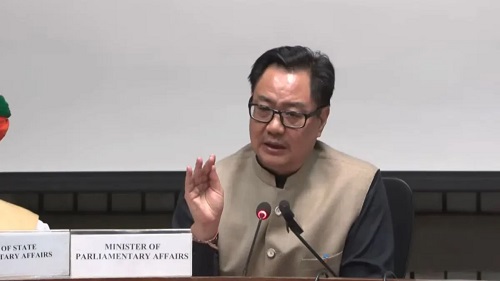
Leading the government’s response, Union Parliamentary Affairs Minister Kiren Rijiju described the development as a “black day” for the country, accusing the opposition—particularly the Congress—of displaying an “anti-women mentality.” Addressing a press briefing in New Delhi after the conclusion of Parliament’s three-day special sitting, Rijiju asserted that the bill’s defeat was not a failure of the government or the Bharatiya Janata Party (BJP), but rather a reflection of the opposition’s stance.
“The government is naturally disappointed, but this is not our failure. What happened in the Lok Sabha shows the mindset of those who opposed it,” Rijiju said, adding that the opposition would be “punished democratically” by the people for blocking a measure aimed at enhancing women’s representation in legislatures.
The minister also criticized the Congress for what he described as celebratory reactions following the bill’s defeat. “It is shameful and condemnable that some are celebrating this outcome. This is not a moment of political victory—it is a setback for women’s empowerment,” he remarked.
Rijiju took direct aim at Congress leader Rahul Gandhi over his reported remarks questioning the constitutionality and democratic validity of women’s reservation. “If Rahul Gandhi says that giving reservation to women is unconstitutional and undemocratic, then someone should explain to him how granting rights to women can be undemocratic. I cannot comment on what kind of thinking that reflects,” Rijiju said.
Despite the contentious outcome, the minister maintained that the special Parliament session had been “extremely successful” overall. He credited Prime Minister Narendra Modi for his government’s continued efforts toward women’s empowerment and broader legislative initiatives.
The failed bill—intended to expand representation for women in the Lok Sabha—has now become a flashpoint in the ongoing political battle between the ruling alliance and the opposition. While the government frames the episode as evidence of opposition resistance to gender equity, critics argue that the handling of the bill reflects deeper political calculations and procedural challenges.
As both sides dig in, the debate over women’s reservation is likely to remain at the forefront of national politics, setting the stage for further confrontation inside and outside Parliament.


















Leave Your Comment