


Delhi’s administrative system was restructured in 1991, leading to the creating of a Legislative Assembly of 70-elected members with a council of seven ministers headed by the Chief Minister. However, Delhi remained a state with limited powers, as law and order, police, and land remain under the central government. The first assembly was constituted in 1993 and Madan Lal Khurana of BJP became the Chief Minister. In 1998, the Congress won the elections, and Sheila Dikshit became the Chief Minister. She remained in the office for 15 years, making her the longest serving Chief Minister of Delhi. Her tenure is widely credited with transforming Delhi into a modern city through infrastructure developments and urban reforms.
In 2011, Anna Hazare launched ‘India Against Corruption (IAC)’ movement, supported by activists including Arvind Kejriwal, demanding the Jan Lokpal Bill. However, disagreeing with Anna Hazare’s apolitical stance, Kejriwal decided to form a political party to combat corruption from within the system. In 2012, the Aam Admi Party (AAP) was officially launched under Kejriwal’s leadership, with the symbol ‘Broom’, signifying the commitment to cleaning up the politics. He presented himself as a common man fighting against systemic corruption pledging to shun VIP culture and ensuring transparency.
The 2013 assembly elections marked a shift in Delhi politics, ending the Congress’s 15-year rule, establishing AAP as a formidable force, and disrupting the BJP’s hopes of regaining power. Anti-incumbency sentiment against Sheila Dikshit’s government and aggressive anti-corruption campaign led to Congress’s defeat, she herself lost to Kejriwal in the New Delhi constituency. The BJP emerged as the single largest party winning 31 seats with 33% vote share, AAP secured 28 seats with 29.5% votes in its debut election, and the Congress managed to get only 8 seats with 24.5% votes. Kejriwal formed the government with Congress’s support but resigned in 49 days, leading to President’s rule. In 2015 elections, AAP campaigned on governance, education, healthcare, infrastructure, promising corruption-free government, Jan Lokpal Bill, ending VIP culture, subsidy on electricity, 20,000 liters free water per month, 500 new schools, 20 new colleges, Mohalla Clinics, CCTV Cameras, 5,000 new buses, slum rehabilitation, skill development centers, Yamuna cleaning, controlling air pollution, and Wi-Fi across Delhi. These promises resonated, leading to a landslide victory for AAP. The party won 67 out of 70 seats with 54.3% vote share, while the BJP managed just 3 seats securing 32.2% votes and the Congress failed to win any seat gaining only 9.7% votes. Kejriwal’s positioning as a common man appealed to voters frustrated with traditional politics. He took over as the Chief Minister for the second time in February 2015 and began implementing key promises like subsidized electricity, free water, and Mohalla clinics.
In 2020 assembly elections, AAP highlighted its governance and promised 200 units free electricity, and free travel for women in DTC buses in Delhi, along with other populist schemes. AAP won 62 seats with 53.6% vote share, while BJP got only 8 seats securing 38.5% votes, and the Congress got 4.3% votes with no seats.
The Liquor Scam, linked to the 2022 Delhi Excise Policy, aimed at privatizing the liquor trade to increase the revenue but faced corruption allegations. CBI and ED probes resulted in the arrest of Deputy CM Manish Sisodia and later, CM Kejriwal. Both secured bail, but legal proceedings are ongoing. Another controversy arose over the renovation of Kejriwal’s official residence, allegedly costing over Rs 50 crore. The opposition termed it as ‘Sheesh Mahal’, criticizing the extravagance.
Following his bail, Kejriwal resigned, and Atishi became the new Chief Minister of Delhi. Ahead of 2025 assembly elections, AAP promised fifteen guarantees, including previous commitments, Rs 2100 monthly to women, Rs 18000 monthly to priests and granthis (Imams are already paid), free travel to students in DTC buses. Congress pledged five guarantees including, Rs 2500 monthly to women, Rs 8500 monthly to unemployed youth for one-year, subsidized LPG cylinder, free ration kits, free electricity up to 300 units. The BJP’s promises included Rs 2500 monthly to women, subsidized LPG cylinder, Rs 21000 and six nutrition kits to pregnant women, Rs 5 meal canteens in slums, KG to PG free education, and significantly ‘the continuation of the existing welfare schemes introduced by AAP.
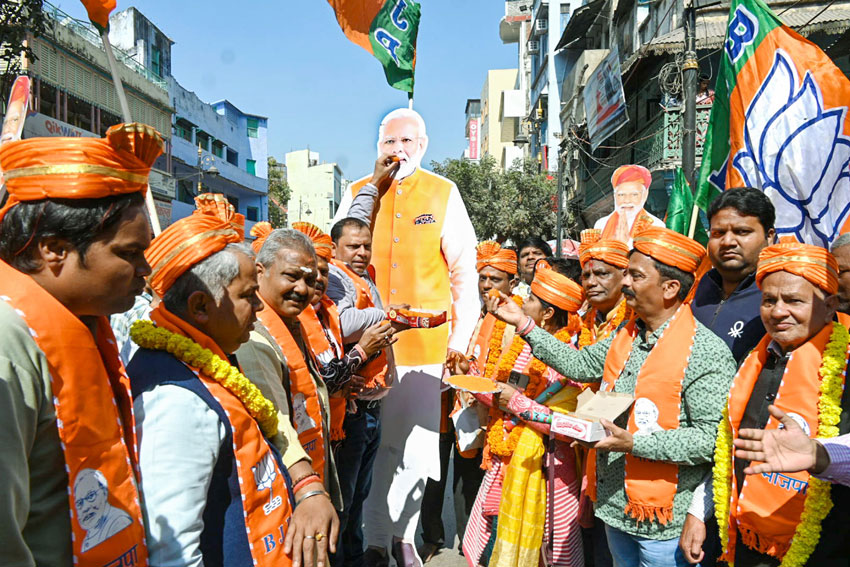
The elections were held on 5th February with counting on 8th, BJP+ won 48 (+40) seats with 47.2 % vote share, AAP managed only 22 (-40) seats with 43.6% votes, and Congress despite increasing its vote share to 6.3%, won no seats. Kejriwal, Manish Sisodia and several key AAP leaders lost.
The reasons for the BJP’s win -
Decline of Congress-
The Congress needs to introspect, in last three Assembly and three Lok Sabha elections the party has not won any seats and got decimated in the city state. No other single data point perhaps encapsulates the story of the decline of India’s grand old party than this journey from dominance to irrelevance in the national capital. In these elections 67 candidates lost their deposits. And the man at the helm of the party through these successive routs is Rahul Gandhi. There is no dearth of capable leaders in the party and they need to look beyond one family.
Kejriwal remains popular among lower and lower-middle-class populations due to his welfare schemes including free electricity, water, and women’s free bus travel. His direct communication with the residents has garnered support for the party. However, corruption allegations have tarnished his image as an honest leader. AAP has lost 10% of the vote share but retained 43.6%, and will remain a challenge to the ruling party.
Extensive welfare promises made by the BJP would strain the state budget and may affect the developmental projects. Excessive welfarism risks harming the economy and taxpayers are taxed more and receive little government services. While the people expect welfare benefits, they also demand clean air, water, and roads. Striking a balance between welfare and growth is crucial. BJP government at the center will be an advantage to the new administration in Delhi.
The freebie culture in the name of welfare schemes has become a trend to win elections, but the real priority should be empowering people. Delhi’s election results may also impact Punjab and Bihar politics.

By Manoj Dubey
Principal (Retd.)
Delhi Public Schools
(The content of this article reflects the views of writers and contributors, not necessarily those of the publisher and editor. All disputes are subject to the exclusive jurisdiction of competent courts and forums in Delhi/New Delhi only)














Comments (6)
N
The sad tale of "THE RISE, DECLINE AND FALL OF THE KEJRI EMPIRE", well chronicled by Mr. Dubey. Hope the ruling dispensation focuses on delivery. Kejriwal fell due to failed promises and corrupt practices. Articles by the Author are a delight to read.
S
Very well written with comprehensible statistics. Hail BJP!
S
Manoj is a prolific writer. He has penned his views on various issues. Let me congratulate him for his consistent contributions.
S
दिल्ली में राजनीतिक गतिशीलता का क्रमागत विश्लेषण यहां की जनमानस की भावनाओं को प्रदर्शित करता है। देशद्रोही और अराजक तत्वों का दमन अनिवार्य है। प्रस्तुत लेख के माध्यम से इसे सुन्दर में दर्शाया गया है।
S
Very well written, highlighted problems of Delhi like clean water, air etc. keep it up
Well written