


Bihar, one of India’s oldest regions, has a rich and illustrious history. It was the heart of ancient empires such as the Magadha Kingdom, which gave rise to the Maurya and Gupta dynasties. Pataliputra (modern Patna) served as a major political and cultural center. The state is also known as the birthplace of Buddhism and Jainism, with Lord Buddha attaining enlightenment in Bodh Gaya. The region flourished as a hub of learning through Nalanda and Vikramshila universities. After centuries of decline under medieval and colonial rule, Bihar became a separate province in 1912 and later played a key role in India’s freedom movement.
Political Evolution After Independence
After 1947, Bihar played a vital role in shaping Indian politics. Initially dominated by the Congress Party under leaders like Shri Krishna Sinha, the state later witnessed the rise of the socialist movement led by Jayprakash Narayan in the 1970s. The 1990s marked the rise of caste-based politics, led by Lalu Prasad Yadav’s Rashtriya Janata Dal (RJD), which focused on social justice. From the early 2000s, Nitish Kumar and his Janata Dal United (JDU) have emphasised development and good governance. Political power in Bihar has since alternated between alliances led by RJD, JDU, and BJP. The state’s population is about 13 crore, with 7.5 crore electors. Bihar has 38 districts and elects 40 members to the Lok Sabha and 16 to the Rajya Sabha. Vidhan Sabha and Vidhan Parishad have 243 and 75 seats, respectively.
Bihar is divided into several political regions based on geography, culture and political influence. The major ones are Magadh (historically rich and politically strong), Mithila (with Mathili culture and intellectual heritage), Bhojpur (political activism and strong caste influence), Seemanchal (with a significant Muslim population), Patna (state’s political and administrative center), and Chotanagpur (less developed but politically relevant).
2020 Assembly elections
The ruling National Democratic Alliance (NDA) coalition (JDU, BJP, and LJP-R) secured 125 seats, while the opposition RJD-led block (including Congress and Left parties) won 110 seats. RJD emerged as the single largest party, winning 75 seats, followed closely by BJP with 74. The voter turnout was about 57.3%. The overall vote-share difference between the NDA and opposition was about 0.2% only, indicating a fiercely contested election.
2024 Lok Sabha elections
Of the 40 seats, the NDA won 30 (BJP 12, JDU 12, LJP-R 5), and the opposition Mahagathbandhan (MGB) comprising Congress, RJD, and others managed 9 seats. JDU’s re-alignment with NDA before the election played a crucial role, combining BJP’s national strength with JDU’s local reach helped consolidate NDA in Bihar. The LJP-R won all 5 seats it contested, showing that smaller regional parties can perform well when strategically focused.
Caste Politics in Bihar
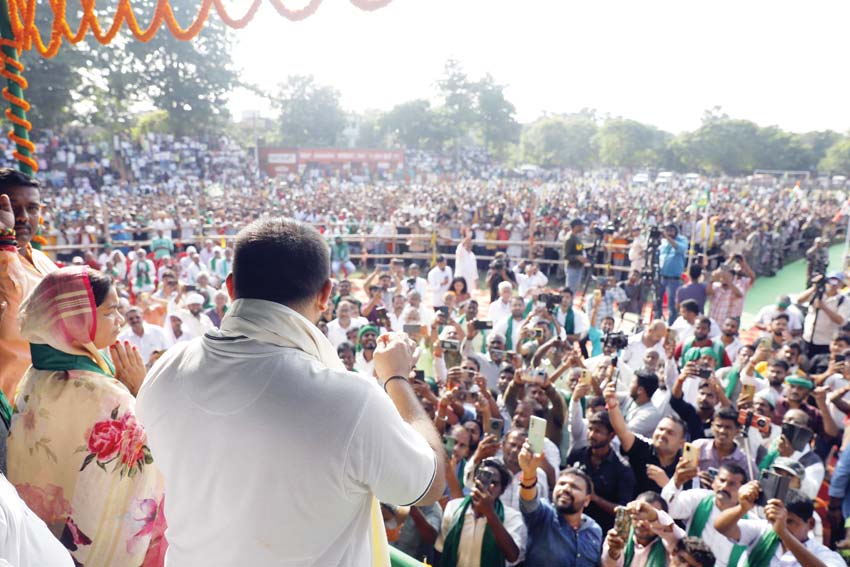
Caste has been a defining feature of Bihar’s political landscape since independence. Initially dominated by upper caste under Congress rule, power shifted in the 1990s with the Mandal Commission’s implementation, empowering Other Backward Castes (OBCs). Lalu Prasad Yadav mobilised Yadavs and Muslims, forming the powerful ‘MY’ alliance, while Nitish Kumar consolidated Kurmis and Extremely Backward Castes (EBCs). Dalit leaders like Ram Vilas Paswan represented marginalised communities, further diversifying caste-based politics. Although there is emphasis on development and governance, caste loyalties continue to shape alliances, candidate selection, and voting behavior.
Minority Politics and AIMIM
Muslims have long been a significant vote bank for secular parties like Congress, RJD, and JDU. Despite benefiting from government welfare schemes, they have largely refrained from voting for the BJP. The AIMIM, led by Asaduddin Owasi, entered Bihar’s politics to represent Muslims and challenge the traditional parties. In the 2020 assembly elections, the party won five seats in the Seemanchal region, reflecting dissatisfaction with traditional secular parties. However, four of its MLAs later shifted to RJD. While AIMIM’s influence remains limited to Seemanchal, it has emerged as an important player in minority and regional politics.
Key Political Figures
Lalu Prasad Yadav
A key figure in Bihar’s political transformation, Lalu Prasad Yadav rose to prominence in the late 1980s as a champion of social justice and the empowerment of backward castes. Becoming Bihar’s Chief Minister in 1990, he united the Yadavs, Muslims, and other backward castes under his RJD, ending Congress dominance. His populist style and rural connect made him immensely popular. However, governance declined under his rule, marked by poor infrastructure and lawlessness, earning his tenure the term ‘Jungle Raj’. The fodder scam and corruption charges led to his conviction and downfall. Presently, he is on bail. His wife Rabri Devi succeeded him until 2005, and later his son, Tejaswi Yadav, carried forward his legacy, symbolising dynastic politics.
Nitish Kumar
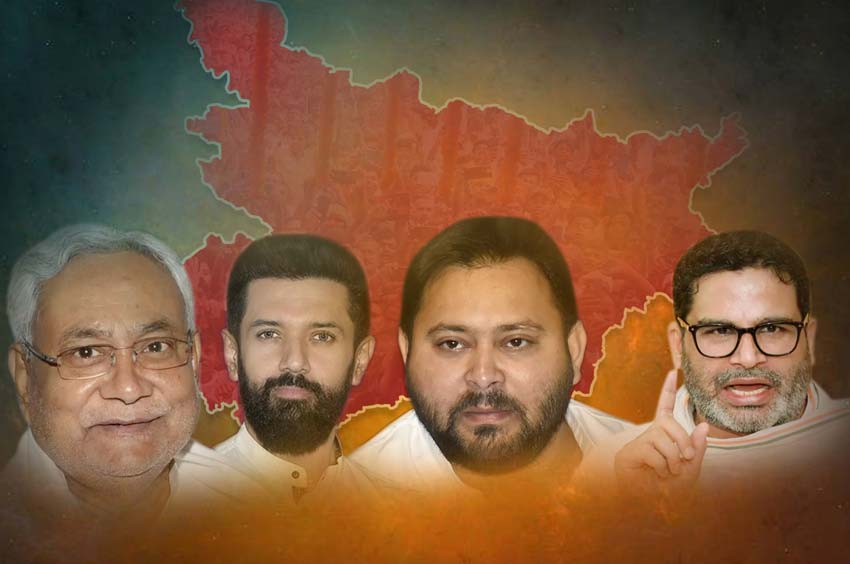
Founder of JDU, Nitish Kumar is known for his clean image and administrative skills. Serving multiple terms as Bihar’s Chief Minister since 2005, he earned the title ‘Sushasan Babu’. He liquidated hardcore criminals in the state, and there are no corruption allegations against him during his 20-year tenure as the Chief Minister. He never promoted dynastic politics in his party and earned the image of an honest politician. Despite switching alliances between BJP and JDU over the years, Nitish remains the most credible and experienced leader in Bihar. He has performed well in last 20 years but a lot more could have been done. Bihar needs a robust policy to get rid of poverty, unemployment, lawlessness and migration. JDU is contesting on 101 seats in the coming elections.
Chirag Paswan
Son of Ram Vilas Paswan, Chirag leads the Lok Janshakti Party (LJP-R) and represents the younger generation of Bihar politics. In 2014, he was elected to the Lok Sabha from Jamui. After his father’s death, Chirag sought to expand LJP’s influence independently. In the 2024 general elections, his party won all five seats it contested. Chirag, a cabinet minister in the Modi government, remains a significant Dalit face in Bihar, appealing to youth and aspiring to revive his father’s political legacy through assertive leadership. His party is contesting on 25 seats in the coming elections.
Prashant Kishore
Prashant Kishore Pandey, popularly known as PK, is a political strategist turned politician who has become a significant figure in Bihar’s contemporary politics. Originally known for planning successful election campaigns for leaders like Narendra Modi (2014), Nitish Kumar (2015), and Mamta Bannerjee (2021). In 2018, Nitish Kumar appointed him as the JDU’s vice president, but PK left the party in 2020 due to ideological differences. In 2022, he launched the Jan Suraaj Yatra, aiming to build a grassroots political movement focused on good governance, education, healthcare, and employment. While he has not contested any elections yet, his data-driven approach and emphasis on clean politics have drawn attention from electors. He has launched the Jan Suraaj Party (JSP) and is contesting the upcoming elections.
Congress
The grand old party of India has struggled to regain relevance in the state since 1990. Rahul Gandhi, its national leader, has limited direct influence in Bihar’s politics. He launched the ‘Voter Adhikar Yatra’ on 17th August 2025, covering 1300 km, to highlight alleged voter manipulation and disenfranchisement, but the campaign has not gained strong traction. Despite leading the party at the national level, his impact remains modest in Bihar due to the weak party organization and dominance of the RJD. Congress continues to be a junior partner in the alliance. To revive its position, the party needs to work at the grassroots level to expand its base and develop credible leaders in the state. Its current campaign for the 61 allocated seats lacks strong planning and momentum.
BJP
The party retains a base among upper castes and Hindutva-aligned voters in the state. Although a dominant national party, the BJP in Bihar is seen as a junior partner to the JDU. The party has not yet developed a strong, widely accepted local leader who can be projected as the Chief Ministerial candidate. BJP’s strength lies in its disciplined cadre and robust central leadership. The election campaign is well planned, featuring rallies by Prime Minister Narendra Modi, Amit Shah, JP Nadda, and Yogi Adityanath. However, its success in Bihar will depend on its ability to build a local identity, address regional concerns, and expand beyond its traditional voter base. The party is contesting 101 seats in the upcoming polls.
Special Intensive
Revision (SIR)
The Election Commission of India (ECI) launched SIR for Bihar ahead of the 2025 assembly polls. It is a full-scale revision of the voter list to remove ineligible or duplicate voters and add new ones, thereby improving the accuracy of the roll. Opposition parties alleged that SIR could lead to disenfranchisement of eligible voters, especially those lacking documentary evidence, or those removed without proper notice. They also questioned the timing of this exercise, as it was done just before the elections. The SIR was challenged in the Supreme Court, which refused to stay the exercise. However, the court emphasized that the ECI should accept certain commonly available documents, such as Aadhar and EPIC, in the process. The court observed that conducting the SIR is within ECI’s prerogative. About 65 lakh names were deleted from the roll, and over 20 lakh new names were added during the revision. The opposition, particularly Congress, has made it an election issue.
Mahagathbandhan (MGB)
The MGB, led by RJD and including Congress, VIP, and left parties, has projected Tejaswi Yadav as its Chief Ministerial candidate. The alliance has focused its campaign on the issues of poverty, unemployment, social justice and electoral fairness. Its manifesto promises include, a government job for one member of every family within 20 months, restoration of the old pension scheme (OPS) for government employees, regularization of contractual/outsourced workers, free limited electricity to poor families, complete waiver of farm loans, MSP procurements and revival of industries. While these promises ambitious, their implementation seems unlikely. However, internal seat-sharing disputes and overlapping contests have weakened its campaign. JMM not contesting under the alliance is another setback. Additionally, Tejaswi is also facing a challenge from his elder brother, Tej Pratap, who is contesting independently with his new party.
National Democratic
Alliance (NDA)
The coalition of the BJP, JDU, and allied smaller parties, the NDA is contesting under the leadership of Nitish Kumar. The government has pushed major infrastructure projects and social-welfare schemes. Financial assistance to women for setting up self-employment or small business, the initial grant of Rs 10,000 (already transferred to over one crore women), and later up to two lakhs for eligible women entrepreneurs. Increased honorariums of women-related workers (Anganwadi and helpers). Pension raised from Rs 400 to Rs 1100 for senior citizens, widows, and persons with disability. Rs 1000 per month for 12th-pass unemployed youth for 2 years, and many other schemes are already in place. The NDA’s manifesto further promises jobs for 10 million people, Lakhpati Didis, metro services in four cities, seven new international airports, seven expressways, Rs 3000 annually to farmers, etc. However, the feasibility of fulfilling all these promises remains uncertain.
Conclusion
Both major alliances have fielded several candidates with criminal backgrounds, reflecting a persistent weakness in Bihar’s political ethics. The state urgently needs good infrastructure, improved law and order, and better governance to attract investment and create jobs.
The MGB is attempting to harness youth aspirations, concerns about unemployment, migration, and anti-incumbency sentiment against the ruling coalition. It is arguably the strongest chance for the opposition to challenge the incumbent government in Bihar. Tejaswi Yadav is a dynamic young leader. The campaign of Congress under Rahul Gandhi doesn’t seem to be effective. There are some seats where RJD and Congress are fighting against each other.
Emerging forces such as Prashant Kishore’s JSP and Owaisi’s AIMIM may influence outcomes in closely contested seats. Although the race remains tight, the NDA currently appears to have a slight advantage, driven by Nitish Kumar’s credibility, women-centric welfare schemes, and its well-structured campaign.
By Manoj Dubey
Principal (Retd.)
Delhi Public Schools
(The content of this article reflects the views of writer and contributor, not necessarily those of the publisher and editor. All disputes are subject to the exclusive jurisdiction of competent courts and forums in Delhi/New Delhi only)

















Comments (6)
M
Great article and Deep analysis of Bihar elections
N
The article “Bihar Elections – Politics, Parties and Prospects” offers a concise overview of Bihar’s shifting political landscape, tracing the journey from Congress dominance to the present NDA–Mahagathbandhan rivalry. It highlights caste dynamics, regional variations, and emerging players like AIMIM. While informative on alliances, promises, and challenges, it remains largely descriptive, with limited data-driven analysis or predictions. The piece aptly captures the state’s complex mix of governance issues, social justice themes, and electoral uncertainty. Overall, it serves as a clear summary of Bihar’s political scene ahead of elections, though deeper analytical insights would enrich its perspective.
H
I have gone through the article in toto. Each and every aspect of Bihar state has been richly described particularly in view of ongoing assembly elections 2025. This is fact that during regime of Nitish led alliance government Bihar has witnessed significant changes in various parameters. The overall environment is peaceful compared to previous Lalu government. First phase of Bihar elections witnessed peaceful voting. Now we may hope a good future ahead for people of Bihar. Nice article ????
A
ARTICLE WELL EXPLAINEDthe Bihar politics taking it to ancient times when Patliputra modern patna very important of Magadh kingdom.writer explain in ARTICLE up to 1970 congress lead the politics but after JP movement sanarrio changed it into caste politics minority consolidation. Lalu Prasad and Nitish emerge as Leaders were important persons.But NDA by launch of sir by election commission taking lead.as ARTICLE shows his great wisdom I congratulate him and write these article for us
R
Appreciation Feedback The article presents an exceptionally comprehensive and well-structured overview of Bihar’s historical, political, and socio-economic landscape. It not only traces the state’s ancient legacy with remarkable clarity but also effectively captures its evolving political dynamics from independence to the present. The detailed explanation of caste equations, regional influences, electoral trends, and key political personalities reflects deep research and mature understanding. The sections on recent elections, the role of alliances, and emerging political forces are particularly insightful and balanced. The coverage of SIR, welfare schemes, and manifesto promises shows an objective and data-driven approach. The writing is lucid, engaging, and maintains a neutral tone while presenting complex political developments in a simple, reader-friendly manner. Overall, this is an excellent, informative, and meticulously written article that demonstrates strong analytical ability and command over the subject. It will be highly useful for readers seeking a holistic understanding of Bihar’s politics and contemporary electoral scenario.
S
The author has done the deep analysis of Bihar politics.The cast factors dominated in every election .The efforts of the author are sincerely appreciated