


Every routine can be converted into an opportunity to be exploited to achieve national goals. Nay-sayers on the other hand start with the assumption that it cannot be done and they prove themselves right. One may wonder why two contradictory statements are being used at the same time.
The simple reason is that the government did the first part and the present opposition did the other part when they were in power. To make the riddle understandable the author has to quote the statement made by learned ex-finance minister Sri P. Chidambaram.
” "The G-20 meetings are routine and have been held every year since 1999. The first Summit of heads of government was held in Washington in 2008 (in the wake of the international financial crisis). Between two G-20 meetings, the leaders have several opportunities to meet under different banners — UN, G-7, WEF, IPCC, SCO, BRICS, QUAD, AUKUS, ASEAN, UNCTAD, and so on. The joke is, if you take any four or five letters of the English alphabet, the chances are it will denote a new multilateral body". The Indian Express September 3, 2023
Sri P Chidambaram took 6 days to destroy his narrative by crying foul for not inviting his leader to a dinner hosted for G20 delegates.
“Can happen only in countries where there’s no democracy or opposition: P Chidambaram on ‘no G20 dinner invite’ to Mallikarjun Kharge” PTI New Delhi | September 9, 2023.
Why waste time on routine matters? Is the question to be answered by the learned leader? Has his party extended the joke by naming the new coalition I.N.D.I.A.
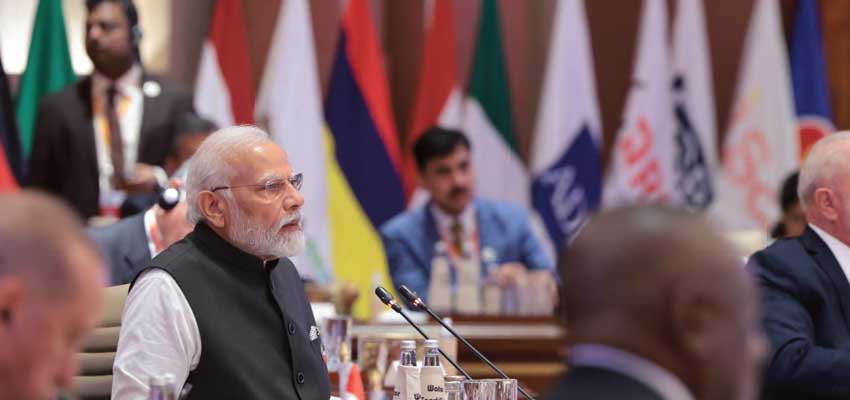
How India took advantage of the one year offered to it as chairman of G20.
The organizers have started with the logo itself, inspired by the vibrant colours of India’s national flag the logo juxtaposes planet Earth with the lotus, India’s national flower that reflects growth amid challenges. The Earth reflects India’s pro-planet approach to life, one in perfect harmony with nature. Below the G20 logo is “Bharat”, written in the Devanagari script communicates the spirit of “Vasudhaiva Kutumbakam” or “One Earth · One Family · One Future” - is drawn from the ancient Sanskrit text of the Maha Upanishad.
The theme is a reflection of ‘LiFE’ (Lifestyle for Environment), striving for just and equitable growth for all in the world, as we navigate through these turbulent times, in a sustainable, holistic, responsible, and inclusive manner. They represent a uniquely Indian approach to our G20 Presidency, of living in harmony with the surrounding ecosystem.
Igniting Indian minds across the country.
The author has been a witness to many international events starting with the Asian Games 1982, Seventh Summit Conference of Heads of State or Government of the Non-Aligned Movement on 7–12 March 1983, The 1983 Commonwealth Heads of Government Meeting Commonwealth Games 2010 and so on. These were the times when India was meant to be the city of Delhi but not now. Before the G20 summit. There were more than 220 meetings held across 60

locations in 32 cities in India with over 1 lakh participants from 125 nationalities. As a result, event calendar which started in December 2022 included most of the states which included the those ruled by opposition parties as well. It provided these states the opportunity to showcase their art culture, natural beauty and progress. Being an avid traveller, I have seen cities soaked in the spirit of G20, from Kashmir to Kanyakumari and Gujrat to the north east. It has created business-promoted tourism and connected far-off places with the spirit of Vasudhaiv Kutumbkam. The citizens of Delhi were also given relief from a year-long restriction on movement, Traffic jams, etc.
Killing many birds without hitting a single stone.
India held two earlier G20 meetings -- one in Arunachal Pradesh which China claims to bully India, and another in Kashmir, where Pakistan has been exporting terror for a long time. Inviting international delegates to attend meetings and see the truth at ground zero was the masterstroke. This was a pleasant surprise as these were the areas where anti-national forces used to strike to spoil the brand, India. This bold approach has delighted the deelgates and has inspired the local people. Let’s look at the coverage.
• G 20 Tourism meet at Sri Nagar, a slap on the face of sponsors of terrorism.
The nation used the opportunity to showcase India’s might by organizing an international meet and hosting the delegates who used to issue advisories for avoiding Kashmir. The successful meeting will attract international tourists as the G20 delegates, who were in Kashmir for the 3rd G20 Tourism Working Group Meeting, called it a unique experience and appealed to tourists around the world to visit Kashmir. The hue and cry made by China and Pakistan is proof that the message has gone home. One must not forget this is the same state where cross-border terrorism was bleeding the free spirit of the nation. The country has proved that democracy may take time but it is always strong enough to destroy the dubious ISI ploy.
• G 20 meet at Arunachal Pradesh.
Chinese map published on the Ministry of Natural Resources website clearly shows Arunachal Pradesh and the Doklam Plateau, over which the two sides have clashes, included within Chinese borders. In a swift move, India organised the above meeting at the same Arunachal Pradesh so that the whole world could see the location as well as who controls the area. This way India revised the English quote as, “Conducting a meeting is better than making 1000 claims”. This meeting is one of the major reasons for the Chinese president abstaining from G 20. The Chinese pain is visible in the comment published by their think tank.
“India has been trying to take advantage of its role as the host of the G20 Summit to promote its own agenda and harm China's interests, a Chinese think tank affiliated with the country's top spy agency said on Saturday.” BEIJING, Sept 9 (Reuters)
To attract investors and improve business ties with the world.
Massive infrastructure improvements, improved ease of doing business ranking, a skilled labour force, and an ever-growing market with a expanding middle-class consumer base are some of the key factors that make India one of the more attractive place to invest and do business. With the successful completion of G 20 India has impressed upon over 40 countries controlling 85 percent of world GDP. One may question how the G20 can have more than 20 countries but the fact is the G20 has the EU as a member which adds all members of the EU as well. India should position itself as the global norm-setter for various aspects of the digital economy, such as data protection, international contracting and digital assets, etc. Successfully managing vaccination using digital intervention. Similarly, digital payments, Rupay cards, and UPI payments have enabled India to top the table. 46% of all real-time payments made worldwide in 2022 were made in India. (MyGovIndia)
Giving competition to China’s Belt and Road Initiative (BRI).
U.S. announced a deal with India, the European Union, Saudi Arabia, Israel, and other Middle Eastern countries to develop an ambitious rail and maritime network hailed as a “game-changing regional investment,” cementing the deal with a three-way handshake may be taken as a sign of softening of differences between the U.S and Saudi prince. One can easily conclude that it is designed to provide competition for Xi’s Belt and Road Initiative (BRI). The recent withdrawal of Italy would be another setback to the BRI, which has already been scaled down as recipient countries grapple with debt distress.
Consensus on joint declaration.
G20 nations appreciated India’s success in reaching an agreement on a joint communiqué resolving differences on Russia’s war in Ukraine. India persuaded China to scale down differences. It has elevated the African Union as a full G20 member, and issues like climate change and debt sustainability were negotiated successfully as the priorities of emerging markets.
“Adoption of the New Delhi Leaders' Declaration is a momentous occasion that marks the zenith of human-centric globalisation, a vision tirelessly pursued under the leadership of Prime Minister Narendra Modi…. the document voices the concerns of the Global South and brings multilateralism centre stage”. G20 Sherpa Amitabh Kant. He further posted on ‘X’ that this was done over 200 hours of non-stop negotiations, and 300 bilateral meetings.
Challenges to be converted into opportunities.
• The European Union will set in motion the carbon border adjustment mechanism from the last quarter of this year, which will make exports expensive from India. India has to negotiate this by setting new norms to deal with environmental issues without compromising on growth.
• Declaration of ambitious rail and maritime network is to be translated into reality. Despite huge funding available with China Belt and Road project has met with many obstacles. This experience tells us that such projects demand more transparency and equal gains for all. The project will benefit the participating nations but building a cohesive team and setting timelines is yet to be done.
• The Russia-Ukraine war is a threat to the unity of G20. Unless the G20 can diffuse the issue, effective implementation of the G20 declaration will be difficult.
Conclusion.
G 20 summit might be a routine matter for some people but Indian team has converted this routine meeting in an opportunity to showcase progress of India, a platform to address Indian concerns and promote Indian ethos, the Chinese move to grab land was reciprocated with taking international delegates to the same area and demonstrating effectively that national integrity is the top priority. Similarly, hollowness of Pakistani claim was aptly proved when delegates interacted with local Kashmiris. If one considers G20 as a lemon India has used it to make a lemonade while few have made their mouth sour both in India and abroad. This meet will promote tourism in new Indian territories like Arunachal Pradesh and revive the same in Kashmir. Indian sherpa Amitabh Kant exploited NITI to bring consensus on global issues.
The world will take a note of progress made by India and new investments will come. The managing the fund raising for Ram temple is a Harvard case study now and the author will not be surprised if the success of G 20 summit 2023 will become a case to be taught across the world.
By Rakesh Kumar
(The content of this article reflects the views of writers and contributors, not necessarily those of the publisher and editor. All disputes are subject to the exclusive jurisdiction of competent courts and forums in Delhi/New Delhi only)














Leave Your Comment