



Dr. Padmalochan Dash
Something has changed, and this transformation came neither with the sound of bullets nor with the footsteps of any aggressive army. The unprecedented expansion of the digital ecosystem has transformed content from a mere medium of communication into a strategic behavioural force. Unlike traditional information, digital content is continuously created, structured through algorithms, personalized for each individual, and redistributed at extraordinary speed through interconnected digital platforms. Its effect is not instantaneous but cumulative; it arrives slowly, yet is profoundly deep.
The current digital content ecosystem is not just a collection of separate platforms. It is a complex network involving content creators, influencers, artificial intelligence-based systems, automated bots, recommendation algorithms, platform owners, political actors, foreign influence operators, criminal networks, consumers, regulatory bodies, and families. Each of these stakeholders shapes the quality, reach, credibility, and social impact of digital content. If the governance system targets only one platform and ignores the entire ecosystem, it is addressing a small part of the problem rather than its root.
An addiction that alters brain structure
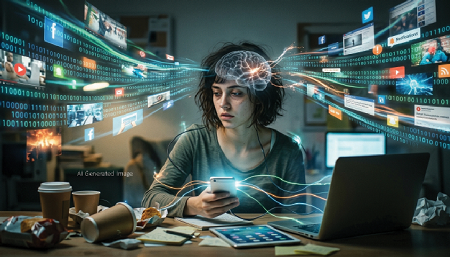
A fourteen-year-old scrolls through reels until two in the morning. Upon waking, eyes are red, attention is scattered, and there is no patience left to listen to a complete sentence from the teacher in class. Parents complain that the child "has changed." He hasn't changed; he is being changed. Every night, one scroll at a time.
The impact of digital content is not limited to just viewing or reading it. It gives rise to a Progressive Impact Chain, beginning with capturing attention, stimulating emotional responses, influencing perceptions, reinforcing beliefs, shaping attitudes, guiding decisions, and ultimately transforming behaviour into enduring habits. Over time, these patterns build an individual's identity, lifestyle, and social affiliations. When this same transformation occurs simultaneously across millions of individuals, its cumulative effects produce far-reaching consequences at social, economic, political, and national security levels.
Excessive consumption of digital content has begun to produce effects similar to addictive substances. This is not an exaggerated metaphor but a structural reality. Continuous exposure to emotionally stimulating, misleading, or psychologically engineered content impairs attention, memory, reasoning, emotional balance, impulse control, empathy, conscience, critical thinking, and the ability to test reality.
Attention span continuously declines. Analytical thinking weakens. Impulsivity increases. Cognitive biases reinforce themselves. Empathy diminishes, trust becomes distorted, and with each scroll, the ability to distinguish between fact and psychological manipulation decreases. The executive functions of the human brain do not merely weaken; they become compromised.
An assault on every relationship
The damage caused by digital content is not confined to an individual's brain. It continuously affects human relationships, trust, empathy, dialogue, and shared values across every sphere of life.
Take the family. A family in a small town, where a grandmother begins to doubt her daughter-in-law's religion based on a misleading video received on WhatsApp. Communication between parents and teenage children ceases because both are living in different realities on different screens. Family authority, emotional connection, the culture of care, expectations, shared experiences—everything is being redefined by the altered form of communication. Such examples are no longer hard to find.
In education, it is reshaping the teacher-student relationship, the dynamics between research supervisor and scholar, and the guru-shishya bond. Learning dispositions, respect for knowledge, academic honesty, discipline—all are under the constant influence of digital content. In the health sector, its impact on the doctor-patient relationship is evident, where patients challenge expert advice based on YouTube videos. In workplaces, work culture, productivity, collaboration, and organizational trust are all within its reach. At the level of governance, it directly impacts public trust, legitimacy, accountability, and institutional credibility between citizens and government, police and citizens, judiciary and media, and political leadership and the public.
No relationship in the social order remains untouched by its influence.
It is suggested that the preservation of Relationship Integrity should be the central objective of any serious content governance system. Ultimately, a resilient nation is built upon those relationships whose foundation rests on trust, responsibility, mutual respect, and prudent judgment. When these relationships, from the individual to the institutional level, begin to be systematically distorted, it is not just social order that weakens; its gradual fragmentation begins.
When the social fabric begins to unravel
Every piece of digital content, whether positive or negative, affects social cohesion, civic responsibility, public trust, and community resilience in some way. The functioning of families, communities, schools, religious institutions, civil society organizations, and democratic processes is affected by it. It continuously shapes public perceptions, social norms, cultural values, collective identity, and the patterns of civic engagement.
In 2018, in several states of India, incidents occurred where innocent people were killed by mobs due to misleading messages and videos circulated on WhatsApp. Rumours spread fear of child-lifters, and digital content organized mobs for violence. No army came, no foreign invasion occurred. A video on a mobile screen, and neighbours became threats to each other.
When content is misleading, divisive, or psychologically driven, social fragmentation deepens. Interpersonal trust weakens. Ideological, religious, and community divisions intensify. Civic responsibility erodes, and trust in social institutions declines. The ultimate outcome of these cumulative effects determines the strength of a nation's Social Capital—that trust, cooperation, reciprocity, and collective capacity upon which a society can function effectively under normal circumstances as well as during crises.
Economically, its impact is equally severe, although it has received relatively less attention. Today, digital content is no longer just a medium of communication; it has become an influential Economic Variable, capable of affecting labour efficiency, human capital, consumer behaviour, and overall economic performance. The expansion of the Attention Economy has turned human attention itself into a commercial commodity. Digital advertising-based models are developing behavioural mechanisms aimed at keeping people engaged with screens for longer periods rather than engaging in productive activities.
Prolonged and unregulated exposure to psychologically stimulating or misleading content has been linked to problems such as stress, anxiety, depression, loneliness, emotional exhaustion, sleep disorders, behavioural dependence, reduced physical activity, and burnout. The rapid spread of health-related misinformation and pseudoscientific content distorts public scientific understanding, weakens trust in experts, and complicates effective response during public health emergencies. The extent to which misinformation spread on social media during the COVID-19 pandemic affected vaccination campaigns is a global experience from which India was no exception.
Just as the mind is affected, the body does not remain untouched by its impact either.
Digital content as a catalyst for internal disorder
It is argued that the impact of digital content is not limited to the information domain, but is increasingly becoming a critical determinant of the internal security structure of modern nations. Digital content acts as a potential Catalyst, capable of progressively converting Narratives into Behavioural Mobilisation and, under favourable conditions, triggering a chain of widespread security challenges.
This process often begins with the creation and rapid dissemination of emotionally charged narratives. These narratives influence people's perceptions, reinforce their sense of identity, and organise them into digitally connected communities. As these narratives gain momentum, online mobilisation can progressively transform into coordinated collective actions, street-level movements, public disorder, and prolonged civil unrest. During the communal violence in Delhi in 2020, coordinated campaigns on social media played a decisive role in organizing mobs, spreading misinformation, and intensifying polarization. Consequently, institutional legitimacy weakened, public trust declined, extraordinary pressure mounted on law enforcement agencies, and internal stability was affected.
Digital content is also emerging as an effective medium for recruitment by extremist organizations, organized crime, cyber-enabled financial fraud, online scams, encrypted communication, radicalization, disinformation campaigns, international criminal coordination, and covert influence operations. These activities often span multiple jurisdictions and operate beyond the effective reach of families, communities, and traditional policing systems.
These are not isolated incidents. They are well-organized networks. Such maleficent networks, aimed at destabilizing society and the state, have now evolved beyond the boundaries of the family, beyond the reach of society, and, in many cases, beyond the traditional control capacity of the state itself.
Content governance should be considered an integral part of the internal security strategy. Its objective should not be merely the identification and removal of illegal content. Expanding its scope, it is necessary to strengthen Cognitive Resilience, protect Information Integrity, reinforce institutional trust, improve coordination among various agencies, and develop proactive capability to identify content-driven security risks in time and control them before they escalate into crises for public order, governance, and national stability.
Universal consciousness under siege
The rise of the digital information ecosystem has necessitated the re-evaluation of the traditional concept of security. Security can no longer be defined merely in terms of physical, cyber, or information security. Its scope must now include the protection of the nation's Cognitive Capacity.
National Cognitive Security aims to develop and preserve those cognitive capacities through which individuals can independently evaluate information, distinguish between fact and disinformation, make prudent decisions, and choose informed options. Today's information environment is saturated with Algorithmic Amplification, Synthetic Media, deepfakes, coordinated influence campaigns, and psychologically engineered digital content. The spread of AI-generated deepfake videos before the 2024 Indian general elections, depicting political leaders making statements they never actually made, is a recent and direct example of this threat. In such an environment, these cognitive capacities serve as the first line of defence against psychological manipulation, social polarization, radicalization, and social fragmentation.
The growing ability of digital technologies to influence human behaviour also demands a reconsideration of the traditional concept of national sovereignty. It is suggested that in the digital age, alongside territory, population, governance, economy, and military power, the behavioural autonomy of citizens has become a critical strategic attribute of a sovereign nation.
Traditional threats sought to occupy a nation's land, disrupt its economy, or weaken its military capability. In contrast, contemporary influence campaigns increasingly target human cognitive processes, emotions, preferences, decisions, and collective behaviour. This is all done through continuously digitally disseminated and amplified content.
When external powers or non-state actors reach a point where they can influence the way citizens think, their information intake tendencies, purchasing decisions, investment choices, electoral participation, propensity to join protests, trust in institutions, formation of social identities, or hostile feelings towards individuals, communities, and the state itself, it becomes an extremely serious strategic challenge for a nation.
This kind of behavioural influence can gradually alter public opinion, consumer behaviour, political participation, social unity, economic decisions, institutional legitimacy, and the direction of national security without any direct military invasion or territorial encroachment.
On this basis, Behavioural Sovereignty can be understood as the capacity of a nation to protect its citizens' independent conscience, decision-making autonomy, and behavioural resilience from orchestrated psychological manipulation, behavioural disruption, coercive influences, and coordinated information campaigns.
Not censorship, but an institutional structure of national resilience
Policy discourse must be moved beyond the narrow concept of content control or censorship towards a Resilience-based Governance Architecture. Digital content simultaneously affects human psychology, public health, education, economic activities, governance, law enforcement, social unity, and national security. A subject with such wide and multi-dimensional impact cannot be addressed by a single institution, a single law, or regulatory action taken on a single digital platform.
The need is for a Whole-of-Government and Whole-of-Society approach, where responsibility is systematically distributed among multiple complementary and mutually reinforcing institutional layers. Four pillars of this framework are proposed.
First, the Constitutional and Legal Pillar, which, while protecting freedom of expression, establishes a clear framework of responsibility, accountability, and due process. This should include institutional coordination at the governance level, strategic oversight, and effective cooperation among various agencies.
Second, the Technology and Platform Pillar, which includes algorithmic transparency, user safety, risk assessment, artificial intelligence-based detection systems, deepfake detection, identification of automated bots, and effective complaint and reporting mechanisms.
Third, the Social Resilience Pillar, which involves the role of the family in responsible Digital Parenting, the education system's responsibility in developing digital literacy and critical thinking, the health sector's priority in Digital Well-being, and the role of communities and civil society in strengthening social unity and community resilience.
Fourth, the Security and Research Pillar, which includes the capacity of law enforcement agencies to deal with cyber-enabled crimes, systematic measurement and analysis of the behavioural, psychological, social, economic, and national security impacts of digital content by the research community, and effective international cooperation for cross-border threats and regulatory coordination.
Collectively, these four interconnected pillars ensure that content governance is not merely a system limited to regulating online platforms, but establishes it as a comprehensive strategic ecosystem of national resilience.
Protecting democratic values, preserving constitutional freedoms, and maintaining an open and free information environment is entirely compatible with strengthening content integrity, relationship integrity, psychological integrity, cognitive security, behavioural sovereignty, institutional trust, and social resilience.
The real threat is not just the screen. The real threat lies in the digital content that reaches us through the screen; in the psychological impact it leaves on the human brain, thought, and behaviour; in the changes it generates in the structure of families, society, and human relationships; and in the slow but continuous erosion through which it weakens a nation's sovereign capacity to think freely, make decisions, and determine its own future.
This is the real struggle. And this struggle has already begun.
(The content of this article reflects the views of writer and contributor, not necessarily those of the publisher and editor. All disputes are subject to the exclusive jurisdiction of competent courts and forums in Delhi/New Delhi only)






















Leave Your Comment