


The rapidly changing geopolitical situation and its increasing impact on geo-economics coupled with the weaponisation of tariffs by US President Donald Trump has compelled India to abandon its slow and restrained approach to international trade deals and fast track entering into free trade agreements like never before. India has done five major trade agreements in less than eighteen months securing market access and promising to boost exports. While the trade deals with Brittain, Oman, New Zealand and the European Free Trade Association (EFTA) consisting of Iceland, Liechtenstein, Norway and Switzerland, gives Indian exporters zero-duty access to their markets, the India-European Union (EU) deal covers 27 EU member countries and more than twenty-five percent of the global GDP.
Trade Deals Galore
In fact, besides India, several other countries have also been entering into bilateral and multilateral trade pacts to garner market access and secure business in a volatile world. America and China restored their trade after a truce between Trump and Xi Jinping with Trump announcing 55 percent tariff on Chinese goods like full magnets and rare earth while China will stick to 10 percent tariff.After decades of negotiations, the EU-Mercosur Trade Agreement, signed in January 2026 seeks to create one of the world's largest free trade zones, linking the European Union with Mercosur (Argentina, Brazil, Paraguay, Uruguay) to eliminate over 90% of tariffs, boost trade in goods like cars, machinery, beef, and agricultural products, and secure critical raw materials. It would be interesting to see how concerns over environmental security and labour issues are addressed.
In global south, The Association of Southeast Asian Nations (ASEAN) unveiled a comprehensive five-year strategic plan during its leaders' summit in Malaysia, aiming to transform the 10-member bloc into the world's fourth-largest economy by 2045, thus concluding negotiations on an upgraded ASEAN Trade in Goods Agreement (ATIGA), which will be formally signed at a meeting in October. The 41-page ASEAN Economic Community Strategic Plan (2026-2030) has ambitious agenda like harmonising trade standards, free movement of goods and people, deeper financial integration, greater regional connectivity and ensure energy security.
With its focus on garnering resources, China announced that it will eliminate all tariffs on imports from 53 African countries with which it has diplomatic ties, aiming to boost trade and offer African exporters broader access to its market.
Not to be sidelined amidst all these deals, the US and the UK announced the completion of the trade agreement, that was struck for a long time, lowering tariffs on certain British goods like cars, aerospace equipment, and steel and aluminium.
Indonesia and Singapore signed landmark deals to trade low-carbon electricity, collaborate on carbon capture and storage and develop green industrial zones, aiming for $10 billion in investment and 3.4GW of power exports by 2035.
Meanwhile, there are reports of Brazilian President Lula da Silva preparing to come to India with more than 260 business entities and a long wish list for a grand trade deal. The urgency in his visit is understandable as this could be his last trade deal before Brazil goes for elections in October this year.
Besides these agreements already signed or agreed upon to be concluded in the coming months, India continues to pursue trade negotiations and exploratory talks with several other emerging economies and regional partners.
Negotiations are ongoing with Israel after terms of reference were signed to formally launch an FTA process. India and Australia are engaged in talks for a second-phase comprehensive trade agreement that would follow up on the current interim pact and deepen liberalisation across goods and services.
Canada has also shifted into higher gear on bilateral economic engagement. Canada’s Prime Minister Mark Carney is likely to visit India in early March 2026 to advance talks on trade and other strategic cooperation, and both sides are working towards formal negotiations on a Comprehensive Economic Partnership Agreement (CEPA) in the year ahead — a process that had been stalled but has now resumed with a sense of urgency from both governments.
India is also reviewing and seeking to upgrade existing trade agreements with the Association of Southeast Asian Nations (ASEAN) and exploring wider economic cooperation with Gulf Cooperation Council (GCC) partners beyond current bilateral CEPAs.
India-EU FTA
After years of false starts, stalled negotiations, disagreements over environmental and labour regulations and differential market access, India and the European Union projected great optimism and concluded a free trade agreement (FTA). On paper, the logic is compelling. The EU is India’s largest trading partner in goods, while India is among Europe’s fastest-growing major markets. Both sides also share a growing strategic convergence amid supply-chain diversification and geopolitical churn. But the immediate trigger was Trump’s warnings over NATO and withdrawal of security cover, demands for unilateral control over Greenland, the brash midnight action in Venezuela, and America-Russia-Ukraine talks to end the war keeping Europe totally out of the picture. More than trade, it was the fear of isolation that prompted EU to rush to New Delhi and agree for the “Mother of all Trade Deals”.
Prime Minister Narendra Modi said that the India-EU FTA agreement was a timely and ambitious step that would deepen economic ties and strengthen India’s integration with global value chains. “People are calling this the mother of all deals. This agreement will bring major opportunities for the public in India and Europe. This is a perfect example of a partnership between two major economies of the world. This agreement represents 25 percent of the global GDP and 1/3rd of global trade”, he added. Government data shows that the EU is India’s largest trading partner in goods, with bilateral trade worth around $136 billion in FY25. The agreement is expected to include phased tariff reductions, safeguards for sensitive sectors and improved access for Indian services.
India-US Trade Deal
With all these trade deals and hectic negotiations for business, security, market access and supply chain restoration, the US could not have kept aloof and talk only of tariffs and punishing thorough sanctions. High tariffs and sanctions have not produced desired results ever. Rather they have held the average American consumer to ransom and become counter-productive in the long run hurting America’s trade and strategic interests. The two “estranged democracies” could not conclude trade deal as India’s discussions with the United States on broader trade issues and market access became victim to tariff weaponisation by Trump.
Sometime in 2025 after the Shanghai Cooperation organisation (SCO) summit, speaking from the Oval Office, Trump has said, "We get along with India very well, but for many years, it was a one-sided relationship”. Trump’s reference was to the high Indian tariff on exports to America. But it should be noted that he preceded his outburst about high tariff by saying “We get along with India very well”. This was probably his way of extending an olive branch towards India especially after the photographs of Narendra Modi, Xi Jinping and Vladimir Putin huddled together at the SCO meeting in Tianjin went viral in social media with comments against Trump.
The SCO meeting, the BRICS regrouping with added members, the talks of de-dollarisation and the pressure of India-EU FTA agreement could have forced the US negotiators to prevail upon the White House to agree for a trade deal with India,
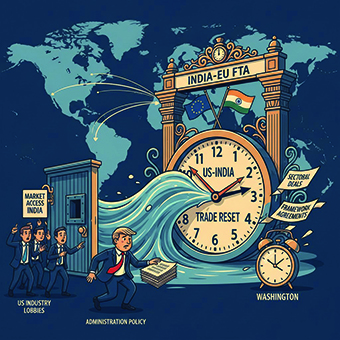
The India-EU FTA acted as a pressure for a US–India trade reset and greater engagement though US trade policy tends to avoid traditional FTAs in favour of sectoral and framework based deals. Since the EU was ready to deal with India through preferential access without the tariff regime blocking trade, US industry lobbies could have stepped up pressure on the Trump administration fearing loss of market access and business with India. The India–EU FTA became a wake-up call for Washington.
Trade is not just about Tariff
The US trade negotiators should have realised the futility of looking at trade deals from a narrow prism of tariffs alone.
The new enabling geopolitical and geo-economic environment is not limited only to tariffs. The ten years of discussions and negotiations that led to the adoption of the General Agreement on Trade in Services (GATS) as part of the Uruguay Round outcomes have produced a much deeper understanding among WTO members of the role that services and the related investment and people flows play in a well-functioning and competitive economy. The GATS itself produced a multilateral framework for the progressive liberalisation of trade in services.
The Uruguay Round resulted in a third outcome that is now clearly assisting the expansion of international trade and investment that is facilitating greatly the negotiation of free-trade agreements, practically becoming the conclusion of the Agreement on Trade-Related Aspects of Intellectual Property Rights (the TRIPS Agreement). Global trade has now become far more confident that mechanisms are available to protect its know-how and drive to produce new ideas and products.
The ease of concluding preferential trade agreements created by the Uruguay Round was further improved by the negotiations under the Doha Development Agenda launched in November 2001. Significant achievements both in market access for goods and services and the rules of the multilateral trading system were streamlined.
Shortcomings of American Business Model
While American remains the strongest economy fueling world trade and extending its business far and wide, its manufacturing sector has witnessed a great set back in the last about four decades. America increased its dependence on China, probably as part of its geopolitical strategy of making China economically stronger so as to wean it away from Russia and also make it depend on the US market. China with high and competitive production capabilities and low consumption economy became the industrial backyard of America. This along with former US President Barrack Obama’s “Pivot of Asia” theory, China grew exponentially, challenging American supremacy. In the bargain, America lost its strategic space in global geopolitical dynamics and also its manufacturing capabilities and remained merely an investing country. China meanwhile, with all the dollars accumulated from US trade, invested in procuring defence technology and began challenging the very American defence production industry that gave it business.
Meanwhile, the high tariff on Indian exports to US, mostly services in the IT sector, as compared to low US tariff on exports to India tilted the balance of trade in India’s favour. From 652.8 million US dollar in 1985, US trade deficit with India has grown to 34,253.8 million US dollars in 2025. Trump should have realised that it was not high tariff of India but cheap goods from China that has pushed the American manufacturing to oblivion and exploited the American consumer.
Instead of complaining about India’s high tariff regime, the Make America Great Again (MAGA) project in America under Trump should have speeded up domestic manufacturing and bring back the manufacturing units from China and elsewhere to America.
Way forward for India-US Trade Deal
After the announcement by Donald Trump that the “deal” is done and that India and the US will now do ‘business as usual’ under 18 percent tariff, it for the negotiators from both sides to work out the details. The trade deal is at a critical juncture, promising tremendous economic and strategic opportunities for the two democracies of the world at a time when the global order and economic fundamentals are being put to test. Recent negotiations have produced an interim framework that reduces certain tariff barriers and signals India’s willingness to expand imports from the United States. However, some complex political and structural challenges remain to be resolved and contentious issues, particularly agriculture, digital trade, and market access, continue to require careful resolution.
One of the key challenges is to balance tariff liberalisation with domestic sensitivities. The apprehensions of Indian farmers and small manufacturers in MSME sector about competition from U.S. agricultural and industrial goods is real. In the U.S., industry groups demand deeper market access and regulatory transparency. Bridging these expectations without triggering political backlash will require calibrated concessions and phased implementation and assurances to Indian MSME sector.
While promise to increase imports in a phased manner is part of the deal, concerns about ambitious trade targets, including proposed large-scale import commitments, are truly challenging. Ensuring that such figures reflect realistic market dynamics rather than political signaling is crucial to maintaining economic stability. Additionally, non-tariff barriers, such as data governance, intellectual property rights, digital taxation, and regulatory standards, will have to be addressed as they are important areas for alignment.
These challenges apart, there are substantial strategic benefits as a comprehensive trade agreement including security pact like that of India-EU FTA, could significantly expand bilateral trade, strengthen supply chain resilience, boost technology and investment flows, and reinforce Indo-Pacific economic cooperation besides strengthening the Quad.
It is strategically important for the US to diversify its partnership with Asia if it wants to contain the “not-so-peaceful” growth of China and reduce its overdependence on one single production place. As for India, a vibrant trade deal with the US will deepen its integration into global supply and value chain mechanisms.
The negotiators on both sides should ensure that the trade deal is structured after consultation with stakeholders, work out HS Code alignment, phased reduction in tariffs and plan for a long term strategic partnership rather than look at the trade as a transactional settlement.
Both India and the US are responsible democracies and have similar outlook towards reducing poverty, rebuild global economy and work towards peace and prosperity in a multilateral framework. Needless to say, negotiators from both countries should strive to insulate the negotiations from business cartels, political misunderstandings, impulsive comments and narrow outlook in order to make the India-US trade deal evolve into a cornerstone of 21st-century economic cooperation.
Seshadri Chari
(The content of this article reflects the views of writer and contributor, not necessarily those of the publisher and editor. All disputes are subject to the exclusive jurisdiction of competent courts and forums in Delhi/New Delhi only)















Leave Your Comment