


The outcome of elections in five states will be analysed by scholars from many perspectives. Yet, to this author, the results in West Bengal and Tamil Nadu point to a deeper, fundamental theme. In the Bhagavad Gita, Krishna tells Arjuna:
यदा यदा हि धर्मस्य ग्लानिर्भवति भारत।
अभ्युत्थानमधर्मस्य तदात्मानं सृजाम्यहम् ॥ 4.7॥
परित्राणाय साधूनां विनाशाय च दुष्कृताम्।
धर्मसंस्थापनार्थाय सम्भवामि युगे युगे ॥ 4.8 ॥
These verses convey a timeless message: whenever dharma declines and adharma rises, a corrective force emerges to restore balance—protecting the righteous and addressing wrongdoing.
Viewed through this lens, the political developments in these two states raise important questions about governance and priorities. Critics argue that excessive efforts to appease particular sections may have come at the cost of broader balance and fairness. Controversies—such as restrictions surrounding religious practices, including instances where devotees reportedly had to seek court intervention even for symbolic acts like lighting a lamp—have fueled debate over the role of the state in matters of faith.
This election outcome reflects more than routine political change; it signals a response to these accumulated perceptions. Whether one sees it as a shift in public sentiment or as a broader correction, the message appears to resonate with the idea that imbalance—of any kind—invites its own course of redress. It is not a surprise that the voter decided to keep both the chief ministers out of the race. This article will focus on West Bengal. BJP Leadership and the media may think that it is the hard work of cadres and the leadership but in the spirit of the Ramayana, it is often said that Ravana was not merely defeated by Rama, but by his own ego (अहंकार) and adharma.
West Bengal’s political landscape has often been defined by sharp rhetoric and high-stakes contests, but recent developments suggest a deeper shift. Political confrontations with institutions and controversies over law-and-order issues has routed TMC supremo Mamata Banerjee in West Bengal elections.
In this perception battle. On one side was a leader known for her grassroots connect and decisive style; on the other were institutions—courts, administrative bodies, and oversight mechanisms—that symbolize checks and balances in a democracy. When disagreements between political leadership and such institutions become public and prolonged, they risk shaping voter sentiment in unexpected ways.
Law and order and intervention of courts!
Law-and-order concerns have added a deeper layer to this unfolding narrative. Incidents such as those in Sandeshkhali and the R.G. Kar Hospital cases have stirred public sentiment, intensifying scrutiny of governance. In such moments, debates and media coverage—whether allegations are proven or contested—often shape perception more powerfully than official clarifications. For many voters, the issue is less about the granular details of each case and more about a broader sense of governance: stability, fairness, and accountability.
At the same time, critics point to a pattern of decisions and confrontations that they argue have heightened tensions. Controversies surrounding administrative interventions—ranging from public event regulations to disputes over institutional authority—have kept the spotlight firmly on the government’s approach. Moves such as limiting the role of central agencies like the Central Bureau of Investigation in certain cases, clashes with constitutional offices, and disagreements over court directives have all contributed to an atmosphere of friction.
Allegations of resistance to border fencing and a soft stance on infiltration have, according to critics, heightened central scrutiny and political pressure on Mamata Banerjee in West Bengal.
In several instances, the involvement of the Supreme Court of India has underscored the seriousness of these disputes and brought them into sharper national focus. Mamta Banerjee mistimed approaching SC herself.
Ultimately, elections are not decided by a single issue but by the cumulative weight of many. Institutional friction and law-and-order debates may influence perceptions, but how much they translate into votes depends on how convincingly each side tells its story—and how deeply that story resonates with the people of West Bengal.
In a state known for its political awareness and spirited electorate, the final verdict has rested not just on narratives, but on trust. Intervention of the Supreme Court in upholding SIR and improving law and order for fair elections.
Rise and fall of Naxal ( Maovadis)
While sympathising with naxals or infiltration, helped in fighting with the left, the image was dented. In one of my previous articles on the end of maovadi violence, the author expected the use of central forces freed from maovadi areas to combat violence in the northeast and other places. It seems TMC leadership failed to foresee additional force available to the centre for responding to the advice of the Supreme Court. TMC did not restrain its cadre from intimidating non TMC voters and election commission observers. Central forces outnumbered Bengal police in efficiency as well as quick response which removed fear.
The seasoned campaigner Modi quickly encashed the situation with “Bhay bahot hua, ab bharosa chahiye” ( end to fear, restore the trust). Making polling booths inside the society took away the control from street scoundrels and intimidation reduced drastically.
Fighting unprofessional politicians is fine but fighting with the system is not beneficial.
West Bengal was ripe for change with factors such as;
BJP narrowed the local leadership gap, expanded grassroots reach, and shifted voter perception.
What made BJP click with voters.
Import + build local leadership (a hybrid model):
Instead of waiting decades to grow leaders organically, BJP has inducted faces from other parties and combined them with its own cadre. The idea is simple: borrow credibility while building your own pipeline. The risk? Imported leaders don’t always transfer voter trust automatically. Many such leader went back to TMC but Mamta Banerjee was defeated twice by her former follower Suvendu Adhikari both in 2021 and 2026.
Reframing identity, not replacing it Bengal has a strong cultural identity, so BJP tries to align with it rather than confront it—invoking icons like Rabindranath Tagore and Subhas Chandra Bose, while blending that with a broader national narrative.
Building a parallel grassroots network The aggressive cadre expansion—RSS-backed volunteers, local committees, and micro-level voter outreach. Motivating Bengali living outside to come and vote was a master stroke. It created a tsunami.
Leveraging central schemes Central welfare schemes are projected as direct benefits to voters, reducing dependence on local intermediaries.
Targeting “beneficiary voters” and women, BJP has focused on groups that respond strongly to welfare delivery and safety narratives. In Bengal, this is crucial because these segments have traditionally backed the incumbent.
Narrative of change vs. status quo They position themselves as the only force capable of challenging Mamata Banerjee, turning the election into a binary choice.
The cost of misreading institutions harmed the TMC.
In a constitutional democracy, institutions are not ornamental—they are foundational. The courts, in particular, represent the rule of law, acting as both arbiter and guardian of accountability. When individuals or leaders appear to underestimate this authority, the consequences can be profound.
The experiences of Subrata Roy and Mamata Banerjee, though vastly different in context and nature, offer a telling reflection of this reality.
The case of Subrata Roy stands as a stark legal lesson. His prolonged confrontation with judicial directives, particularly in the high-profile dispute involving regulatory compliance, ultimately led to serious personal and corporate repercussions. The courts, in asserting their authority, reinforced a simple but powerful principle: no individual, regardless of influence or resources, stands above the law. The episode underscored how defiance or delay in complying with judicial orders can escalate matters beyond control, transforming legal disputes into cautionary tales.
In contrast, the situation surrounding Mamata Banerjee unfolds in the political arena, where the dynamics are less about direct legal penalties and more about perception, narrative, and public trust. Political disagreements with institutions—whether courts or regulatory bodies—are not unusual in a vibrant democracy. However, when such confrontations appear frequent or combative, they can create an impression of friction with the very frameworks that uphold democratic balance. Over time, this perception may influence how governance is judged by the electorate.
institutions derive their strength from consistency and legitimacy, and challenging them—whether in courtrooms or in public discourse—requires careful calibration.
For leaders and public figures, the takeaway is not submission but respect for institutional processes. Democracies thrive on debate and dissent, but they also depend on a shared understanding that institutions are the final arbiters of disputes. Undermining that balance, intentionally or otherwise, risks eroding not just individual standing but public confidence in the system itself.

In this election TMC was fighting more with institutions and less with political rivals.
Attacking the Enforcement directorate (ED), snatching files, registering FIR against central government officials, not cooperating with election commission in SIR campaign, no confidence in chief election commissioner and threatening observers blurred the line between political rivals and constitutional institutions. Failure to prove discrimination in the Supreme Court made people believe that TMC is not on the right side of the law and made them vote for her ouster.
From Mandate to Management: The Real Challenge.
Mamata Banerjee’s refusal to resign despite criticism highlights a deeper tension between political mandate and public accountability— critics see it as resistance to scrutiny.
Mamata Banerjee is a combative political leader who has little faith in consensus-driven politics. Her tenure as Railway Minister reinforces perceptions of a rigid approach to decision-making. Her ability to mobilize support, lead protests, and challenge opponents effectively may create tension and chaos.
As a result the real test for the next CM lies not in holding office but in converting authority into effective governance, restoring trust, and steering the state toward sustained growth.
Channeling public emotion toward healing rather than division.
There is a palpable sense of anger among families who lost loved ones to political violence, and that emotion risks spilling over if not addressed with care. Reports and alleged videos circulating during victory celebrations have only heightened these anxieties. The government can help defuse such sentiments by reopening unresolved cases, strengthening investigations, and establishing fast-track courts to ensure timely justice. It is essential to reinforce that grievances must be addressed through the rule of law, not through acts of retaliation.
At the same time, shifting political loyalties at the grassroots level could create fresh tensions if not managed responsibly. In moments like these, leadership matters. The example of Nelson Mandela offers a powerful lesson—choosing reconciliation over retribution, and channeling public emotion toward healing rather than division.
Conclusion.
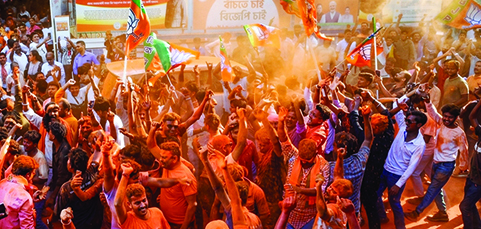
The Bengal election outcome is more than a routine victory of one political party over another. It reflects a broader mandate—one that many interpret as support for stronger border management, curbing infiltration, safeguarding the strategic Siliguri Corridor, and rebalancing governance priorities. It also signals a desire, among sections of voters, to move beyond politics of appeasement toward what they view as a more even-handed and consistent form of secularism.
At its core, the result is seen as a call to replace a climate of fear with trust-based governance—where institutions function transparently and citizens feel secure and heard.
Former capital of India is demanding its lost glory to contribute in realising ‘vision 2047’.
There is an element of historical irony in this moment. Lee Kuan Yew once acknowledged that, at the time of independence, cities like Kolkata were far more developed and prominent than Singapore. Today, that comparison has reversed, with Singapore often held up as a benchmark for urban growth, governance, and economic transformation.
The question now is whether West Bengal can script a similar turnaround. Can a vision akin to the GIFT City model be reimagined for Kolkata—perhaps as a “KIFT City”—to drive investment, infrastructure, and global relevance? The answer will depend not just on political will, but on execution, institutional strength, and the ability to inspire long-term confidence.

Rakesh Kumar
(The content of this article reflects the views of writer and contributor, not necessarily those of the publisher and editor. All disputes are subject to the exclusive jurisdiction of competent courts and forums in Delhi/New Delhi only)




















Leave Your Comment