


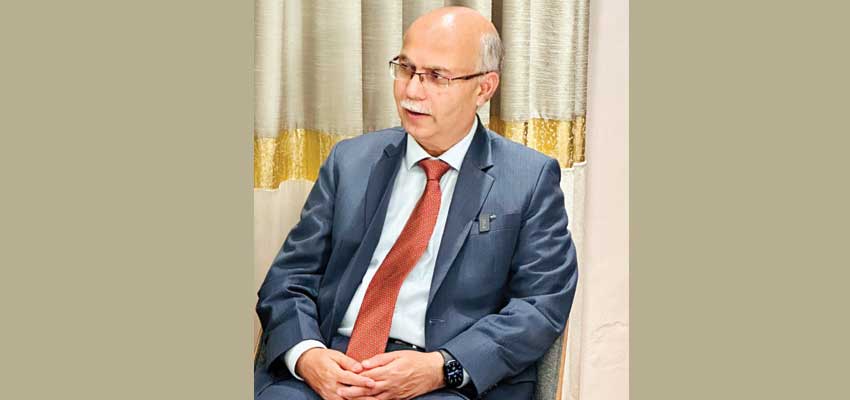
"We have taken a big step in collaboration with Delhi Metro. We have signed an MoU with them in the last 2 years and it has been our endeavour to find out how to replace the products that are imported in the Metro. So, this is our first success. That is the Automatic Train Supervision System, which we have created this time, which has been installed on the Red Line of Delhi Metro in February itself. The Red Line is operated by BEL and DMRC jointly through indigenous air traffic supervision system, which is a big achievement. Apart from this, we have also prepared a system for the platform screen door installed at the stations, which has been prepared in collaboration with NCERT," said Bhanu Prakash Shrivastav, Chairman, Bharat Electronics Limited, in an interview to Anshuman Anand, News Editor. Excerpts:
See, Bharat Electronics Limited believes in providing state-of-the-art equipment to its army by doing new research in the field of defence and related areas. Almost 75 per cent of our products and equipment are with indigenous technologies and designs. That means they have been manufactured indigenously. Our dependence on outside countries is very less. For this we pay a lot of attention to research and development. Bharat Electronics spends about 6.5 per cent of its turnover on research and development. We have a 3 level research and development structure and around 2700 engineers and scientists are working continuously today. We have two central research laboratories, which work on future technology. The Product Development and Innovation Center in Bengaluru does research on all the modules and subsystems that are installed in all the products. And there are about 24 research and development units, which are aligned with various strategic business units, which give the final product to the customer. So, the result of all this is that we are working on a large scale to bring self-reliance in the country, which is linked to PM Modi's self-reliant India campaign. Today, we are not only providing our products to the defence services but we are also trying to bring them to the civilian sector.
See, there are two things, one is that we make an anti-drone detection system, which is called the D4 system. In this whatever drones are coming in the future, they are detected either through radar or through optic electric sensors. And after that there is a system in our D4 system to deter them. Firstly, we jam it with a Radio Frequency (RF) wave, due to which the functioning of the drone gets disrupted and it falls. If it comes close to the radio frequency area, we also have the facility to eliminate and deactivate it with laser.

This D4 system, we did not prepare it specifically for G20. It was designed for any type of threat. We had already given this system to the Army, Navy and Air Force. And it was used mainly by government agencies during the G20. In the G20, we had mainly prepared a system for NDRF and it was based on chemical, biological, radiological and nuclear hazardous material breaking. This is called CBRN hazmat breaking in short. It was imported at the time of the Commonwealth Games. But this time when the G20 summit was held in India, NDRF thought why not develop it in the country, which would be mainly useful in G20. So we made this system for the Army, but the NDRF mainly needed it for the G20. In a short time of 5 and a half months, we designed, manufactured and delivered four systems to the NDRF, which were deployed during the G20. It had the ability to catch any threat. So it had complete biological sensors, nuclear radiation, and the ability to monitor all this. NDRF responders can go anywhere and appropriate steps can be taken to monitor their health. In that, we gave a control system, in which the CBRN movement is completely monitored through a control system to know about where it is and where it is going. So, on the request of NDRF, we made this system especially for G20 and we gave 4 such systems to NDRF.
We have worked to help the environment in all our units by ensuring that all our units have solar power and also our wind energy, which we have installed in Bengaluru. We mainly benefit from the wind energy that goes into the grid. We have installed solar power on a large scale in our factory and staff colony, due to which a lot of our energy is converted into renewable energy. We have also made very good arrangements for rain water harvesting. All our units are fitted with LED bulbs. And in all the renovation work that we are doing, we are making sure that maximum amount of sunlight comes in. We are mainly focusing on that thing, due to which there is less consumption of electricity during day time. Apart from this, we have been working with the defence forces and we have made a special contribution in technology and PM Modi says that India should be made self-reliant, so we have tried to use our knowledge in the civil market. . There are two things I want to mention - first, we have tied up with the Airport Authority of India to see how much we can indigenise the navigational instruments, air traffic management systems, and radar systems at the airport. And our first successful effort, in the same direction, has been that we have developed a completely indigenous Air Traffic Management System, i.e. with the Airport Authority of India. We have installed the first system at Bhubaneswar Airport. It is fully in service and will soon be inaugurated by the Airport Authority of India. Once this is successful, this system will be installed at all the remaining categories C and D airports also. Till now this system has been imported from outside. And secondly, we have taken a big step in collaboration with Delhi Metro. We have signed an MoU with them in the last 2 years and it has been our endeavour to find out how to replace the products that are imported in the Metro. So, this is our first success. That is the Automatic Train Supervision System, which we have created this time, which has been installed on the Red Line of Delhi Metro in February itself. The Red Line is operated by BEL and DMRC jointly through indigenous air traffic supervision system, which is a big achievement. Apart from this, we have also prepared a system for the platform screen door installed at the stations, which has been prepared in collaboration with NCERT. Also, our effort is to install it at more stations instead of one. There is a third thing which is the computer based train control system of the Metro, on which we have also started working together with Delhi Metro. And within the next one to two years, we will bring this also into use. BEL's efforts are being made with Metro, Airport Authority as well as in other areas, so that the country becomes more and more self-reliant.
If we talk about business, then last year, i.e. in the year 2022-23, BEL had got a contract worth about Rs 20 thousand crore. We had made sales worth Rs 17,733 crore. So at the end of the year our order book position was approximately Rs 60 thousand crore. And if we talk about now, since April till now, orders worth about Rs 15,500 crore have come to BEL. So in that sense, it is a good achievement. Because in the entire last year there were orders worth Rs 20 thousand crore. It will be our endeavour to break last year's record. Accordingly, the growth in revenue that we achieved in turnover last year was 15.22 per cent. In the year 2021-22, we had given a turnover of Rs 15 thousand 44 crore and in 2022-23 it became Rs 17,700 crore, which was a growth of about 15 per cent. This year our target is to cross the limit of Rs 20 thousand crore, and if we cross it, then our growth will be 17 per cent, which will definitely be an achievement. Our endeavour will be to keep developing in the field of business also. In this era of competition, profit matters and BEL's profit last year was 23 per cent, which will remain around the same this year also. Because in today's era, competition matters a lot and our competition is direct with foreign companies and private sector companies. And we are confident that this year also, we will achieve a profit of 21 to 23 per cent.
Talking about business, last year we supplied almost 97 per cent of the turnover in the country, of which 87 per cent went to the defence sector. And 3 per cent BEL exported to other countries. It is noteworthy that export in the defence sector is quite a challenging task, so last year we exported to the tune of only Rs 400 crore, but this year our target is to export to the tune of Rs 700 crore. In this, we are trying to supply mainly to our country as well as to friendly countries. And being an offset business, we try to supply to France, Spain and Airbus. As far as indigenous products are concerned, all our products are being made in India only. In this, 75 to 80 per cent are designed in India only. 20 per cent of our products are made with foreign partners, in which we manufacture some things in India only.
We have a very aggressive plan regarding this, so that we can easily sell our products abroad. Efforts are made for that in two ways. One is that we can sell our products wherever there is a need. In this direction, we have opened our offices in Sri Lanka, Oman, Vietnam, as well as in all the friendly countries. We also have offices in New York and Singapore. We are also going to open our office in Brazil. And in this field, our team is trying its best to go to other countries and bring orders on a large scale from there, which will further increase our marketing. Our second part in this direction is that all the big foreign companies have a big contract and they have an offset obligation, under which they have to make some percentage in India. So, we have a partnership with them also. In this we make and export them on the basis of our manufacturing capacity. We are making some products for AAI and exporting them. And our effort is to take this call of the Prime Minister in a sporting manner and export as many products as possible.
BEL's product range is very large. Communication is a small part of it. If you look at the product range, BEL has its range in all these areas - on land, on water, underwater and in the air. We make radar, we make means of communication, we make sonar to be fitted in ships. Fire control systems are made through which torpedoes and rockets are fired. We also mainly manufacture Torpedo Defence Systems. We make all the systems installed in submarines such as the sonar system, torpedo fire system, fire control system, communication systems. In the air sector, we make and provide avionics packages for fighter jets like Tejas. We have an agreement with Airbus in C-295, so we are making and providing some things to Airbus in India like Countermeasure Dispensing System, Missile Approach Warning System, which is being used to make aircraft like C-295. We are also making weapons and tools for strategic platforms. We are also making and providing a combat management system. The C4I system is also one of our strengths, under which we create networking elements for the entire product, such as Integrated Air Command System, Naval Command Control System, Coastal Surveillance System, Integrated Perimeter Security System, which is manufactured by BEL. And this shows the story of expansion.
We will give any product to HAL and HAL exports it. We are OEM, i.e. Original Equipment Manufacturer of any products. In this direction, the main sales of the products will be done by HAL. Under this, we will supply products to HAL. We will ensure to fulfill the demand of the customer. For example, Argentina's requirement is not to use a particular country's products, so we will take care that we provide that product to it without that particular country's products.
We have 2700 engineers in the field of research and development. Our total strength is 9000, in which half of the population are engineers, and half of that, i.e. 2700 people are from the field of research and development. And these are directly linked to BEL. If we talk indirectly, then BEL is connected with the people on a large scale and is also providing employment opportunities. More than 8800 people are directly associated with BEL, but on the other hand, many people from MSMEs and the private sector are also associated with BEL. Hence, the family of BEL is quite big and BEL is connected with 80000 to 1 lakh people. Due to this, all these people are getting a livelihood. At present, we have a total of nine units in India and in the future we are also opening five more units in India, whose work is in progress. There are full chances of it becoming active from the month of December, which will definitely generate employment.














Leave Your Comment