


The foundations of AI were laid in the mid-20th century, when scientists explored whether machines could simulate human thinking. In 1950, British mathematician Alan Turing proposed the famous “Turing Test” to assess a machine’s ability to exhibit intelligent behaviour. The term “Artificial Intelligence” was officially coined in 1956 at the Dartmouth Conference, organised by John McCarthy and other researchers. Early AI research in the 1950s and 1960s focused on problem-solving and symbolic reasoning. Programs could solve algebra problems and play simple games. However, progress slowed in the 1970s and 1980s due to limited computing power and high expectations, leading to periods known as “AI winters.” In the 1990s and 2000s, AI advanced rapidly with improved algorithms and increased computational capacity. In 1997, IBM’s Deep Blue defeated world chess champion Garry Kasparov, marking a major milestone. The 2010s saw the rise of machine learning and deep learning. In 2016, AlphaGo defeated Go champion Lee Sedol. Today, AI powers voice assistants, self-driving cars, and advanced language models, transforming industries and daily life worldwide.
Artificial Intelligence (AI) has emerged as one of the most transformative forces of the modern era. From automating industries to reshaping governance and global economics, AI represents a visible technological revolution worldwide. As humanity transitions from an agrarian economy to an industrial one—and now into a knowledge-driven digital age—AI stands at the centre of this transformation.

Advantages of AI
Artificial Intelligence offers numerous benefits across industries and in daily life. One of its key strengths is automation. AI-powered systems can efficiently perform repetitive, time-consuming tasks, reducing human workload and increasing productivity. In manufacturing, robots can work continuously without fatigue, improving speed and accuracy. Another key advantage is accuracy and reduced human error. AI systems analyse vast amounts of data with precision, minimising mistakes. In healthcare, AI tools help doctors diagnose diseases early by analysing medical images and patient records. Companies like IBM have developed AI-based systems that support medical decision-making. AI also enhances decision-making. By analysing big data, AI identifies patterns and trends that humans might overlook. Businesses use AI-driven analytics to predict customer behaviour, manage risks, and optimise operations. In transportation, AI improves safety and efficiency. Self-driving technologies developed by companies such as Tesla aim to reduce road accidents caused by human error. AI is also used in traffic management systems to reduce congestion. Another major benefit is personalisation. Platforms like Netflix and Amazon use AI algorithms to recommend movies and products based on user preferences, improving the customer experience. AI enables 24/7 availability through chatbots and virtual assistants, providing instant customer support. AI will also reshape the nature of intelligence. Instead of memorising information, humans may focus more on creativity, emotional intelligence, ethical judgment, and complex decision-making—areas where machines still struggle. Human intelligence may evolve from “information storage” to “information management and interpretation.” AI will not replace real intelligence; it will transform it. If used wisely, it will complement and enhance human intelligence. It also supports scientific research, climate modelling, cybersecurity, and education. Artificial Intelligence has emerged as one of the most transformative forces of the 21st century. By February 2026, AI systems power everything from personalised healthcare diagnostics and autonomous vehicles to generative content creation and advanced scientific research. The global AI market continues to grow rapidly, with projections showing significant economic contributions—such as adding hundreds of billions to economies like India's through widespread adoption.
Overall, AI increases efficiency, accuracy, and innovation, making it a powerful tool for economic growth and societal development.
Disadvantages and Risks of AI
Artificial Intelligence has many benefits, but also presents some challenges. One major concern is job displacement. Automation in manufacturing, banking, retail, and customer service may reduce demand for certain jobs, especially low-skilled jobs. Another serious issue is the lack of human judgment and emotion. AI systems operate on data and algorithms but lack empathy, ethics, and moral understanding. In sensitive fields such as healthcare or law enforcement, relying heavily on AI can lead to unfair or harmful decisions if human oversight is weak. Privacy and data security are also major concerns. AI systems require large amounts of personal data to function effectively. Companies like Meta Platforms and Google collect vast amounts of data for AI-driven services, raising concerns about surveillance and misuse of information. Another disadvantage is bias in algorithms. If AI systems are trained on biased or incomplete data, they may produce discriminatory outcomes in hiring, lending, or policing. This can reinforce existing social inequalities. AI development is also expensive and requires substantial computational resources. Advanced systems such as OpenAI’s models demand powerful infrastructure, limiting access to large corporations and wealthy nations. Finally, there are security risks. AI can be misused for cyberattacks, deepfakes, and autonomous weapons, posing global threats. Responsible regulation and ethical governance are therefore essential.
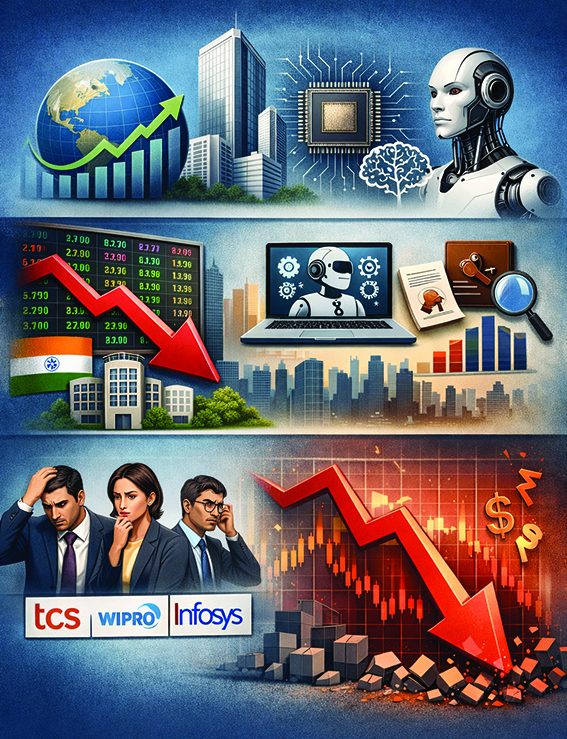
Digital Revolution
The digital revolution has reshaped communication, governance, and commerce worldwide. In India, initiatives such as Digital India and the Unified Payments Interface (UPI) have revolutionised transactions. The digital revolution has boosted economic growth, improved transparency, and created new job opportunities, while also raising concerns about data privacy, cybersecurity, and the digital divide. Globally, companies such as Microsoft and Google have driven cloud computing and AI development, creating an interconnected global digital economy.
AI Ecosystem in US, China, and India
The global AI race is led primarily by the United States and China. In the United States, innovation is driven by leading technology companies such as OpenAI, Google, Microsoft, and NVIDIA, supported by leading universities and venture capital. The US focuses on advanced AI models, semiconductors, and global AI standards. In China, the government plays a central role. Companies such as Baidu, Alibaba, and Tencent lead AI innovation. China benefits from large-scale data, strong state funding, and national strategies like the New Generation AI Plan. It emphasises surveillance technology, smart cities, and industrial AI, aiming for global leadership. India’s AI ecosystem is growing rapidly. Initiatives such as Digital India and India AI Mission promote AI adoption. IT firms such as Tata Consultancy Services, HCL Tech, and Infosys support AI services. India’s strengths lie in skilled talent, startups, and digital public infrastructure, though challenges remain in research funding and chip manufacturing. Canada, Israel, and the UK excel in research, startups, and innovation-driven AI development. India currently ranks third globally in artificial intelligence competitiveness, behind the United States and China, according to Stanford University's 2025 Global AI Vibrancy Index.
To compete with the United States and China in AI, India must significantly increase research funding and strengthen collaboration between industry and top institutes such as the Indian Institutes of Technology and the Indian Institute of Science. Expanding the IndiaAI Mission with robust semiconductor and data infrastructure is crucial. India should promote AI startups by easing access to funding and fostering global partnerships. Investment in high-performance computing, chip manufacturing, and data centres is essential. Skill development programmes must train millions in AI and machine learning. Clear AI regulations that balance innovation and ethics will also help India emerge as a global AI leader.
The India AI Impact Summit 2026, New Delhi
It is a major international artificial intelligence forum held in New Delhi from February 16 to 20. It brought together global leaders, top tech CEOs, policymakers, researchers, and startups to discuss inclusive, safe, and equitable AI development, especially for the Global South. The summit features hundreds of sessions, exhibitions, and collaborations to shape AI innovation, governance, and real-world applications. World figures and industry pioneers participate to explore future AI policies, investments, and partnerships. India is also showcasing its AI capabilities and pushing for broader global cooperation on the responsible use of the technology. The summit features a stellar global lineup of leaders and innovators. Prime Minister Narendra Modi delivered the inaugural address alongside other heads of state, including French President Emmanuel Macron and UN Secretary-General António Guterres. Top tech CEOs include Sam Altman (OpenAI), Sundar Pichai (Google), Dario Amodei (Anthropic), Brad Smith (Microsoft), Alexandr Wang (Meta), Demis Hassabis (Google DeepMind), Shantanu Narayen (Adobe), and Rishad Premji (Wipro). Indian industry leaders such as Mukesh Ambani (Reliance) and Nandan Nilekani (Infosys) also participated. Former UK PM Rishi Sunak joined global discussions on AI governance and collaboration. India is joining Pax Silica, the flagship US initiative to build secure global semiconductor and AI supply chains.
Mukesh Ambani announced an investment of $110 billion in AI over the next seven years. TCS has entered into a multi-year strategic collaboration with OpenAI to build large-scale AI infrastructure and solutions in India. Infosys has signed an agreement with Anthropic to integrate Anthropic’s Claude AI models with Infosys’ Topaz AI platform to build advanced AI systems for large companies and regulated sectors. Adani Group will invest about $100 billion to build renewable energy, AI-ready data centres and infrastructure across India by 2035. The summit concluded with 86 countries signing the AI accord. The New Delhi declaration on AI, adopted by 88 countries and international organisations, put concerns such as the cost of computing power, the absence of a reliable internet, and the lack of trained workers at the centre of the global AI summit for the first time. India has done well to foreground the template for global AI governance. It is a remarkable and ambitious vision that has the potential to address the immense challenges of our times.
Conclusion
We are in the era of knowledge, having moved from CPU to GPU. AI represents a turning point in human history, and the world is not far from early versions of superintelligence. It enhances efficiency, accuracy, and productivity across various fields. AI brings the world's knowledge together in one place, enabling the sharing of best international practices. India is set to emerge as a major AI hub in the near future and become a global service provider. Government initiatives like NITI Aayog’s National Strategy for AI and the IndiaAI Mission aim to promote responsible and inclusive AI development. India’s strengths include a large IT workforce, strong digital infrastructure (such as Aadhaar and UPI), and a growing startup ecosystem. There may be job losses at first, but by imparting AI-based skills to the youth, new opportunities will emerge. In the coming years, AI in India will expand in agriculture, education, healthcare, and governance. India is investing in AI data centres and semiconductor manufacturing to reduce its dependence on foreign technology, thereby transforming industries such as manufacturing, finance, defence, and entertainment. Currently, about 16% of Indians use AI, and this will increase rapidly. We have talented youth who can be the creators of AI. The future of AI is promising, but it requires responsible governance. There is a need to maintain a balance between regulation and innovation, automation and employment, technological power and ethical responsibility. If guided wisely, AI can boost economic growth, improve living standards, and help India move confidently toward its vision of becoming a developed nation by 2047.
Artificial Intelligence is not merely a technological advancement; it is a civilizational shift. The responsibility now lies with policymakers, industry leaders, and citizens to ensure that this powerful tool benefits humanity as a whole.

Manoj Dubey
(The content of this article reflects the views of writer and contributor, not necessarily those of the publisher and editor. All disputes are subject to the exclusive jurisdiction of competent courts and forums in Delhi/New Delhi only)




















Comments (4)
A
Good information about AI, especially in countries like India, China and Russia.
S
Excellent article showing use if AI even in astrology now a days charts are prepared with ai and books can be analysed without wasting any time keep it up. ShyamSunder
Y
Artificial intelligence or AI, the modern science to influence the human life and working. It is so powerful that IBM Deep blue had defeated the world champion Gary Casparov in chess. AI has powerful application in human life especially in defence and many countries like US and China started use of AI in many fields. India also started its application with a high level world conference. The auther has overviewed the issue very nicely in world reference and enlightened the knowledge.
N
The wonderful article by Mr. Manoj Dubey discusses how Artificial Intelligence (AI) is revolutionizing the 21st century, with Prime Minister Narendra Modi emphasizing its potential to democratize and empower, particularly in the Global South. Modi outlined India's M.A.N.A.V. vision for AI, focusing on moral and ethical systems, accountable governance, and accessibility. The article highlights AI's transformative impact, citing its ability to multiply human capability and create new opportunities.