


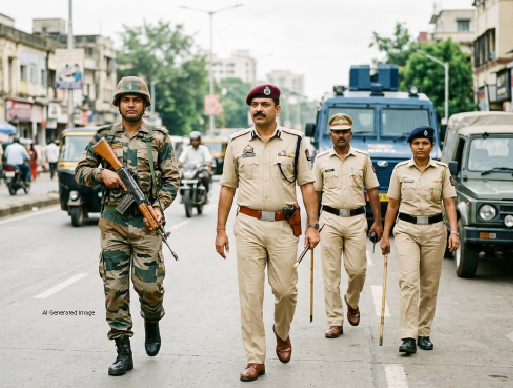
The general correlation and administrative connectivity between the Army and the Police has, recurringly, been marked by strained relations arising from an overlap of functions, competing jurisdictions and divergent institutional cultures. The Army, bestowed with the nation's ultimate fighting capability and so being the last weapon of the state, stands as the final shield of the State under the worst circumstances. The Police, on the other hand, remains vested with the ultimate authority to maintain internal order, apply the law and uphold the writ of the civil administration. The boundary separating the operational domains of the Army and the Police is neither rigid nor clearly defined; it is a delicate threshold, susceptible to ambiguity, contestation and, at times, avoidable confrontation. On multiple occasions, the Army has been pushed into to bridge the gaps occurred due to the limitations, inadequacies or temporary incapacities of the police machinery. Notwithstanding the Army's singular contribution in restoring order and stability, the ultimate authority invariably rests with the civil executive and the police establishment. The intra organizational chemistry between the army and the police thus is unrivalled and unparalleled yet there exists a remarkable gulf of trust between these two ultimate power instruments.
The Army, by the very nature of its mission and deployment pattern, operates across diverse geographical and operational theatres, unlike the police whose jurisdiction is predominantly restricted within the territorial limits of a State. Yet, long after Army’s departure from a particular station, military personnel are frequently summoned to answer notices, attend investigations or participate in judicial proceedings initiated within that State. These persistent demands exact a heavy personal, professional and institutional cost upon soldiers who, having faithfully answered the nation's call, find themselves entangled in legal processes emanating from places where they no longer serve and impose disproportionate burden upon army personnel’s.
The Army: Constitutional Position
The Army is most prime national instrument of war carrying within strategic deterrence. Its primary purpose is the defence of the sovereignty, territorial integrity and security of the nation against external aggression and organised armed threats.
Objectives
• Defence against external aggression,
• Preservation of territorial integrity,
• Assistance to civil authorities only as an exceptional measure,
Capabilities
• Superior firepower,
• High mobility,
• Organised command structure,
Legal Position
The Army derives its authority principally from the Constitution, the Army Act, 1950, and allied regulations. It is not designed to function as a regular law enforcement agency.
Limitations
• Absence of ordinary policing powers,
• No independent criminal investigative framework,
• Exposure to criminal liability in prolonged civil deployment,
• Virtually no public interactions,
Responsibilities
• Counter-insurgency under authorised frameworks.
• Disaster relief / internal turbulence
The Police: Legal Character
The Police are the permanent coercive arm of the civil State.
Their function is governance through law enforcement.
Objectives
• Maintenance of public order,
• Crime prevention.
• Investigation of offences.
• Protection of life and property.
• Enforcement of judicial orders.
Capabilities
• Investigative powers,
• Arrest and detention,
• Intelligence gathering,
• Daily interface with the civilian population,
Legal Position
Police derive authority from criminal law statutes and state legislation.
They possess statutory powers unavailable to the military.
Limitations
• Political interference.
• Resource constraints.|
• Capacity deficits.
• Public trust deficit.
• Inadequate training for prolonged armed conflict situations.
Responsibilities
• Internal security,
• Criminal investigation,
|• Public order management,
Obligations
• Constitutional accountability,
• Judicial scrutiny,
• Adherence to due process,
• Protection of fundamental rights,
Comparative Analysis
Parameter Army Police
Primary role National defence Internal law enforcement
Operational ethos Mission accomplishment Rule enforcement
Legal powers Restricted in civil areas Extensive statutory powers
Training Combat operations Investigation and policing
Accountability Military justice Civil courts and judicial review
Relationship with civilians Exceptional engagement Continuous interaction
The Persistent Paradox
The Army as the instrument of last resort becomes the default remedy for institutional deficiencies and the governance failure. Yet the paradox is profound; Army is expected to deliver extraordinary outcomes while operating within an imperfect and uncertain legal landscape.
Whenever policing structures falter, administration collapses, insurgency overwhelms or riots flare up, the Army is requisitioned. It is expected to neutralise threats while remaining vulnerable to retrospective criminal scrutiny. The State often seeks military efficiency without conferring legal certainty. On the contrary, Counter-insurgency operations have repeatedly transformed soldiers into de facto policemen, intelligence collectors, crowd managers and peacekeepers which are never part of theoretical or practical training of military pers. The soldier is expected to succeed where others have failed, to restore order where institutions have faltered and to stabilise situations beyond the capacity of ordinary law-enforcement agencies.
Hierarchical Mismatch:
A fundamental asymmetry exists between the organisational structures of the Army and the Police. Even a non-gazetted police functionary exercises substantial statutory authority over the public occupying a position of considerable practical significance within the civil framework. By contrast, non-gazetted personnel in the Army, though numerous and indispensable to operational effectiveness, are largely entrusted with internal military functions and possess no corresponding public authority. notwithstanding superficial similarities in rank structure, the two occupy vastly different constitutional and functional spaces, separated by a significant gulf in legal authority, public interface and operational mandate. At the level of commissioned officers, the post-independence period has witnessed a perceptible erosion in the relative hierarchical standing and institutional primacy of the Army vis-à-vis the Police. This gradual shift in status, authority and administrative influence has contributed to an asymmetry between two institutions that are expected to function in close coordination during crises. The resulting imbalance indicates at the institutional, functional and perceptual gaps that continue to separate these parallel arms of the The Army – Police Frictions
The overwhelming majority of Army–Police interactions are characterised by cooperation and mutual professionalism. However, occasional episodes of friction serve as reminders of the need for clearer protocols, institutional parity and an effective dispute-resolution mechanism, possibly through an "Armed Forces and Police Tribunal.
• Nyoma, Ladakh (2020): An altercation reportedly occurred between Army personnel and members of the local police, highlighting tensions arising from overlapping jurisdictions and differing institutional cultures.
• Leh, Ladakh (2021): A dispute involving Army officers and police personnel over procedural and jurisdictional issues once again brought to the fore the delicate nature of civil–military interaction.
• Punjab–Army Personnel Incidents (2023–24): Isolated episodes involving serving soldiers and state police authorities attracted public attention and revived concerns regarding mutual sensitivity, procedural safeguards and institutional respect.
Several incidents have, from time to time, been reported across the country wherein Army personnel, while on leave, temporary duty or transit, have allegedly been subjected to undue harassment, indignity and, in certain cases, excessive use of force at the hands of police personnel acting under the colour of their statutory powers of detention and investigation. Such episodes, irrespective of their frequency, have the potential to erode mutual trust, diminish institutional esteem and inflict a deep sense of humiliation upon soldiers who otherwise dedicate their lives to the service and security of the nation.
Congruity and Consilience Inter relations of the Police and defence forces including Paras
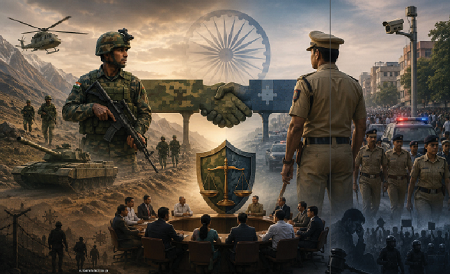
There is an imperative need to view the tri-services, para-security forces and the police as distinct yet interdependent institutions, each possessing its own functional objectivity, operational scope, legal mandate and organisational ethos. While all constitute integral components of the national security architecture, their purposes, powers, responsibilities and domains of engagement are neither identical nor interchangeable. They belong to distinct institutional domains, characterised by different objectives, legal foundations, operational cultures and command structures. Failure to recognise these distinctions risks creating institutional incongruities, diminishing trust, encouraging functional encroachments and blurring jurisdictional boundaries. A coherent policy architecture delineating the respective spheres of the Armed Forces, Central Armed Police Forces and the State Police is therefore essential to foster institutional harmony, strengthen inter-force connectivity and ensure that cooperation is founded upon clarity, mutual respect and clearly defined lines of responsibility.
Special Security Forces Tribunal
A specialised tribunal should be established for expedited adjudication of allegations involving Army and Police personnel arising from operational duties.
Its jurisdiction may include:
• Excessive force allegations,
• Operational misconduct,
• Jurisdictional disputes,
• Human rights complaints,
• Compensation claims,
The objective should be swift accountability rather than prolonged persecution.
Civil Administration Familiarisation
Army officers, particularly at junior and middle levels, must undergo structured exposure to the following issues before embarking upon Counter insurgency and other civil area responsibilities:
• Criminal procedure,
• Police functioning,|
• Evidence law,
• Administrative law.
• Human rights jurisprudence.
Understanding civil systems reduces avoidable friction.
Joint planning diminishes misunderstanding,
No Deployment Without Defined Legal Authority,
Military deployment in civilian spaces must remain exceptional,
Army involvement without explicit legal empowerment should be resisted,
Every deployment should specify:
• Objective,
• Duration,
• Command arrangements,
• Rules of engagement,
• Liability protections,
• Exit strategy,
Additional Recommendations
Operational Immunity Review Board
• A pre-prosecution scrutiny mechanism should examine allegations against military personnel before FIR registration proceeds. This would discourage frivolous and motivated complaints.
• Parliament should enact a comprehensive framework governing military aid to civil authority,
• Present arrangements rely excessively upon executive discretion,
• No prosecution arising from bona fide operational acts should proceed without prior sanction from the competent authority,
• The principle should be:
• “Operational errors warrant examination; mala fide conduct warrants prosecution.”
• Independent Incident Documentation,
• Body cameras, operational recordings and digital logs should become standard,
Time-bound Disposal
• Cases involving operational deployments should be concluded within fixed statutory timelines,
• Justice delayed becomes institutional harassment,
Conclusion
The Army is not an alternative police force. Nor should it become the perpetual insurance policy against failures of governance. A State that repeatedly deploys soldiers to perform police functions while denying them police powers creates a dangerous asymmetry: operational responsibility without corresponding legal authority.
The principle ought to be simple:
Deploy the Army only when absolutely necessary, empower it clearly when deployed, protect it when acting bona fide, and withdraw it the moment civilian institutions regain capacity. A coherent policy architecture delineating the respective spheres of the Armed Forces, Central Armed Police Forces and the State Police is therefore essential to foster institutional harmony, strengthen inter-force connectivity and ensure that cooperation is founded upon clarity, mutual respect and clearly defined lines of responsibility.
Lt Col (Dr) Atul Tyagi
Lt Col (Dr) Atul Tyagi, Advocate is a Practising Lawyer ranging from Trial Court to High Court in NCR. He is duly associated with Academics with different Universities. He has accomplished his research work in respect of Under trials. He has many articles and write ups to his credits on contemporary subjects in various magazines, e -papers and portals. He has articulated a book, Fleeing Justice, Under-trial Conundrum which examines India’s Under- Trial Prisoner crisis.
(The content of this article reflects the views of writer and contributor, not necessarily those of the publisher and editor. All disputes are subject to the exclusive jurisdiction of competent courts and forums in Delhi/New Delhi only)




















Comments (1)
L
A well researched and meticulously articulated piece. The issue highlighted is not only urgent but has implications for national security...