


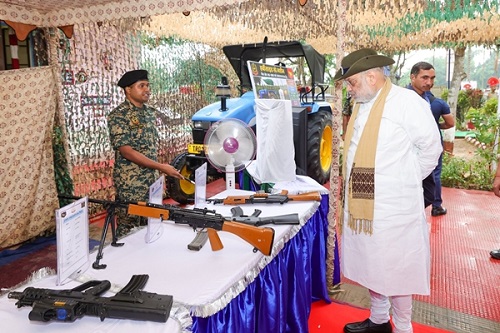
Union Home Minister Amit Shah on Friday said that Prime Minister Narendra Modi is working with a clear vision of transforming India into a developed nation by 2047, emphasizing that national security remains the foundation for achieving this ambitious goal. Addressing the Prahari Sammelan at the Lankamura Border Outpost along the India-Bangladesh international border in Tripura, Shah highlighted the critical role of border security in safeguarding the country's future.
Speaking to Border Security Force (BSF) personnel and officials, the Home Minister stressed the need to completely eliminate cross-border threats such as drug smuggling, human trafficking, cattle smuggling, and the circulation of fake currency. He said that protecting the nation's youth from the menace of drug abuse and preventing economic sabotage through counterfeit currency are equally important aspects of national security.
To strengthen border management, Shah announced that the Union Government is in the final stages of implementing the Smart Border Project, a technology-driven initiative aimed at transforming traditional border security systems. The project seeks to create a synchronized framework that combines advanced surveillance technology, local administration, and security forces to establish what he described as an “impenetrable border.”
Under the proposed integrated security grid, specific responsibilities will be assigned to district administrations and local governance institutions. District Magistrates, Superintendents of Police, police station officials, village Patwaris, and Sarpanches will work in close coordination with border security forces to enhance monitoring and response capabilities in sensitive areas.
The Home Minister informed that the Smart Border Project has reached its final execution stage and that a pilot phase will be launched next year across seven to eight sensitive locations where the BSF and the Sashastra Seema Bal (SSB) are deployed. He expressed confidence that the initiative would significantly strengthen India's ability to counter infiltration and smuggling activities.
Praising the dedication and courage of BSF personnel deployed along the country's borders with Pakistan and Bangladesh, Shah said their tireless service plays a crucial role in maintaining national security and stability. He acknowledged the difficult conditions under which the jawans operate and commended their unwavering commitment to protecting the nation.
Coinciding with World Environment Day, Shah also participated in a large-scale plantation drive organized by the BSF at Lankamura. During the event, he planted an Agar (Aquilaria) tree and lauded the environmental efforts of the Central Armed Police Forces (CAPFs). He noted that CAPF personnel have planted more than 6.40 crore trees across the country since 2019. Building on this achievement, he announced a new target of planting over 2 crore trees annually beginning next year, enabling security personnel to contribute simultaneously to environmental conservation and national service.
Addressing concerns over illegal migration and demographic changes in border regions, Shah asserted that the government would not allow any demographic shifts caused by infiltration through porous border stretches in Tripura, West Bengal, and Bihar. He said the modernization of border fencing remains a top priority and revealed that the government has approved the construction of 119 kilometers of newly designed fencing in Tripura. Work on the first phase of the project has already begun.
The high-level border review meeting and Prahari Sammelan were attended by Tripura Chief Minister Manik Saha, BSF Director General Pravin Kumar, BSF Tripura Frontier Inspector General Alok Kumar Chakraborty, and Inspector General Princy Rani, along with senior administrative and security officials.
The announcements underscore the government's twin priorities of strengthening border security and accelerating national development, with technology, environmental sustainability, and coordinated governance emerging as key pillars of India's long-term strategy.



















Leave Your Comment