


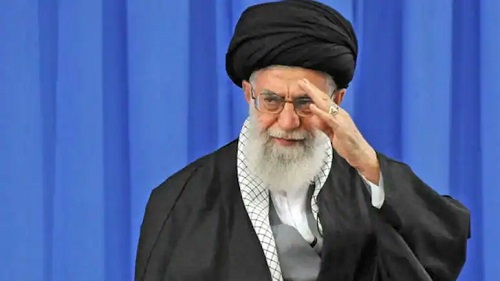
In a development attracting international attention, Iran’s Supreme Leader Ayatollah Ali Khamenei has, for the first time since assuming the country’s highest office in 1989, missed the annual February 8 meeting with air force commanders—a ritual that had been upheld for 37 consecutive years.
The February 8 meeting commemorates a pivotal early moment in the Islamic Republic’s history: on that day in 1979, several Iranian air force officers pledged allegiance to Ayatollah Ruhollah Khomeini, the architect of the Islamic Republic, helping hasten the fall of the Pahlavi monarchy.
Since Khamenei became Supreme Leader following Khomeini’s death, he had personally attended this event every year, including during crises such as the global COVID-19 pandemic—until now.
This year, instead of the Supreme Leader presiding over the ceremony, Chief of Staff of the Armed Forces Abdolrahim Mousavi received the air force commanders—marking a notable departure from decades of tradition.
Some reports even note that other senior clerical figures, including figures connected to the legacy of Khomeini, appeared in official functions related to the event, underscoring possible shifts in internal protocol or messaging.
Khamenei’s absence occurs against a backdrop of particularly heightened tensions between Iran and the United States:
In recent weeks, the US has significantly bolstered its military presence in the Middle East, including positioning the USS Abraham Lincoln carrier strike group in the Arabian Sea with its full complement of warplanes and support ships.
Additional American air assets and fighters—including F-15 jets and reconnaissance aircraft—have been deployed in the broader region, heightening concerns over potential conflict escalation.
These movements have raised speculation that Khamenei’s decision to skip the ceremony may be linked to security considerations, whether to minimize risk to Iran’s supreme civilian-military leader or because he is increasingly preoccupied with strategic national security priorities.
The absence also comes as diplomatic efforts continue, albeit amid significant friction:
The United States and Iran are engaged in talks, with discussions focused on the Iranian nuclear program and broader security issues. While negotiations have been revived after earlier tensions, core disagreements—especially over ballistic missiles and Iran’s wider defense posture—remain unresolved.
Iran has repeatedly warned that any US strike could ignite broader conflict across the Middle East, evoking memories of the 12-day clash with Israel in mid-2025 and emphasizing Tehran’s readiness to defend its interests.
Analysts suggest that breaking such a long-held ritual sends layered signals:
Externally, it may reflect Tehran’s awareness of, and response to, the present security environment, especially with a substantial US military force nearby.
Domestically, it could indicate a recalibration of ceremonial roles within Iran’s leadership, or a shift in how symbolic events are leveraged during times of diplomatic strain.
While it remains unclear whether this absence will have long-term symbolic impact within Iran’s political culture, the deviation from decades of precedent is being watched closely by international observers as an indicator of how Tehran perceives its strategic vulnerabilities and priorities at a critical juncture.














Leave Your Comment