


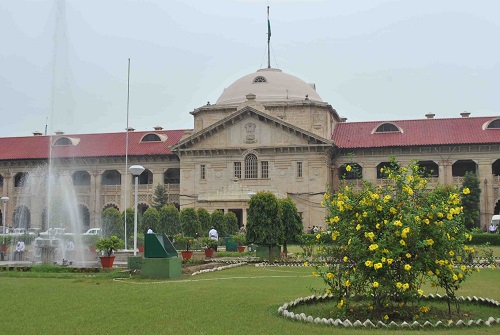
The legal battle surrounding Swami Avimukteshwaranand Saraswati, the Shankaracharya of Jyotirmath, has reached the Allahabad High Court. The seer has filed a pre-arrest bail petition through his legal counsel, advocates Rajarshi Gupta, Sudhanshu Kumar, and Shree Prakash, as he faces charges under the stringent Protection of Children from Sexual Offences (POCSO) Act.
Sources indicate that the petition is likely to be heard soon by the High Court bench. The development comes after a lower court in Prayagraj ordered the registration of an FIR against the Shankaracharya, leading to a police case that has now sparked a political and spiritual confrontation in the state.
The case against Swami Avimukteshwaranand was initiated following a complaint filed by Ashutosh Brahmachari, a disciple of Tulsi Peethadhishwar Swami Rambhadracharya. The complaint was lodged under Section 173(4) of the BNSS (formerly CrPC) in the District Court. Acting on this complaint, ADJ Vinod Kumar Chaurasia of the POCSO and Rape Special Court directed the Jhunsi police in Prayagraj to register a case and initiate an investigation.
In compliance with the court's order, Jhunsi police registered an FIR against the Shankaracharya, his disciple Mukundanand Giri, and two to three other unidentified individuals. The case has been filed under stringent legal provisions, including Section 351(3) of the BNS (Grievous Hurt) and various sections of the POCSO Act, specifically Sections 5, 6, 3, 4(2), 16, and 17, which deal with aggravated penetrative sexual assault and the abetment of such offenses.
As the legal proceedings gain momentum, a new narrative has emerged from Shahjahanpur that adds a layer of complexity to the case. A man named Ramakant Dixit has come forward with claims that he and his family were approached by individuals attempting to pressure them into filing a false complaint against the Jyotirmath Shankaracharya.
According to Dixit, three unidentified individuals visited him and attempted to persuade his family to level allegations against the religious leader. Dixit alleges that during the conversation, he was made to speak on the phone with Ashutosh Pandey (also referred to as Ashutosh Brahmachari), the original complainant in the case.
"Three people came to me and made me talk to Ashutosh Pandey on my phone. They told us that 'Swamiji needs to be fixed a bit.' They talked about making allegations against Shankaracharyaji," Dixit recounted. He firmly rejected the suggestion, stating, "I told them how you can say such things about my daughters... I have met Shankaracharyaji. I have not made any allegations against Shankaracharyaji."
Dixit's statement has provided ammunition to the Shankaracharya's defense, suggesting a possible conspiracy to defame the seer. His legal team is expected to highlight these fresh allegations in the Allahabad High Court to bolster the pre-arrest bail plea, arguing that the case is maliciously motivated and lacks substantive evidence.
The case has also brought to the fore the underlying tensions within the spiritual landscape of Uttar Pradesh. The complainant, Ashutosh Brahmachari, is a known disciple of Swami Rambhadracharya, who holds the title of Tulsi Peethadhishwar. Swami Rambhadracharya was previously awarded the title of 'Shankaracharya' by the Kashi Vidvat Parishad, a move that was not recognized by the existing Shankaracharyas of the four traditional mathas, including Swami Avimukteshwaranand.
This doctrinal dispute over the legitimacy of the Shankaracharya title is now seen by many as a backdrop to the criminal allegations. While the legal battle centers on the POCSO charges, the timing and nature of the complaint have led to speculation about deeper rivalries within the religious community.
As the Allahabad High Court prepares to hear the pre-arrest bail petition, the police investigation continues. The Jhunsi police are currently collecting evidence and recording statements. The coming days will be crucial in determining whether the court grants anticipatory relief to the Shankaracharya or if he must face the trial process, which now includes not only the criminal charges but also a fierce war of narratives involving allegations of conspiracy and character assassination.




















Leave Your Comment