


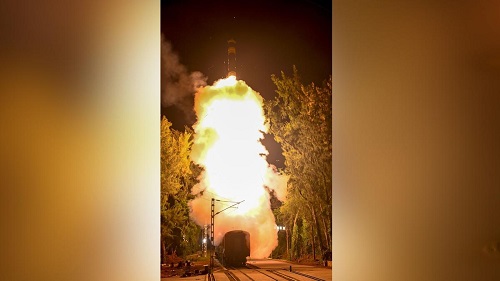
The pre-dawn hours of Thursday witnessed a significant, albeit characteristically understated, announcement from India’s Defence Minister, Rajnath Singh. On the social media platform X, he confirmed the successful test-firing of the new-generation Agni Prime missile. While weapons tests are routine for a nation with a mature missile program like India's, the footage shared by the minister revealed this was no ordinary launch. The explosive lift-off originated not from a static silo or a road-mobile launcher, but from a launch bed pulled by an Indian Railways locomotive.
With this test, India has quietly joined a highly exclusive global strategic club, whose only other confirmed members are Russia, the United States, and China. This test demonstrates a nascent but operational capability for rail-based missile launches, a game-changing development for India’s strategic deterrence posture.
Beyond the Road: The Strategic Genius of Rail Mobility
The Agni Prime is a nuclear-capable, intermediate-range ballistic missile (IRBM) with a strike range of approximately 2,000 kilometres. Its canisterised design allows it to be stored for long periods and launched rapidly from a mobile platform. Until now, this mobility was primarily road-based. The shift to rail is a quantum leap in strategic thinking.
So, what does a rail-based Agni Prime mean for India’s defence?
Unprecedented Mobility and Stealth: As Defence Minister Singh stated, the system "has the capability to move on the rail network without pre-conditions." India boasts the world's fourth-largest railway network, spanning over 70,000 km. This transforms the entire country into a potential launch pad. An enemy satellite would find it nearly impossible to distinguish a missile train from the thousands of freight and passenger trains crisscrossing the nation every day. This "needle in a haystack" effect provides a significant survival advantage.
Enhanced Survivability and Second-Strike Capability: The core of credible nuclear deterrence is a guaranteed second-strike capability—the assurance that even after a devastating first attack by an adversary, enough assets would survive to launch a retaliatory strike. Rail mobility makes this assurance far more robust. By hiding missiles in the vast railway network, and particularly within mountain tunnels, India can ensure a portion of its arsenal remains undetected and protected from a pre-emptive strike. This complicates an adversary's targeting calculus immensely.
Tactical Surprise and Flexibility: The ability to launch from any point along the rail network drastically shortens reaction times. A missile train can emerge from a tunnel, fire, and disappear, catching an enemy by complete surprise. It also allows the military to choose launch points that are logistically challenging for road vehicles, adding another layer of unpredictability.
This development is particularly poignant given recent conflicts. The 2019 Balakot airstrikes and subsequent skirmishes highlighted the vulnerability of static military bases to aerial threats, including drones and missiles. Rail-based launchers mitigate this risk by ensuring missiles are not sitting ducks in known locations.
The Drawbacks: No System is Perfect
Despite its significant advantages, the rail-based launch system is not without limitations. The most obvious is its dependence on the integrity of the railway tracks. If a section of the track is destroyed or compromised, the launcher is rendered immobile. Furthermore, modern missile launches require precise positioning and alignment data. Ensuring this level of accuracy from a moving train, potentially in remote areas, presents its own set of technical challenges.
A Message of Strategic Resolve
The successful test of the rail-launched Agni Prime is more than a technical milestone; it is a powerful statement of strategic intent. It signals India's commitment to continuously modernising its deterrent forces, making them more survivable, agile, and credible. By mastering this complex technology, India has not only entered an elite league but has also sent a clear message to its adversaries: its strategic arsenal can now strike from anywhere, at any time, with the element of surprise firmly on its side. The age of the missile train has arrived on the Indian subcontinent, and it fundamentally alters the region's strategic landscape.






















Leave Your Comment