


India has been facing the brunt of terrorism for quite a long time and now like Bhasmasur, it is killing innocents in the country of its origin. The recent bombings in Pakistan are a proof of that. For the unversed, according to police, a suicide bomber detonated explosives at a political gathering in northwest Pakistan, killing at least 44 people and injuring close to 200 others. On the outskirts of Khar in Pakistan's northwest Bajaur district, which borders Afghanistan, the fundamentalist Jamiat Ulema-e-Islam (JUI-F) party gathering was where the explosion occurred on Sunday. Initial investigations suggested that the ISIL (ISIS) group could be behind the attack and officers were still investigating.
Attacks in Pakistan have been carried out by Tahreek e Taliban Pakistan, an offshoot of Taliban in Afghanistan, as per sources. Now read this. A UN report has warned that Al-Qaeda is planning to target India. The report, said that Al-Qaeda is "ideologically inclined" to carry out attacks in India and that it is "seeking security gaps for opportunistic attacks."
The UN Report
According to this UN report, the terrorist organisation Al-Qaeda is "shaping" its regional affiliate in the Indian subcontinent to expand its operations into Jammu and Kashmir, Bangladesh, and Myanmar.
This 32nd report by the UN Security Council's 1267 ISIL (Da'esh) and Al-Qaeda Sanctions Committee, noted that "one Member State assessed that Al-Qaeda is shaping AQIS (Al-Qaeda in the Indian Subcontinent) to spread its operations into neighbouring Bangladesh," Jammu and Kashmir, and Myanmar.
The report also said that Al-Qaeda is "exploiting the current situation in Afghanistan" to expand its operations in the region. Al-Qaeda has been able to take advantage of the chaos in Afghanistan following the withdrawal of US troops in August 2021. The group has been able to re-establish its presence in Afghanistan and is now using the country as a base to plan attacks in other parts of the world.
According to the report, "that Member State also noted that a small number of AQIS members are prepared to either join or cooperate with ISIL-K (Islamic State of Iraq and the Levant-Khorasan)."
The terror group's newest affiliate, Al-Qaeda in the Indian Subcontinent (AQIS), is "ideologically inclined" to conduct strikes inside India, but its capability is thought to be minimal and it is largely isolated due to enhanced security measures in the area.
According to the assessment, AQIS is "relatively isolated owing to increased security measures within the wider region, but the group continues to seek security gaps for opportunistic attacks." According to Member States, the strength of AQIS in Afghanistan is estimated at several hundred people, spread across the provinces of Laghman, Paktika, Kandahar, Ghazni, and Zabul. The group is "ideologically inclined to carry out attacks inside India but its capability is believed to be low," it added.
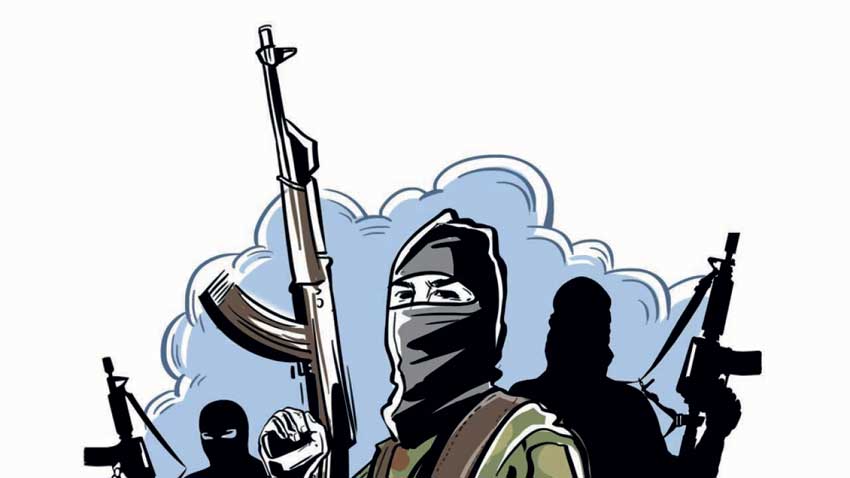
The report noted that Al-Qaeda still has a presence in South Asia and claimed that the terrorist organisation adapts to the local setting, makes an effort to integrate itself into local conflicts and communities, and is closely associated with the Taliban.
The number of Al-Qaeda combatants in Afghanistan is estimated to be 400, with a total of 2,000 when family members and supporters are counted. The core of Al-Qaeda in Afghanistan has remained consistent at 30 to 60 people. Al-Qaeda has about 200 fighters on the Indian subcontinent, with Osama Mehmood serving as the emir. According to the report, some member states believed that Sayf al-Adl, who is supposedly still in Iran, had the best chance of succeeding Aiman al-Zawahiri as the leader of Al Qaeda.
ISIL-K was deemed by the member nations to be the most significant terrorist danger in Afghanistan and the rest of the region due to its improved operational capacity inside of Afghanistan. There are between 4,000 and 6,000 ISIL-K members total, including family members.
One member state claimed that Sanaullah Ghafari was killed in Afghanistan in June, but the report emphasised that this has not yet been verified. Ghafari is thought to be the most ambitious leader of ISIL-K.
ISIL-K's assaults on both the Taliban and foreign targets are become increasingly sophisticated. According to the report, the group was intent on carrying out a plan of high-profile strikes to erode the Taliban's capacity to provide security.
In order to infiltrate and establish strongholds in nations in Central Asia, Al-Qaeda leaders are working to strengthen their ties with regional terrorist organisations of non-Afghan origin operating in Afghanistan, such as the Islamic Movement of Uzbekistan, ETIM/TIP (The East Turkestan Islamic Movement/ Turkestan Islamic Party), and Jamaat Ansarullah. The member states voiced worry that Tehreek-e-Taliban Pakistan (TTP) would develop into a regional threat if it keeps a safe operational base in Afghanistan, according to the report.
Some member states also expressed worry that the TTP would act as a hub for a variety of foreign groups to operate or possibly unite, evading Taliban attempts at control.
Dangers for India
Readers may already know the ISIS dangers for India. The IS supporters give recruits to join jihadi organisations outside of India while they expand their network within India. Up to 200 people may have left India, many of whom are from Kerala, according to sources. Despite the fact that India has a sizable Muslim population, the involvement had an impact on the domestic network and served as a vital channel for advice and communication with the organisation in Afghanistan and Syria.
The report stated that "according to one Member State, ISIS in Afghanistan is accountable for at least one attack in the Kashmir region." However, the report contained no information regarding the attack in Kashmir.
Every six months, the Security Council receives an independent report from the sanctions monitoring team on ISIS, Al Qaeda, and related individuals, groups, undertakings, and entities.
India's terrorism is a complicated topic with numerous actors. The most serious threat from terrorism comes from organisations that have close ties to the international jihadist network led by slain Usama bin Laden, al Qaeda, and its allies in the Pakistani jihadist culture. For more than a decade, al Qaeda and the international jihadist movement have targeted India. India has frequently been mentioned by bin Laden and his ally Ayman Zawahiri as a component of the 'Crusader-Zionist-Hindu' conspiracy against the Islamic world. The most serious threat from terrorism, however, is posed by Kashmiri organisations with strong ties to al Qaeda that are based in Pakistan.
The UN report said that Al-Qaeda is specifically targeting India because of the country's "secular and democratic character." The report said that Al-Qaeda sees India as a "major obstacle" to its goal of establishing a caliphate in the region.
The report's findings have raised concerns in India. The Indian government has said that it is taking the threat seriously and that it is taking steps to increase security. The government has also said that it is working with other countries in the region to counter the threat of Al-Qaeda.
The UN report is the latest in a series of warnings about the threat of Al-Qaeda in India. In 2021, the US State Department warned that Al-Qaeda was planning to carry out attacks in India. The State Department said that Al-Qaeda was targeting "soft targets" such as tourist destinations and religious sites.
Conclusion
The threat of Al-Qaeda in India is a serious one. The group has the capability to carry out attacks in India and it is motivated to do so. The Indian government and its allies need to take the threat seriously and take steps to counter it.
The UN report is a reminder that the threat of terrorism is still very real in India. For many years, India has been the target of terror attacks, including cross-border terrorism. As a result of its support for and implementation of a "zero tolerance" policy towards terrorism, India has also been at the forefront of global community's fight against terrorism. Under the Taliban in South Asia, Al-Qaida, ISIL, and a number of other UN-designated terrorist organisations, such as Lashkar-e-Taiba and Jaish-e-Mohammed, once again run the possibility of finding refuge in Afghanistan. The Taliban Sanctions Committee's 2021 report of UN and other assessments have acknowledged the persistence of ties between the Taliban and other terrorist organisations in our vicinity, including Al Qaeda and the Haqqani Network. The exercise of human rights is gravely hampered by terrorism, which also jeopardises the social and economic advancement of all nations and areas and that is why the Indian government needs to continue to take steps to strengthen its security and to protect its citizens from such terrorist attacks.
Here are some additional details from the UN report
By NILABH KRISHNA
(The content of this article reflects the views of writers and contributors, not necessarily those of the publisher and editor. All disputes are subject to the exclusive jurisdiction of competent courts and forums in Delhi/New Delhi only)














Leave Your Comment