


The history of warfare has always been a history of who processes information faster. Every historical shift in military advantage has followed the same underlying logic that the state that can observe its environment, interpret what it sees, and act on that interpretation before any of its adversaries do is the state with the utmost advantage. Artificial intelligence does not represent a departure from this logic. It represents a technological capability that compresses the gap between information and action to a speed that human cognition cannot match and human institutions were never designed to govern.
What is new, and what makes the current moment historically significant, is not that militaries are using AI. What is historically significant about the current moment is the unprecedented convergence of sufficiently mature autonomous AI, its indigenisation by non-Western states outside traditional defence-industrial structures, and its live battlefield deployment in a globally visible conflict most recently exemplified by Operation Sindoor.
Operation Sindoor was, on its surface, India's precision military response to the Pahalgam terrorist attack of April 22, 2025. Beneath that surface, it was something of far greater strategic consequence: a middle-income, non-Western democracy operationally validating an indigenously built, AI-native defence architecture in live combat against systems supplied by the world's second-largest military power. The significance of this moment cannot be measured by battlefield outcomes alone. What Sindoor demonstrated, with a clarity that strategic theory rarely affords, is that advanced AI-powered military capability is no longer the exclusive domain of the United States, China, or the established Western defence-industrial world. It is a capability that deliberate policy, sustained institutional investment, and a coherent indigenisation strategy can produce and produce on a timeline that the existing hierarchy of AI defence powers did not anticipate, and is only beginning to confront.
The systems India deployed during Operation Sindoor were not improvised. They were the product of deliberate policy procurement reforms that redirected defence spending inward, institutional mandates that embedded AI across all three services, and indigenisation targets that forced India's defence industry to build what it had previously been content to import. At the centre of that validation was Akashteer. This matters because Akashteer was not an ageing platform upgraded with artificial intelligence as an afterthought. It was designed as an AI-native command system from the ground up unburdened by the hardware constraints and doctrinal assumptions that limit legacy systems
This matters because it signals a cultural shift. When a middle-income, non-Western state operationally validates an indigenously built, AI-native air defence system in live combat, it demonstrates that this class of capability is no longer structurally dependent on access to Western or Chinese defence-industrial networks. That is a meaningful shift in what the existing distribution of military AI capability looks like and what it can no longer be assumed to look like going forward.
DEFENCE INDEGENISATION
The Indian government is not investing in AI and defence as two separate ambitions; it is betting that one accelerates the other. The bridging point is this: AI reduces the cost of building defence systems, and indigenisation reduces the cost of deploying them. Together, they create something India has never had before export worthy military technology that is both advanced and affordable.
What distinguishes India's defence indigenisation trajectory from comparable modernisation efforts in other emerging economies is not the scale of investment but the architectural coherence of the institutional framework that preceded it. Most developing states that have attempted to reduce arms import dependency have done so reactively responding to supply disruptions, sanctions exposure, or balance of payments pressures and have consequently built defence industries that are structurally fragmented, technologically shallow, and dependent on licensed foreign designs
The creation of the Defence AI Council (DAIC) and the Defence AI Project Agency (DAIPA) in 2019 represents the clearest expression of this design logic. Rather than embedding artificial intelligence as a subsidiary function within existing service bureaucracies which would have subordinated AI adoption to institutional inertia the government constituted two dedicated bodies with distinct but complementary mandates. The DAIC, chaired by the defence minister and composed of the three service chiefs alongside representatives from DRDO, industry and academia, provided strategic governance over AI integration at the highest institutional level. DAIPA, operating beneath it, translated that strategic direction into operational implementation coordinating pilot projects, managing budgetary allocation, and ensuring that AI adoption progressed across all three services simultaneously rather than unevenly.
What this two-tier structure achieved, in effect, was the institutionalisation of AI not as a technological experiment but as a doctrinal commitment.
INDIA'S GLOBAL POSITIONING AI, DEFENCE AND THE NEW STRATEGIC ORDER
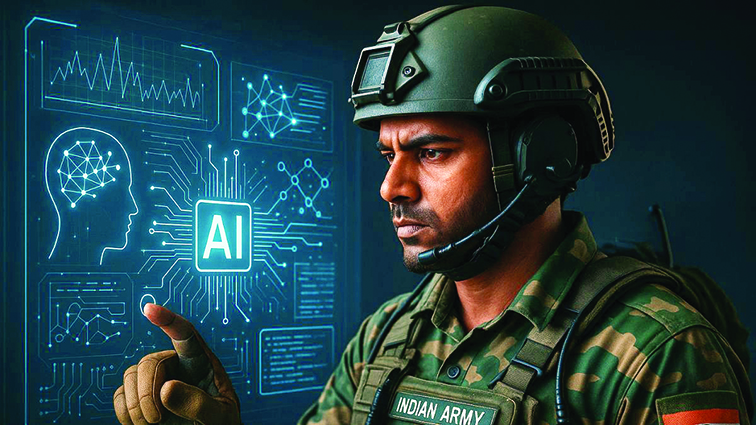
India occupies an analytically distinct position in the emerging hierarchy of AI-powered defence states neither at the frontier occupied by the United States and China, nor at the periphery where most developing nations currently remain, but in a middle tier that is rapidly acquiring the characteristics of the tier above it.
The most progressive countries in AI-driven defence the United States, China, Israel, and to a lesser extent the United Kingdom and France each built their positions over decades of sustained institutional investment. India is compressing that timeline through deliberate policy architecture rather than technological accident. The strategic implication is significant: India is not catching up to the established order of AI defence powers. It is constructing a parallel order, one defined by affordability, democratic legitimacy, and combat validation that the existing hierarchy is structurally ill-equipped to replicate.
For the better part of two decades, China has dominated the defence supply relationship with the Global South not because its systems are technologically superior but because its commercial and political proposition is structurally difficult to refuse. Beijing offers affordable hardware, tolerates governance deficits that Western suppliers will not, attaches no democratic conditionalities to its contracts, and frames every arms sale within a broader Belt and Road logic that bundles defence supply with infrastructure financing, diplomatic cover and debt instruments. For governments in Sub-Saharan Africa, South and Southeast Asia, and parts of Latin America operating under constrained budgets and complicated domestic politics, this package has historically been the path of least resistance. The United States and Israel, the two other major suppliers whose systems are technologically credible and combat-proven, have been largely unable to penetrate this segment of the market not because their systems are inferior but because their political and financial conditions are prohibitive for the very states China targets most aggressively. America's arms sales come embedded in end-use monitoring agreements, congressional scrutiny and human rights conditionality frameworks that sit uncomfortably with many Global South governments. Israel's systems, however, operationally validated, now carry significant political cost in Muslim-majority nations and across Africa following the post-2023 deterioration in its global standing. The result has been a market structure in which China effectively operates without serious competition in the price-sensitive, politically non-aligned segment of the Global South and it is precisely this segment that India's post-Sindoor indigenisation trajectory is now positioned to contest.
The nature of India's competitive challenge to China is not primarily technological it is reputational and positional, which makes it far more durable. China's arms export model depends on a perception of value that has quietly been eroding. Across multiple theatres where Chinese-supplied systems have been deployed whether Pakistani air defence infrastructure, drone platforms operated by African state militaries, or naval vessels supplied to smaller Asian navies questions about maintenance dependency, spare parts availability, technology transfer limitations and the political strings that inevitably accompany Chinese defence relationships have accumulated into a structural buyer dissatisfaction that no individual system upgrade can address. Governments that purchased Chinese systems a decade ago are, in many cases, discovering that the total cost of ownership when factored to include the political exposure, the maintenance lock-in, and the reputational association with Beijing's foreign policy posture is considerably higher than the initial procurement price suggested. India's entry into this conversation offers these governments a genuine alternative that China's model structurally cannot replicate: a democratic supplier with no hegemonic ambitions in the regions it sells to, no history of using defence relationships as instruments of debt leverage, and now, after Sindoor, a portfolio of combat-validated indigenous systems that were demonstrably tested against Chinese-supplied technology and held their own.
This last point deserves analytical weight because it fundamentally changes the terms of competition. Before Operation Sindoor, India's defence export pitch rested primarily on the promise of indigenous capability systems that performed well in tests and exercises but lacked the combat credibility that Israel built through decades of operational conflict and that Chinese systems accumulated through sheer volume of deployment. Sindoor closed that gap in a single operational episode. When Akashteer intercepts aerial threats operating within a combat environment supplied by Chinese hardware, it generates exactly the kind of third-party validation that no government procurement agency can manufacture through domestic testing alone. For a Global South defence ministry currently evaluating whether to renew a Chinese air defence contract or explore Indian alternatives, that operational comparison is not an abstraction, it is the most relevant data point available. India is no longer selling potential. It is selling performance and doing so at a price point that reflects a domestic manufacturing economy with genuine scale advantages over both Israel and China's more technology-intensive production models.
What ultimately distinguishes India's competitive position is that it combines the two advantages that have historically belonged to separate suppliers. China owns the affordability argument. Israel owns the combat credibility argument. India, post-Sindoor, can credibly make both arguments simultaneously and adds a third that neither China nor Israel can offer the Global South: political non-alignment that is genuine rather than performative, rooted in a foreign policy tradition of strategic autonomy that resonates deeply across the very nations China has been supplying for two decades. That combination, affordable, proven, and politically clean, is the competitive proposition that, if India's indigenisation programme sustains its current trajectory, will define the next chapter of the global defence economy in the Global South.
GOVERNENCE: THE NEXT STRATEGIC QUESTION
The most important conversation that Operation Sindoor has started is not about the systems India deployed, it is about the framework within which those systems will continue to be developed, exported, and used. As India accelerates its AI-defence programme and positions itself as a supplier to the Global South, a set of governance questions that have until now remained theoretical are beginning to demand practical answers.
India's current position on international autonomous weapons governance is procedural rather than obstructive. India has supported a political declaration based on the 2019 Group of Governmental Experts guiding principles, arguing that this expert-led process under the Convention on Certain Conventional Weapons is the appropriate forum for LAWS discussions rather than the UN General Assembly, where India believes duplicating the process risks diluting technical rigour. This is a reasonable institutional argument. The GGE process is technical, careful and inclusive of the states most actively developing these systems. India's preference for this forum over a faster-moving General Assembly track reflects a considered judgment about where substantive progress is possible rather than merely declaratory.
India has also argued, in formal submissions to the CCW, that autonomy in critical weapon system functions can impart greater precision and reduce human error, a position that frames AI-enabled systems not as escalatory threats but as potential improvements in the accuracy and proportionality of military force. When read alongside Akashteer's operational performance during Sindoor, a system that intercepted aerial threats with speed and precision that a manually operated equivalent could not have matched this argument has genuine empirical grounding.
What remains open, however, is the harder question that no government statement has yet fully addressed: at what point does the delegation of lethal decision-making to an algorithm require not just national policy frameworks but internationally agreed accountability standards? India has built the DAIC-DAIPA institutional architecture, which demonstrates a domestic commitment to govern AI development. It has a combat record, via Sindoor, that demonstrates restraint in how those systems were used. But as India moves from deploying these systems domestically to exporting them to the Global South to militaries with varying levels of institutional oversight, legal infrastructure and democratic accountability the governance question extends beyond India's own conduct and into the conduct of every state that purchases what India builds.
This is the challenge that the road ahead presents not just for India but for every AI defence power navigating the same terrain. It is worth sitting with a few questions as this article closes, not because they have clean answers but because the quality of the thinking they generate will determine whether the next chapter of AI-powered defence is one the world looks back on with confidence.
1)When an autonomous system makes a targeting decision in a conflict where Indian technology has been exported to a third party, who bears accountability to the user state, the manufacturer, or the algorithm itself
2)And most fundamentally can a nation simultaneously claim the mantle of Global South leadership and resist the multilateral governance frameworks that the Global South itself may eventually need protection from?
India has, through Akashteer and the indigenisation ecosystem behind it, answered the capability question that has defined its defence ambition for a decade. The governance question is the one that will define its credibility for the decade ahead.

YASHNA CHAUDHARY
(The content of this article reflects the views of writer and contributor, not necessarily those of the publisher and editor. All disputes are subject to the exclusive jurisdiction of competent courts and forums in Delhi/New Delhi only)






















Leave Your Comment