


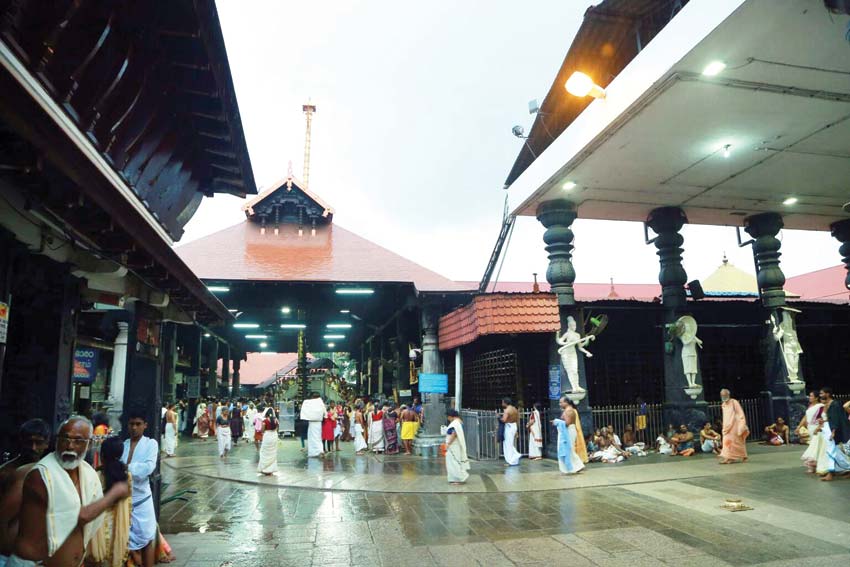
Kerala’s revered temples are once again under the shadow of controversy. After the shocking gold theft at Sabarimala, a 2019–20 audit report on Guruvayur Temple — one of South India’s holiest shrines — has revealed that several valuable assets, including gold, ivory, and even ritual offerings, are missing. The findings, which have surfaced only now, have triggered outrage and calls for greater accountability in temple administration.The state audit department’s report lists multiple irregularities, including mishandling of gold and silver items, unaccounted offerings, and violations of temple protocols.
It notes that even the traditional manchadi seeds — the symbolic red coral seeds offered by devotees — were missing from the records. Saffron flowers used in rituals were also unlisted, indicating poor inventory management and disregard for long-standing temple traditions.A key financial lapse highlighted in the report concerns a loss of ₹79 lakh related to deposits made under a gold investment scheme with the State Bank of India.
Auditors found that the Guruvayur Devaswom failed to properly track or reconcile the scheme’s returns, leading to an unrecovered financial shortfall. Adding to the list of missing items, around 2,000 kilograms of traditional temple cookware (uruli), worth approximately ₹15 lakh, was found excluded from the temple’s asset records.The report also points to a startling disappearance of over 530 kilograms of ivory from the Punnathur Kotta elephant fort — an auxiliary facility under the Guruvayur Devaswom that houses the temple’s elephants. The ivory, collected from elephants that died over the years, was supposed to be catalogued and secured as a protected temple asset in compliance with forest and wildlife laws.
The Guruvayur Devaswom Board, which governs 12 temples across Kerala, said in a statement that all audit observations had been addressed and clarified before the Kerala High Court. “The discrepancies have been resolved, and the report has been duly submitted through an affidavit,” the Board said. The Kerala government said it would issue a clarification soon, asserting that all audit issues had already been settled.The revelations, however, have led to political uproar, with opposition leaders accusing the ruling Left government of negligence in protecting temple wealth. BJP spokesperson Shehzad Poonawalla condemned what he called “intentional mismanagement” of sacred assets, saying, “After Sabarimala, now Guruvayur — this is shocking. The Left government’s disregard for the sanctity of temples is appalling.” The growing public anger over temple mismanagement has renewed calls for independent oversight of Devaswom boards, many of which are run under state control.The controversy over Guruvayur comes even as the judiciary tightens its grip over the Sabarimala gold theft case.
Last week, the Kerala High Court observed that the theft “cannot be brushed aside as an isolated act” and hinted at the possibility of a “well-orchestrated conspiracy” involving temple officials. The case pertains to the removal of gold plating from the Dwarapalaka idols and side frames of the Sreekovil (sanctum sanctorum) at Sabarimala.
In 2019, the idols were taken out of the temple and handed over to a sponsor, Unnikrishnan Potti, for repair work — a serious violation of temple customs, which mandate that such works be done within temple premises.
Investigators later found that the idols had been falsely described in temple records as “copper plates,” allowing them to be moved out without proper authorisation or verification. When the idols were returned, they were never weighed or inspected to confirm the gold content. The Special Investigation Team found that Potti had been allowed to retain over 400 grams of gold from the side frames. In emails accessed by the investigators, Potti had even requested permission to use a portion of the temple’s gold for a family marriage ceremony. Altogether, nearly 475 grams of gold remain untraced, raising suspicions of collusion within the Board.Incredibly, despite these findings, the same sponsor was again given custody of the idols in 2025 to “repair plating damage.” The High Court said this was “highly irregular and possibly an attempt to conceal the earlier theft.” The judges observed that the temple officials’ actions pointed to systemic failure and deliberate misconduct, necessitating a judicially monitored inquiry.
The court has now ordered the registration of a new suo motu writ petition to replace the earlier proceedings of the Special Commissioner. It directed the Special Investigation Team to seize the Guruvayur and Sabarimala Devaswom Board’s minutes book and place it under judicial custody. The idols, whose gold plating was reattached on October 17, have already been inspected as part of a court-mandated inventory check.As the two temple controversies run parallel, public confidence in the management of Kerala’s most sacred institutions has taken a major hit. The judiciary’s intervention in both cases underscores an urgent need for transparency and reform in Devaswom governance. Whether these revelations will lead to structural change or fade into bureaucratic routine remains to be seen, but for now, the twin scandals of Sabarimala and Guruvayur have raised a deeper question — who really safeguards the faith when the guardians of the temple fail to do so?
UDAY INDIA BUREAU
(The content of this article reflects the views of writer and contributor, not necessarily those of the publisher and editor. All disputes are subject to the exclusive jurisdiction of competent courts and forums in Delhi/New Delhi only)




















Leave Your Comment