


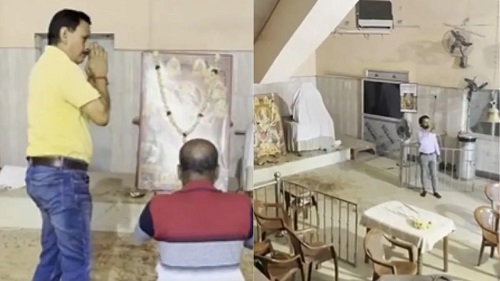
A long-closed Durga temple in West Bengal’s Asansol region has reopened its doors to devotees, drawing large crowds and renewed spiritual enthusiasm among local residents. Managed by the Shri Shri Durgamata Charitable Trust, the temple had remained shut for several years, and its reopening is being viewed as both a religious and socio-political milestone in the area.
Since the gates were opened, devotees have been visiting in significant numbers to offer prayers, marking an emotional return to a sacred space that had long been inaccessible. Many locals expressed relief and joy at being able to freely participate in daily worship, rather than being limited to occasional festival access.
The development has also attracted political attention, particularly from leaders of the Bharatiya Janata Party (BJP), who have linked the reopening to a broader change in governance and administrative approach in the state. Agnimitra Paul, who recently secured a decisive victory in the Asansol Dakshin constituency by a margin of over 40,000 votes, has been associated with efforts surrounding the temple’s revival.
According to Nilu Chakraborty, the reopening has brought a sense of relief to the Hindu community in the region. He alleged that access to the temple had previously been restricted and limited to select festival periods. Chakraborty further stated that repeated appeals had been made over the years to political leadership in Delhi, and credited the recent change in state government for enabling consistent public access to the shrine.
Fulfilling a key electoral promise, Krishnendu Mukherjee visited the temple shortly after his electoral victory. During his campaign, Mukherjee had assured voters that the temple would remain open throughout the year. His visit marked the formal reopening and reinforced the perception among supporters that campaign commitments were being implemented swiftly.
For many in the region, the reopening of the temple goes beyond religious significance. It is being interpreted as a symbol of a broader transformation underway in West Bengal’s political landscape. The recent assembly election results saw the BJP secure a historic mandate, winning 206 out of 294 seats—well above the two-thirds majority mark.
This outcome ended the 15-year rule of the All India Trinamool Congress and marked a significant realignment in voter sentiment. In one of the most notable upsets, Chief Minister Mamata Banerjee lost the high-profile Bhabanipur seat to Suvendu Adhikari, further underscoring the scale of political change.
With the BJP now in power both at the Centre and in the state, West Bengal appears poised to enter a new political phase. The reopening of the Durga temple in Asansol, while rooted in faith, has thus come to represent a wider narrative—one of governance shifts, fulfilled promises, and evolving public expectations in a rapidly changing political environment.




















Leave Your Comment