


The results of the Bihar Assembly elections have not only changed the political landscape there, but have also triggered new movements in the power equations of Uttar Pradesh. The historic performance that the NDA has delivered in Bihar has become a fresh source of enthusiasm within the BJP. Crossing the 200-seat mark out of 243 is no ordinary mandate. It is a political message that those who understand politics know will not remain confined to Bihar’s borders, but will influence the political map of the entire Hindi belt. A key point for the BJP was that, for the first time, it emerged as the largest party in Bihar. In the previous election, the BJP had stopped at 74 seats, while this time it rose to nearly 90 seats in terms of wins and leads. On the other hand, the JDU also emerged as a strong partner by securing around 85 seats. The performance of the Mahagathbandhan was extremely disappointing. RJD slipped to around 25 seats and Congress was reduced to just 6. This is the scenario that has given a new direction to the entire political discourse.
Behind this victory, not only the strength of organization or alliance mattered, but the contribution of UP’s leaders is also considered equally significant. Deputy Chief Minister Keshav Prasad Maurya was made co-in-charge of the Bihar election, and he handled strategies for 78 seats with Muzaffarpur as the center. His ability to connect with the OBC community proved highly effective in Bihar. The election strategy prepared along with Dharmendra Pradhan showed visible impact on the ground. Several UP ministers Brajesh Pathak, Mahendra Singh, Anil Rajbhar, Daya Shankar Singh, Suresh Rana, Dinesh Pratap Singh and others spent months visiting villages and working with party workers at the booth level. This effort was not limited to gathering crowds for rallies; it was a concrete part of the strategy to increase the vote percentage.
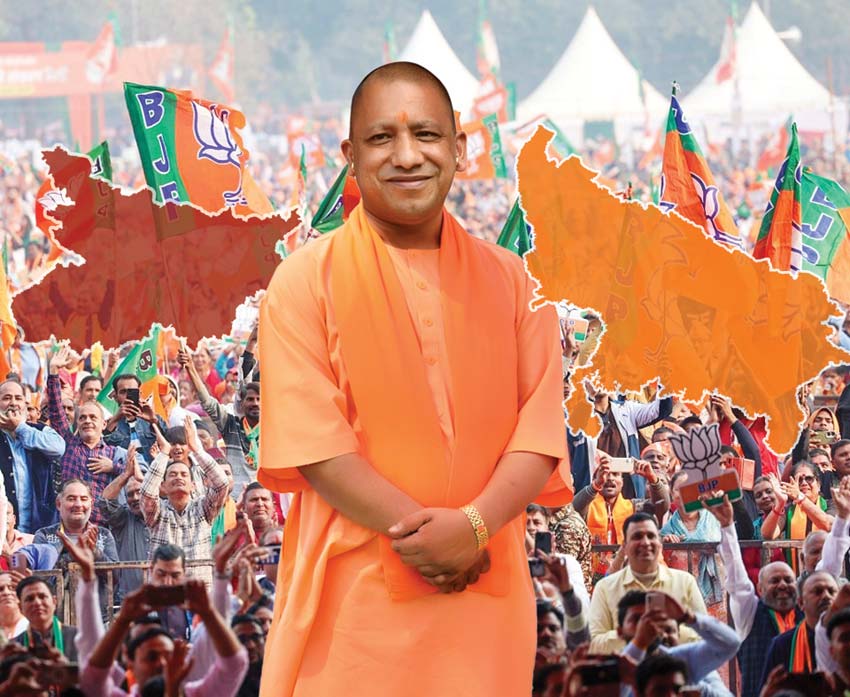
In this chain, Chief Minister Yogi Adityanath’s rallies also had a strong impact. He held 32 rallies and one major roadshow. Of the 43 candidates he campaigned for, most seats went into the NDA’s bag. This was not just the effect of popularity, but also a display of the political skill of establishing his image of security, law and order, and development among Bihar’s voters. Yogi’s name and work were used as a powerful message in Bihar, and the results proved that this strategy was successful.
The biggest impact of Bihar’s massive victory will now be seen in Uttar Pradesh. The 2027 assembly elections in UP may seem far away, but the BJP has already begun preparations. Discussions have intensified regarding organizational changes, cabinet reshuffles, and strategies to balance regional equations. The way caste arithmetic was handled differently in Bihar and balanced with development-oriented politics will now be attempted in UP as well. The BJP’s top leadership is now reviewing the Bihar model so it can be implemented in UP, because after the setback in 2024, this election is not just about power but also about political prestige.
On the other hand, the strategy of allied parties will also be forced to change after the Bihar results. The Suheldev Bharatiya Samaj Party had claimed that it would contest 153 seats before the election, but eventually contested only 32, and lost most of them with even deposits forfeited. This sent a message that the pressure tactics regional parties used to increase their bargaining power with the BJP will not be as successful now. The NDA’s strength in Bihar has indicated that the BJP is capable of winning elections on its own, and allies will have to rethink their strategies.
Meanwhile, the Samajwadi Party also received a strong message from Bihar. Even though the SP did not contest the election in Bihar, Akhilesh Yadav held 22 rallies as part of the INDIA alliance. The Bihar results have compelled the SP to consider that relying solely on the core vote bank is no longer possible. The era of the MY equation is over, and the PDA model that Akhilesh talks about now needs to be implemented at the ground level. Senior SP leaders also admit that the 2027 battle will be fought not on the basis of caste equations but on development and broader social partnerships. The SP will have to reach out to non-Yadav OBCs, non-Jatav Dalits, and emerging rural social groups, because the Bihar results have made it clear that the public is no longer willing to accept purely caste-based politics.
In the meantime, Akhilesh Yadav has made serious allegations regarding the SIR process and claimed that electoral manipulation took place in Bihar. He also said that such manipulation will not be allowed in West Bengal, Tamil Nadu, and UP. The SP claims that its PPTV meaning PDA Prahari will remain alert at every booth and closely monitor any potential irregularities. The BJP has strongly responded to these allegations. Keshav Prasad Maurya said clearly that leaders accustomed to defeat are now questioning the process to malign the people’s mandate. He asserted that in 2027, UP will witness a sweeping majority like in 2017.
For the BJP, this 200-plus wave in Bihar is not just a victory but the first chapter of its 2027 strategy. This victory shows that the public has chosen good governance over jungle raj, dynastic politics, and caste upheavals. The effort to take this mindset to UP will now intensify. The BJP wants Bihar-like results in UP by balancing organizational strength, understanding of caste equations, and development-based politics. For the opposition, this election is a warning that old formulas must be abandoned and new politics adopted. However far this Bihar wave travels, it is clear that its impact will definitely reach UP. In the coming months, political strategies will be exchanged between states even more rapidly. It is hard to say which direction the 2027 election will take, but the Bihar results are enough to signal that political equations are changing fast and the next election will be more interesting, challenging, and unpredictable than before.
By Swadesh Kumar from Lucknow
(The content of this article reflects the views of writer and contributor, not necessarily those of the publisher and editor. All disputes are subject to the exclusive jurisdiction of competent courts and forums in Delhi/New Delhi only)














Leave Your Comment