


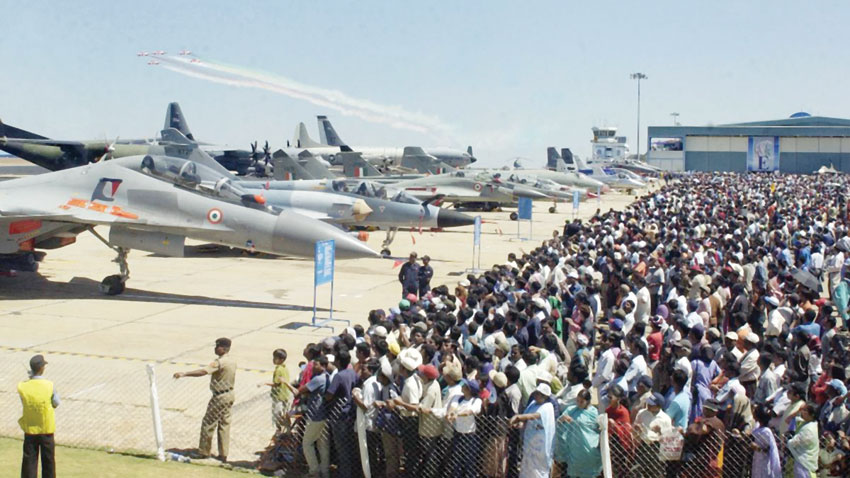
10th to 14th February, 2025 would be the period, and Air Force Station, Yelahanka, Bengaluru, Bharat, would be the location, where the whole world's attention would focus upon. In the backdrop of the Aero India Show 2025, it is seemingly a good juncture to examine the unfolding geopolitics of South Asia, obviously with India firmly at its center.
South Asia, comprising eight countries, is an ever evolving dynamics of competing interests, historical rivalries, and emerging alliances. India, that is Bharat, as the largest and most populous country in the region, plays a pivotal role in shaping the geopolitics of South Asia.
South Asia: The historical and diplomatic backdrop
From the Indus Valley Civilization to the Vedic period and the dominance of the Maurya and the Gupta empires, South Asia has been a political, economic and social expanse for empires and civilizations. A common cultural spectrum however had bound the region for centuries.
Finally, the European colonial era saw the region fragment into separate entities, with India emerging as the dominant power after its independence in 1947. The partition of India and Pakistan led to a complex web of relationships. With time, due to its democratic structure and systematic civil-military relations, India emerged as a major economic and military power.
In the last decade or so, India has further cemented its position in South Asia because of its rapid economic growth, technological advancements, and strategic diplomacy. India's rise and its extension of aid for countries have significant implications for the region.
Nonetheless, the landscape of geopolitics of South Asia is characterized by several key issues:
A. The longstanding dispute(s) between India and Pakistan remain(s) major flashpoint(s) in the region. The two countries have fought four wars, and their relations remain less than cordial, particularly over cross-border terrorism into Indian soil, which by all perceivable means, originate in Pakistan.
B. China's increasing presence in the region, through its Belt and Road Initiative (BRI) and strategic investments, has naturally raised concerns in India and other countries. China's growing influence has led to a reconfiguration of regional alliances and partnerships.
C. The South Asian Association for Regional Cooperation (SAARC) was established in 1985 to promote regional cooperation and integration. However, the organization has faced challenges because of impediments being created in its smooth functioning due to regional tensions.
D. South Asia has witnessed the emergence of new alliances and partnerships, such as the India-US strategic partnership, the Bangladesh-China-India-Myanmar (BCIM) economic corridor, and the China-Pakistan Economic Corridor (CPEC).

The Big Question of CPEC
In this regard, it is noteworthy to mention that CPEC is a significant component of China's Belt and Road Initiative (BRI), aiming to connect China's Xinjiang province with Pakistan's Gwadar port. While CPEC is projected as an economic development project, it poses strategic concerns for India.
1. CPEC provides China with direct access to the Indian Ocean, enabling it to expand its naval presence and challenge India's dominance in the region.
2. China's presence in Pakistan, particularly in Gwadar, raises concern about potential military bases, which could be used to monitor and counter Indian naval activities.
3. CPEC, combined with China's presence in Nepal, Bhutan, and Myanmar, creates a strategic encirclement for India, which could potentially pose challenges for India's strategic maneuverability.
4. CPEC strengthens economic ties between China and Pakistan, furthering interdependence that could be leveraged to influence Pakistan's foreign policy and undermine India's interests.
5. Its infrastructure development, including roads, railways, and energy projects, enhances China's ability to rapidly deploy military assets in the region.
6. Its passage through Pakistan-Occupied Kashmir (PoK) has been a long-standing concern for India, as it may sort of legitimize Pakistan's control over the disputed region.
7. CPEC’s extension into Afghanistan and Central Asia could create new security challenges for India, as China expands its influence in these regions.
While CPEC poses significant strategic concerns for India, its implications are complex and multifaceted. India is of course monitoring CPEC's development and engages in muliti-dimensional efforts to address its concerns. Simultaneously, India is focusing on strengthening its own economic and strategic ties with regional countries to counterbalance China's growing influence in South Asia.
The Aero India Show 2025
The Aero India Show 2025, scheduled to take place in Bengaluru, India, would be an apt platform for India to showcase its growing military capabilities and technological advancements. The show is expected to attract participation from over 100 countries, including major defense manufacturers and military delegations.
The Aero India Show 2025 would also open up vistas of opportunity for India to strengthen its defense partnerships and collaborations with other countries. India has been actively pursuing defense cooperation with countries such as the United States, France, Israel, among others, and the show is expected to further solidify these relationships.
It would also be a good time to recollect the crucial role played by The Indian Air Force (IAF) in the India-Pakistan wars, particularly in the 1971 Indo-Pak War. The IAF gained air supremacy over the Pakistan Air Force (PAF) in the eastern theater, thanks to its superior numbers and technology. Some key operations carried out by the IAF were Battle of Longewala, Operation Trident – in which the IAF launched a surprise attack on the Pakistani naval base at Karachi – sinking several ships and destroying fuel storage facilities; and Tangail Airdrop, in which the IAF para-dropped a battalion group over Tangail in East Pakistan, cutting off the retreating Pakistani 93 Brigade and ultimately leading to the fall of Dhaka.
The Show’s Implications for South Asia
The Aero India Show 2025 can have significant implications for the geopolitics of South Asia and beyond. India's growing military capabilities and technological progress would be a matter of deterrent for Pakistan and China.
The show will also provide an opportunity for India to promote its defense exports and strengthen its position as a major defense manufacturer. This could lead to increased defense cooperation and partnerships between India and other countries in the region.
Conclusion
There is no gainsaying the fact that the geopolitics of South Asia, with India at its epicenter, is a complex and dynamic landscape. In this background, the Aero India Show 2025 will provide a strong platform for India to showcase its growing military capabilities and defence technology, while also strengthening its defense partnerships and collaborations with other countries, not just within South Asia, but far without.
As the region continues to evolve, it is essential to monitor the shifting dynamics and alliances, and to assess their implications for regional stability and security. The Aero India Show 2025 will be a significant event in this context, providing valuable insights into the geopolitics of South Asia and a right step in the direction of India's growing role in the region.

By Dr Uddipan Mukherjee, PhD, IOFS
(The content of this article reflects the views of writers and contributors, not necessarily those of the publisher and editor. All disputes are subject to the exclusive jurisdiction of competent courts and forums in Delhi/New Delhi only)














Leave Your Comment