


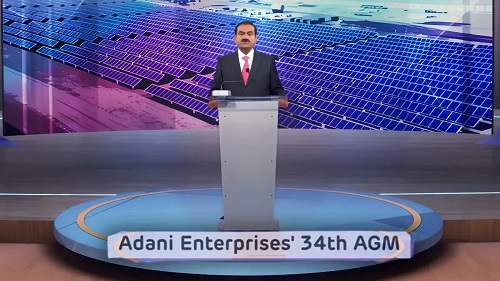
Adani Group Chairman Gautam Adani on Wednesday said the conglomerate's record investment in infrastructure during FY 2025-26 reflects its unwavering commitment to nation-building and India's long-term growth story. Addressing the Annual General Meeting (AGM) 2026, Adani revealed that the group invested more than Rs 1.5 lakh crore in hard infrastructure during the fiscal year, accounting for over 30 percent of India's total new private-sector capital expenditure.
"For us, this is more than a financial number. It is a statement of belief, and there can be no stronger testimony to our commitment to nation-building than the scale at which we continue to invest in the infrastructure that will power India's next chapter," Adani said.
Highlighting the group's performance across sectors, he noted that Adani Energy Solutions' transmission order book has grown to Rs 72,000 crore. The company secured several strategic projects, including the Khavda South-Olpad High Voltage Direct Current (HVDC) transmission line, strengthening its position as India's only private-sector player with proven HVDC capabilities.
In the power sector, Adani Power is executing what the chairman described as India's largest-ever private-sector power capital expenditure programme, valued at over Rs 2 lakh crore. The company aims to expand its generation capacity to 45 gigawatts over the next five years.
The group also reported significant progress in its ports and logistics business. Adani Ports handled more than 500 million tonnes of cargo in FY26, keeping it on track to achieve a capacity of 1 billion tonnes by 2030. The Vizhinjam International Seaport crossed the milestone of one million TEUs in its first year of operations, a development Adani described as a landmark moment for India's emergence on the global transshipment map.
In the aviation sector, the group marked the inauguration of the Navi Mumbai International Airport, completed in just over four years, along with the opening of a new integrated terminal building at Guwahati Airport.
Adani also highlighted the group's ambitions in digital infrastructure. Its data centre business is targeting a 3-gigawatt platform by 2030, supported by a gigawatt-scale memorandum of understanding with Google in Visakhapatnam.
The conglomerate's cement business expanded its installed capacity to 110 million metric tonnes per annum (MMTPA), while its mining services business achieved a record capacity of 145 million tonnes annually through four new Mine Developer and Operator (MDO) agreements.
In defence and aerospace, the group entered into partnerships with global firms Leonardo and Embraer to develop regional aircraft and helicopter ecosystems in India. Referring to Operation Sindoor, Adani said the group's drones, anti-drone systems, missiles and ammunition played a supportive role for the Indian armed forces during the operation.
A major announcement at the AGM was the group's entry into the nuclear energy sector. Gautam Adani unveiled Adani Atomic Energy, a new venture that aims to develop 10 gigawatts of nuclear power capacity by 2035. He said land for the proposed projects has already been identified, marking a significant diversification into clean and reliable energy generation.
Meanwhile, Adani Total Gas continued expanding its city gas distribution network, surpassing 1.1 million piped natural gas (PNG) connections while accelerating infrastructure development despite ongoing geopolitical challenges.
The announcements underscore the Adani Group's aggressive expansion strategy across energy, transportation, logistics, digital infrastructure and emerging technologies, positioning it as a key player in India's infrastructure-led economic growth.





















Leave Your Comment