


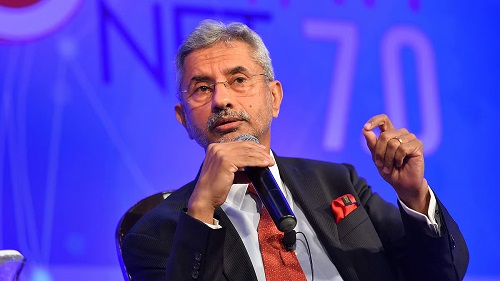
The stable, rules-based global order that defined the post-Cold War era is being systematically dismantled, replaced by a period of intense volatility and strategic realignment. This was the stark assessment delivered by India’s External Affairs Minister, Dr. S. Jaishankar, in a keynote speech at the Aravalli Summit at Jawaharlal Nehru University.
Against the backdrop of significant economic disruptions driven by the trade policies of the Donald Trump administration in the US, Dr. Jaishankar painted a picture of a global landscape undergoing a profound and rapid transformation, where traditional calculations have been overturned by "tariff volatility" and international regimes are being "revisited or discarded."
The Overturning of Global Economic Assumptions
At the heart of this transformation are two interconnected shifts. First, the minister highlighted a dramatic concentration of global economic power, noting that "a third of global manufacturing has moved to a single geography," a clear reference to China. This concentration has created fragile, centralized supply chains, leaving the world vulnerable to disruptions.
Second, and more immediately disruptive, is the weaponization of trade. "Trade calculations are being overturned by tariff volatility," Jaishankar stated, in an apparent direct reference to the Trump administration's approach. This remark gains sharp context from the recent downturn in India-US relations, triggered by President Trump’s decision to hike tariffs on Indian exports to as high as 50%, including punitive levies over issues like Russian oil purchases.
This "tariff volatility" is not an isolated phenomenon but part of a broader pattern where economic tools are leveraged for strategic ends. The minister’s comments underscore a world where the predictable formulas of globalization have given way to a more mercantilist and protectionist reality.
The Strategic Consequences: From Big Tech to Eroding Sovereignty
Dr. Jaishankar’s analysis extended far beyond trade, outlining a multi-front challenge to national sovereignty and strategic autonomy.
The Technology Battleground: He pointed to "competing models on the harnessing of data and evolution of artificial intelligence," where nations and "Big Tech" companies, now "significant players in themselves," jostle for dominance. This competition, he warned, facilitates an "erosion in sovereignty... through tech penetration and manipulation."
The New Financial Arsenal: The tools of economic statecraft have evolved. "The application of sanctions, the seizure of assets, the advent of crypto – they have all today changed the face of global finance," he said, creating a landscape where financial power is aggressively projected.
Resource Nationalism and Connectivity: The "visceral" competition for rare earths and critical minerals, coupled with the emergence of new connectivity routes with "a strategic purpose," highlights a return to great-power rivalry where control over resources and trade corridors is paramount.
The Changing Face of Conflict: The nature of warfare itself has been transformed, becoming "more stand-off, more impactful and definitely more risk-prone." This is driven by what Jaishankar termed the "weaponisation of everything," where nations show "less inhibition to use available tools."
The Indian Response: Navigating the "Intersection of Interests"
In this fragmented world, Dr. Jaishankar argued that the foundational promise of global cooperation has receded. "The needle has shifted towards an intersection of interests and away from the promise of cooperation," he observed. For a rising power like India, this presents a complex challenge.
The minister concluded that as the majority of nations struggle to defend their interests in this volatile environment, India’s imperative is to accurately read the "complex and evolving landscape." The task for analysts and policymakers is to strategise a path that allows India to continue its ascent amidst this turmoil, carefully calculating its responses to protect its sovereignty, secure its economic interests, and navigate the shifting alliances of a new geopolitical era.
Dr. Jaishankar’s speech serves as a sobering reminder that the era of steady globalization is over. Nations now operate in a world where every tool—from tariffs and technology to finance and connectivity—is a potential instrument of strategy, demanding a new and more agile form of statecraft.



















Leave Your Comment