


Leaders are remembered not only for the offices they hold but for the horizons they open. At seventy-five, Narendra Modi stands at such a point of reflection—his life’s journey mirroring India’s rise and his leadership shaping its path to 2047. From humble beginnings to guiding the world’s largest democracy, he embodies the determination and discipline that have redefined Indian governance.
For Chhattisgarh, this national moment carries a deeper resonance. As the state marks twenty-five years of its formation, the tribal heartland of Bastar is undergoing one of the most profound transformations in its history—the steady decline of the LWE (Left-Wing Extremism) insurgency. The return of peace and the renewed promise of progress in Bastar stand as a vivid expression of Modi’s conviction that development must touch every citizen and every corner of the nation.
This philosophy of inclusive growth is rooted in Narendra Modi’s own journey.Born in 1950 in Vadnagar, Gujarat, Modi grew up in modest circumstances. The discipline of his early life shaped his character. His association with the Rashtriya Swayamsevak Sangh brought him into the world of organisation, service, and nation-building. Rising through the Bharatiya Janata Party, he gained experience across states, learning the diversity of India’s challenges and building the skills of governance and leadership.
When he became Chief Minister of Gujarat in 2001, the state was facing the devastation of the Bhuj earthquake. Modi’s response was immediate and structured. Relief and rehabilitation were combined with long-term rebuilding. Roads, houses, and public services were restored in record time.
Beyond disaster management, his years in Gujarat were marked by economic and social initiatives. Power supply was stabilised through the Jyotigram Yojana, which separated agricultural and domestic feeders to provide round-the-clock electricity to villages while ensuring efficiency in usage. The Sabarmati Riverfront Project transformed an urban space into a hub of tourism and recreation, showing his emphasis on both development and aesthetics. Industrial corridors and Special Economic Zones attracted investment, while agricultural growth was supported through water conservation, micro-irrigation, and soil health initiatives.

Agriculture was given renewed attention through Krishi Mahotsavs—farmer outreach
programmes where officials, experts, and the Chief Minister himself interacted directly with cultivators. These interactions encouraged the adoption of drip irrigation, modern seeds, and soil health management, leading to measurable gains in farm productivity. Large irrigation projects, most notably the Sardar Sarovar Dam, expanded water availability and improved agricultural resilience in drought-prone areas. The combination of infrastructure growth and agricultural reforms gave Gujarat a reputation for balanced development.
The state became a preferred destination for investors, with the Vibrant Gujarat Summit showcasing its potential to the world and attracting global partnerships. These measures created an environment where both industry and agriculture advanced together. These experiences gave Modi a national profile as a decisive leader who insisted on delivery. By the time he led the BJP in the 2014 general election, his record in Gujarat had made him a symbol of development and efficient governance.
At the national level, economic reform became a central focus. The introduction of the Goods and Services Tax (GST) unified India’s indirect tax system, creating a common market that reduced barriers and improved compliance. The Make in India initiative encouraged industries to expand domestic production and sought to create jobs for India’s growing workforce. Digital India promoted the use of technology in governance, making services more accessible and transparent.
The Insolvency and Bankruptcy Code provided a new framework for resolving stressed assets and improving the credit environment. Direct Benefit Transfers, enabled by the JAM trinity (Jan Dhan, Aadhaar, and Mobile), reduced leakages in welfare schemes and ensured subsidies reached intended beneficiaries. The scale of direct transfers has been vast, with crores of farmers and poor households receiving timely support directly into their bank accounts. India has also emerged as a global leader in digital payments, with the Unified Payments Interface (UPI) facilitating billions of transactions each month. This home-grown system has given ordinary citizens—from street vendors to small shopkeepers—an easy, secure way to transact digitally. The combination of banking access, DBT, and UPI reflects a comprehensive approach to economic inclusion. The Pradhan Mantri Jan Dhan Yojana opened over 50 crore bank accounts, integrating millions of citizens into the formal financial system. Together, these measures expanded financial inclusion on an unprecedented scale. Infrastructure has been another area of priority. The Bharatmala Pariyojana is expanding highways and expressways across the country, while Sagarmala is modernising ports and improving coastal logistics. Dedicated freight corridors are under construction to ease goods movement, and regional airports under the UDAN scheme are enhancing connectivity for smaller towns. These investments are not only building capacity but also spreading growth beyond metropolitan centres.
In 2025, the government also introduced second-generation GST reforms, designed to simplify compliance and strengthen the ease of doing business. These reforms reflect Modi’s ongoing commitment to creating an economy that is transparent, efficient, and growth-oriented.
Modi’s tenure has also been defined by ambitious social programmes. The Swachh Bharat Abhiyan mobilised citizens across the country, leading to the construction of over 100 million toilets and a visible change in sanitation habits. Independent surveys have recorded significant reductions in open defecation, with positive impacts on health and dignity, especially for women.
Ayushman Bharat has become the world’s largest public health insurance programme, giving financial security to millions of families who would otherwise struggle with hospital expenses. Rural health and wellness centres under the same scheme are strengthening preventive and primary healthcare.
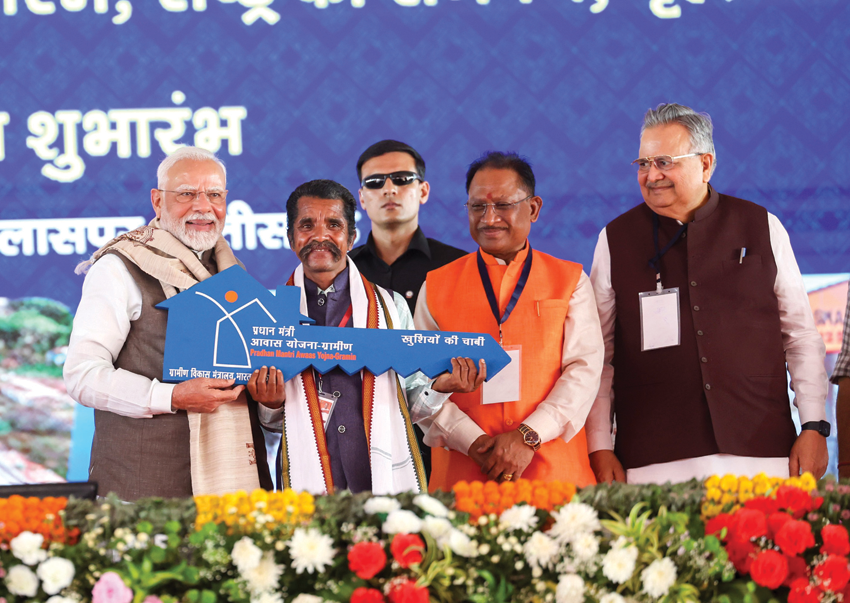
Equally transformative have been initiatives like the Ujjwala Yojana, which gave women relief from smoke-filled kitchens, and the Pradhan Mantri Awas Yojana, which helped lakhs of families own secure homes. By 2024, more than three crore houses had been sanctioned under urban and rural PMAY, providing safe shelter to millions. Rural electrification has ensured that every village in India is connected to the power grid, a milestone reached in 2018.
In education, PM-SHRI and Eklavya Model Schools are raising learning standards, while technology-driven monitoring through Vidya Samiksha Kendras is improving outcomes. The Beti Bachao Beti Padhao initiative has raised awareness on the value of the girl child and improved sex ratio at birth in several states.
The Sukanya Samriddhi Yojana has encouraged savings for the education of girls, while women’s self-help groups under schemes like Lakhpati Didi are promoting entrepreneurship and income generation. These programmes reflect a consistent emphasis on women’s empowerment as a cornerstone of national progress.
Another area of focus has been nutrition. The Poshan Abhiyaan is addressing malnutrition through integrated interventions for mothers and children. Supplementary nutrition, community mobilisation, and technology-enabled monitoring are part of a holistic effort to secure healthier futures.
India’s global stature has risen significantly under Modi. His active participation in forums such as the G20, BRICS, and SCO has positioned India at the centre of discussions on global growth, security, and climate change.
Bilateral ties have expanded in defence, technology, and investment. Partnerships with Japan and Australia have strengthened India’s role in the Indo-Pacific, especially through the Quad grouping, which is advancing cooperation on maritime security, supply chains, and emerging technologies. The International Solar Alliance, launched with France, has positioned India as a leader in renewable energy, drawing the participation of over a hundred countries. During the COVID-19 crisis, Vaccine Maitri supplied vaccines to more than 100 nations, demonstrating India’s role as a trusted partner in global health. Modi’s interventions at UN climate summits and his call for “Lifestyle for Environment” have placed India at the forefront of global climate leadership.
India’s engagement with Africa has expanded through lines of credit, capacity-building programmes, and connectivity projects, making it a partner in the continent’s development journey. Relations with the European Union have deepened in the areas of renewable energy and digital governance.
India’s G20 presidency in 2023 was a high point, as world leaders gathered in New Delhi and acknowledged India’s role as a bridge between the Global North and South. Initiatives on climate finance, digital governance, and sustainable development were widely recognised. Modi’s diaspora outreach has also energised overseas Indians, making them active stakeholders in India’s growth story.
Modi’s leadership has also faced challenges. The economic slowdown during COVID-19 tested India’s resilience. The government’s response—free vaccination, expanded healthcare capacity, and direct transfers—provided relief.
The abrogation of Article 370 in Jammu and Kashmir in 2019 was a historic step which strengthened national unity. The Citizenship Amendment Act reflected deep engagement on citizenship and inclusion.
For nearly four decades, Bastar was synonymous with conflict. LWE insurgency found one of its strongest bases in the tribal areas of Bastar, exploiting dense forests and backwardness to establish control. Villages were cut off from governance, roads were blown up, schools shut down, and healthcare facilities destroyed. Ordinary citizens were left without security or opportunity.
That reality is now being rewritten. Security operations have weakened insurgent strongholds, but what has truly turned the tide is the consistent expansion of welfare. Roads are reaching deep into the interiors, linking markets and enabling farmers to bring their produce out. Schools, hostels, and healthcare facilities are active.
Families are receiving LPG connections under Ujjwala, Ayushman Bharat cards are offering health security, and hostels for tribal students are helping children pursue education. Local markets are now places of trade and not fear. This reflects a deliberate and coordinated approach. The Centre and the State, under Prime Minister Modi’s leadership, have ensured that security and welfare move together. Development fills the space once occupied by violence. For Bastar, this is the beginning of a new era of peace and progress. For India, it is a national success story—demonstrating that democracy, with patience and inclusion, can defeat extremism. With the coordinated efforts of both the Centre and the State, the goal is now to ensure that extremism is permanently defeated and peace becomes irreversible in Bastar — an objective that seemed unimaginable only a decade ago.
For Chhattisgarh, Modi’s leadership has meant rapid progress. The Centre has invested in infrastructure, spanning roads, railways, housing, energy, and education. The state’s rail network is fully electrified, with new projects underway.
Under Pradhan Mantri Awas Yojana, lakhs of homes have been built. Schools, colleges, and hospitals are being constructed in remote districts. Paddy procurement has improved, MSP bonuses have been cleared, and farmers have gained greater confidence in agricultural sustainability.
Women and artisans are receiving support through livelihood schemes, creating new opportunities. The PM Gram Sadak Yojana has connected villages with all-weather roads, while irrigation schemes are improving agricultural productivity. Transparent recruitment processes have restored trust among youth. Corruption control has ensured that resources reach intended beneficiaries.
Under Prime Minister Modi’s leadership, tribal empowerment has moved to the centre of national life, symbolised by the election of India’s first tribal President, Droupadi Murmu—an inspiration for Chhattisgarh, where tribal communities form the heart of society and are shaping its future growth. These efforts show how central and state coordination can accelerate progress in a young state like Chhattisgarh, making it a partner in India’s national growth.
Modi’s vision of a New India emphasises self-reliance, innovation, and cultural pride. The Atmanirbhar Bharat initiative promotes domestic manufacturing, technological progress, and entrepreneurship. The youth are at the centre of this vision. Startups, digital platforms, skilling schemes, and innovations such as UPI payments are creating opportunities for young Indians. India’s emergence as a leading startup hub is a reflection of this policy framework. The government has also articulated the Amrit Kaal roadmap, covering the twenty-five years leading up to 2047. Investments in renewable energy, green hydrogen, semiconductor manufacturing, and artificial intelligence are part of a strategy to place India among the world’s leading economies.
At seventy-five, Modi’s focus is firmly on preparing India for its centenary of independence in 2047. His leadership connects past struggles with future aspirations, offering direction at a crucial juncture in history.
Behind the political leadership is a personal ethic of discipline and reflection. Modi’s early life was shaped by responsibility and struggle. Even today, his routine combines long working hours with yoga and meditation. His interest in literature and poetry reveals a reflective mind, while his spiritual practices ground him in India’s traditions. These qualities give his leadership consistency, resilience, and balance—essential traits in a democracy of India’s size and diversity.
The year 2025 brings together two milestones: Narendra Modi turns seventy-five, and Chhattisgarh celebrates twenty-five years of statehood. This parallel is symbolic. Modi’s journey represents the rise of a leader from modest beginnings to global statesmanship. Chhattisgarh’s journey represents a young state growing into a confident partner of the Union.
For Chhattisgarh, his leadership has meant investments in infrastructure, education, housing, and a decisive decline in the insurgency. For India, it has meant enhanced global standing, expanded social welfare, and renewed national confidence.
As the nation moves towards its centenary of independence in 2047, Modi’s role will be remembered not only for what he achieved but also for the direction he provided. At seventy-five, he stands as both a statesman reflecting on history and a leader guiding India’s future. His life story is an invitation to all Indians to carry forward the task of building a secure, prosperous, and united nation—one ready to step into the next century of independence with confidence and pride.
By Vishnudeo Sai
(The writer is Chief Minister of Chhattisgarh.)














Leave Your Comment