


The BJP-led National Democratic Alliance (NDA), anchored by Chief Minister Nitish Kumar’s JD(U), delivered a historic mandate in the 2025 Bihar Assembly elections, securing an unprecedented 202 seats. This marks the alliance’s second-best performance in the state, falling just four seats short of its 2010 record of 206. In sharp contrast, the Mahagathbandhan, led by Tejashwi Yadav, suffered a humiliating setback, reduced to only 35 seats.
Bihar voted in two phases—November 6 and 11—and the elections witnessed an extraordinary surge in public participation. The Election Commission reported a 65.08 per cent turnout in the first phase and an even higher 69.20 per cent in the second. With an overall turnout of 67.13 per cent, Bihar recorded the highest voter participation in its history. Such enthusiasm at the polling booth contributed significantly to the scale of the mandate.
The NDA’s victory goes beyond the boundaries of state politics. Its impact will be felt in the national political landscape, particularly in shaping the future of coalition arrangements. The Mahagathbandhan’s dismal performance could also influence the trajectory and credibility of the larger Indi Alliance. The Bihar verdict reaffirmed several political realities: Nitish Kumar continues to hold strong sway over the electorate, the Congress remains the weakest link in the Grand Alliance, and the AIMIM is slowly entrenching itself in select pockets. Although exit polls predicted an NDA advantage, the sheer margin—with both BJP and JD(U) registering robust gains—surpassed all expectations.
High Stakes Battle
The stakes in this election were exceptionally high. For Nitish Kumar, the long-time steward of JD(U), the contest doubled as an assessment of his 20-year governance legacy. For RJD leader Tejashwi Yadav, it was a critical generational test—a bid to cement his own political identity. The broader electoral context has traditionally revolved around a bipolar contest between the RJD-Congress-Left alliance and the NDA. However, the 2025 election transformed into a triangular battle with the entry of Prashant Kishor’s Jan Suraaj movement, which attempted to reset Bihar’s political vocabulary but ultimately failed to make a significant mark.
The election was also crucial for the BJP, particularly after the 2024 Lok Sabha mandate left the party dependent on allies like Nitish Kumar and Chandrababu Naidu. Bihar served as the next major battleground after Maharashtra for the BJP to reaffirm its foothold in the Hindi heartland following setbacks in Uttar Pradesh. Strategically, the party views Bihar as a stepping stone to the East, with Prime Minister Modi’s remark “Ganga Bihar se Bengal jaati hai” underscoring an eye on the 2026 West Bengal polls.
Mahila Shakti’s Mandate
One of the most defining features of this election was the unprecedented role of women voters. For the first time in Bihar’s electoral history, women not only outnumbered men at the polling stations but decisively shaped the political outcome. Female voter turnout soared to an impressive 71.6 per cent compared to 62.8 per cent for men, signaling a dramatic shift in a state long governed by caste-driven political mobilisation.
For Nitish Kumar, this surge vindicated two decades of women-centric policymaking. Initiatives such as free bicycles for schoolgirls, prohibition, expanded representation for women in local bodies, police reservations, the Jeevika self-help network, and the recent ₹10,000 cash transfer scheme for nearly 25 lakh women created deep reservoirs of goodwill. Across districts, women voters credited these interventions for tangible improvements in their economic and social lives. The NDA’s narrative of women’s empowerment and “strong daughters of Bihar” resonated naturally with these beneficiaries.
The Mahagathbandhan struggled to match this emotional and developmental connect. Tejashwi Yadav’s last-minute offer of ₹30,000 per year in women’s accounts failed to gain traction, especially since the NDA’s benefits had already been disbursed well before polling. Once again, the alliance appeared reactive rather than visionary.
Few elections in the state have been influenced so profoundly by women voters. Their overwhelming turnout did not merely contribute to the process—they reshaped Bihar’s political geography. In many ways, the 2025 verdict is as much a mandate for the NDA as it is a testament to the rising political agency of women in Bihar.
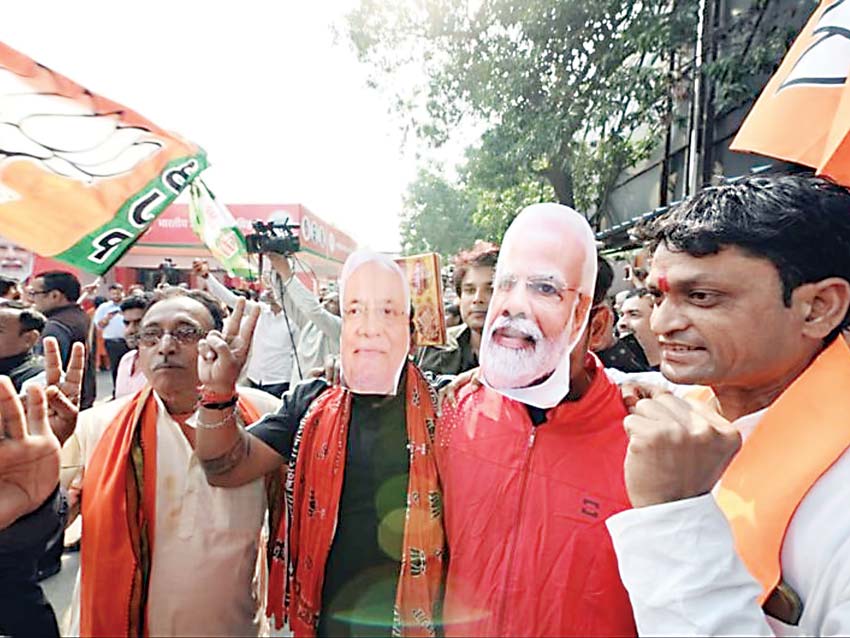
How the NDA Engineered a Historic Landslide
The massive electoral triumph of the BJP-led National Democratic Alliance (NDA) in the Bihar Assembly elections marks one of the most decisive political mandates the state has witnessed in recent years. Winning 202 of 243 seats, the alliance not only consolidated its dominance but also demonstrated how a well-crafted mix of governance narrative, caste arithmetic, welfare delivery, and coalition management can create a near-unbeatable electoral force. The sweep was not a sudden wave but the result of a meticulously calibrated campaign designed to cut across the state’s most complex social and political fault lines.
A major pillar of the NDA’s victory was its ability to stitch together a broad and inclusive caste coalition. Bihar’s caste matrix is deeply layered, but the NDA succeeded in unifying upper castes, EBCs, OBCs, Dalits and Mahadalits under its umbrella. The BJP held its traditional fort among forward castes while expanding its appeal among youth and first-time voters. Nitish Kumar’s JD(U), despite criticisms about his political longevity, remained a magnet for Kurmis and EBCs, a sizeable demographic whose consistent support becomes decisive in tight contests. Smaller allies like LJP (Ram Vilas) and HAM added further depth among Dalit communities. This rainbow coalition eroded the once-formidable MY (Muslim-Yadav) base of the RJD, diluting its relevance beyond a few pockets. The opposition’s overreliance on identity politics gave the NDA the space it needed to portray itself as a more inclusive and future-oriented platform.
The NDA also succeeded in reviving and reinforcing the “Jungle Raj” narrative, reminding voters of the lawlessness and fear associated with Bihar’s 1990s political era under Lalu Prasad Yadav. The campaign skillfully positioned the RJD’s return as a potential return to instability, contrasting it with the NDA’s pitch of governance, development and rule of law. For many voters, especially in semi-urban and rural belts, this comparison struck an emotional chord. It helped convert apprehension into a pro-NDA sentiment, particularly among communities who felt vulnerable during earlier periods of disorder. The fear of sliding backwards—combined with the desire for predictable governance—gave the NDA an ideological edge that the opposition failed to counter convincingly.
Another turning point in the election was the unprecedented mobilisation of women voters. Female turnout surpassed male turnout in several districts, aided by targeted outreach by the Election Commission and the NDA’s sustained narrative of empowering women through welfare schemes. Initiatives such as cash transfers, subsidised utilities, and rural livelihood programs touched households directly, and women emerged as key beneficiaries. In a state where male migration is high and women often run households single-handedly, schemes promising financial security and social dignity created a powerful emotional and material connect. For many women, voting for the NDA was not just political preference but an endorsement of a governance model that they felt had tangibly improved their lives. The combination of the “Mahila” and “EBC” vote—referred to by BJP strategists as the “ME factor”—proved to be the decisive edge in turning the mandate into a landslide.
Despite concerns that Nitish Kumar’s image had dimmed due to frequent political shifts and age-related criticisms, he remained a stabilising force in the coalition. His governance record in social indicators such as education, health, roads and rural infrastructure continued to resonate strongly among voters who associate him with Bihar’s transformation from the turmoil of the past. Moreover, the seat-sharing arrangement between the BJP and JD(U) was handled with rare precision, avoiding the internal friction that often plagues alliances. Both parties campaigned cohesively, projecting unity and complementing each other’s strengths rather than competing for the same vote blocs. This organisational discipline reflected maturity and ensured that the NDA cadre functioned seamlessly at the booth level.
Electoral management also played a key role. Learning from the 2020 elections, where a fragmented NDA had struggled in some regions, the alliance invested heavily in booth-level mobilisation, micro-messaging, and targeted outreach. The BJP’s digital campaign machinery, combined with JD(U)’s grassroots presence, created an effective ground network capable of translating narrative into votes. The opposition, in contrast, appeared disjointed. Tejashwi Yadav’s RJD did attempt to broaden its appeal by focusing on unemployment and economic issues, but the message lacked depth and consistency. The Congress performed poorly, mired in internal conflict and organisational weakness, making the Mahagathbandhan look more like an uneasy coalition than a credible alternative.
Welfare politics played a significant supporting role in shaping perceptions. While critics questioned the timing of schemes like the ₹10,000 cash transfer for women announced before the polls, the impact on the ground was undeniable. For voters who rarely see direct financial benefits, the move symbolised responsive governance, even if it raised eyebrows among opponents. To many households, particularly among the poorest, these transfers represented immediate relief in a difficult economic climate. The NDA's broader messaging positioned welfare as empowerment rather than entitlement, allowing voters to connect the benefits they received with a larger governance vision.
Ultimately, the NDA’s landslide victory in Bihar is a product of narrative control, social engineering, and impeccable execution. The opposition’s failure to present a compelling leadership face, a unified ideological plank, or a trustworthy governance alternative only widened the NDA’s margin. For the BJP, the win strengthens its grip over the Hindi heartland, proving that a mix of welfare, nationalism, caste realignment and governance talk can produce formidable results. For the JD(U), it reaffirms that Nitish Kumar—despite political fatigue—is still indispensable in Bihar’s electoral landscape.
This mandate illustrates a defining political truth: in a state as socially diverse and politically fragmented as Bihar, electoral success belongs to those who can combine stability with aspiration, welfare with governance credibility, and caste alliances with a forward-looking narrative. The NDA did this with precision, and the results reflect a decisive endorsement of its political strategy and its promise for Bihar’s future.
Why Mahagathbandhan Collapsed
The crushing defeat of the Mahagathbandhan in the Bihar Assembly elections stands as a textbook case of political miscalculation, organisational disarray, and leadership paralysis. While the NDA’s strategy was sharp and disciplined, the opposition’s structure was fragile from the outset. The alliance—led nominally by Tejashwi Yadav but heavily influenced by the Congress high command—crumbled under the weight of its own contradictions, internal rifts, and a complete failure to read the evolving aspirations of Bihar’s electorate. At the centre of this collapse was Rahul Gandhi, whose lack of seriousness, poor campaign timing, and repeated missteps made him the single biggest liability for the opposition alliance.
The Mahagathbandhan’s first major flaw was its inability to project a united and coherent leadership. Tejashwi Yadav, though energetic and articulate on issues like unemployment, was constrained by the overwhelming baggage of the RJD’s legacy. The constant reminder of “Jungle Raj” created a psychological barrier for many voters, preventing them from seeing him as a credible chief ministerial alternative. Instead of helping him overcome this image problem, the Congress—especially Rahul Gandhi—added another layer of instability. Rahul’s erratic presence, lack of message consistency, and poor articulation of Bihar’s issues made the coalition appear disjointed rather than strengthened. Instead of amplifying Tejashwi’s campaign, his involvement diluted it.
Rahul Gandhi’s role in the Mahagathbandhan’s defeat was particularly significant because it showcased the Congress’s inability to evolve with the political realities of 2025. Rahul failed to present himself as a serious campaigner. His rallies were limited, poorly timed, and lacked connection with local voters. His messaging remained tainted by national narratives that had little resonance in Bihar’s socio-political context. Worse, his vacation to Pachmarhi in the middle of the campaign was seen by voters as unforgivable negligence—confirming long-standing perceptions about his disinterest in electoral politics. When the leader of a major alliance partner appears absent and indifferent, it affects morale on the ground. Congress cadres were demotivated, and alliance workers questioned whether the party was even invested in winning.
Seat-distribution disagreements prior to the elections also weakened the coalition long before the polling began. The Congress demanded more seats than its organisational strength justified, leaving several constituencies contested by weak candidates. This overreach created fissures within the alliance, with RJD leaders privately expressing frustration at being forced to accommodate an ally that contributed little but demanded much. Once campaigning began, Congress candidates struggled without a support system, lacking both resources and grassroots networks. Many constituencies were effectively surrendered to the NDA even before voting began simply because the Congress failed to run an effective ground game.
Tejashwi Yadav’s campaign, despite moments of energy, was riddled with structural weaknesses. His strategy relied heavily on unemployment as a central theme, but the messaging was repetitive and failed to evolve. Voters were looking for a roadmap, not just criticism. The BJP and JD(U) successfully countered by reminding people of past instability and projecting themselves as protectors of governance and social order. In contrast, the Mahagathbandhan did not offer a convincing alternative governance model. Tejashwi’s manifesto promised government jobs in large numbers, but the lack of clear financial planning made the promises appear unrealistic.
What further crippled the opposition was its failure to match the NDA’s narrative on law and order, social welfare, and women’s empowerment. The NDA successfully mobilised women, EBCs, and Dalits with tangible benefits and a clear message of stability. The Mahagathbandhan underestimated the political agency of these groups, relying on caste arithmetic rather than addressing everyday socio-economic concerns. By the time they attempted last-minute course corrections, the NDA had already entrenched its messaging deeply among beneficiaries of government schemes.
Moreover, the Congress’s internal dysfunction became a public spectacle. Senior leaders gave disconnected statements, contradictory positions were taken on caste census and reservation policies, and no concerted effort was made to build a coherent ideological narrative. Rahul Gandhi’s speeches often appeared detached from Bihar’s realities, and his repeated attacks on institutions like the Election Commission backfired, making the alliance look like it was preparing excuses rather than presenting confidence. His presence at joint rallies did not add weight; instead, it overshadowed Tejashwi Yadav’s local appeal and reinforced the perception that the alliance lacked a stable centre of gravity.
The Mahagathbandhan also underestimated the scale of the NDA’s social engineering. While the opposition focused on traditional caste blocs, the NDA expanded its base through strategic outreach to women and economically backward communities. The opposition’s reliance on MY consolidation proved ineffective against a far larger and more diverse coalition that the NDA had stitched together. Congress’s inability to win back upper-caste or urban voters further shrank the alliance’s reach.
Ultimately, the Mahagathbandhan’s defeat was not caused by one factor alone—it was the result of a chain reaction of failures. But at the heart of this chain was the Congress leadership crisis, embodied in Rahul Gandhi’s lack of commitment and strategic clarity. His inconsistent presence, inadequate campaigning, and poor organisational oversight undermined the alliance’s credibility at a critical moment. Tejashwi Yadav, already burdened with his party’s historical baggage, could not compensate for the vacuum created by his national partner.
The Bihar verdict illustrates a harsh political reality— alliances cannot succeed when one partner behaves like a spectator. Rahul Gandhi’s leadership vacuum left the Mahagathbandhan rudderless, disorganised, and unable to counter a well-prepared NDA. In the end, while many factors contributed to the collapse, Rahul Gandhi emerged as the foremost reason for the rout—a reminder that leadership, or the lack of it, can make or break an electoral coalition.

By Nilabh Krishna
(The content of this article reflects the views of writer and contributor, not necessarily those of the publisher and editor. All disputes are subject to the exclusive jurisdiction of competent courts and forums in Delhi/New Delhi only)














Leave Your Comment