


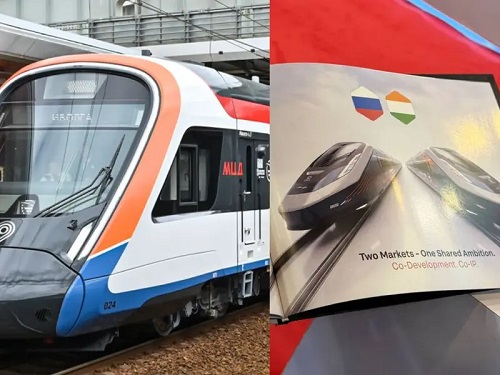
India’s high-speed rail ambitions could get a new technological partner as Russia has proposed its Ivolga FG train for the Indian market, offering joint development and manufacturing of the high-speed train within the country. The proposal, unveiled on the sidelines of the 18th BRICS Summit in New Delhi, comes at a time when India is expanding its railway modernisation programme and exploring advanced technologies to build faster, safer and more efficient rail connectivity.
Russian rolling stock major Transmashholding (TMH) has put forward the Ivolga FG concept as a potential solution for India’s future high-speed railway network. The proposed train has a design speed of 360 kmph, placing it in a category significantly above conventional semi-high-speed services currently operating on Indian tracks.
The Russian company has also proposed cooperation with India in research, development and manufacturing of high-speed railway technologies. The idea is to combine Russian engineering capabilities and scientific expertise with India’s manufacturing ecosystem, potentially allowing advanced trains to be developed and produced domestically rather than simply imported.
The proposal builds on an existing relationship between TMH and Indian Railways. TMH is already associated with India through Kinet Railway Solutions, a joint venture involving TMH and Rail Vikas Nigam Limited (RVNL).
The partnership is engaged in the manufacture and maintenance of Vande Bharat sleeper trains, underlining the growing role of international technology partnerships in India's railway transformation.
Under the project, 120 Vande Bharat sleeper trainsets, each consisting of 16 coaches, are to be manufactured at the Marathwada Rail Coach Factory in Latur, Maharashtra. The experience gained through this programme could provide a foundation for deeper cooperation in advanced railway technologies.
For Russia, the Ivolga FG proposal therefore represents more than a standalone train offer. It could become part of a broader strategy to establish itself as a technology and manufacturing partner in India's rapidly developing rail sector.
The Ivolga is a family of modern electric multiple-unit trains developed by TMH at its Tver Carriage Works in Russia. Unlike the proposed Ivolga FG high-speed concept, conventional Ivolga variants have primarily been designed for high-capacity commuter and urban passenger operations.
The trains are particularly associated with Moscow's Moscow Central Diameters (MCD) network, where rapid passenger turnover and high-frequency services are critical.
The Ivolga family has evolved through several generations, from Ivolga 1.0 to the newer Ivolga 4.0. The latest versions have introduced features aimed at reducing station dwell times. Among them are three doors on each intermediate coach, which TMH says can improve passenger boarding and alighting speeds by as much as 30 per cent.
Production versions of the Ivolga family generally operate at speeds ranging from around 120 kmph to 160 kmph, with rapid acceleration and short turnaround times at terminal stations.
The trains are equipped with features designed for modern commuter travel, including wide 1,400-mm doorways, open gangways between coaches, climate control, smart adaptive lighting and USB charging facilities. Dedicated areas for bicycles, scooters and passengers with reduced mobility are also incorporated into newer versions.
Another notable feature is the high level of domestic content in the latest Russian versions, with newer generations reportedly using more than 90 per cent and, in some configurations, up to 97 per cent Russian-sourced components.
India has one of the world's largest railway networks and is undertaking an ambitious transition towards faster passenger services. The success of the Vande Bharat programme has demonstrated the country's growing ability to design and manufacture modern passenger trains domestically.
At the same time, India's high-speed railway plans require sophisticated technologies involving aerodynamics, propulsion, signalling, braking, track systems and passenger safety.
The proposed Ivolga FG, with its stated 360-kmph design speed, could therefore offer an opportunity for cooperation beyond the conventional manufacture of railway coaches. If the proposal progresses, joint research and development could potentially help India acquire additional expertise in high-speed train engineering while retaining an emphasis on domestic production.
However, bringing a 360-kmph train into regular service would require infrastructure capable of supporting such speeds. High-speed trains cannot simply operate at their maximum design speed on existing conventional railway lines. Dedicated tracks, advanced signalling, high-standard maintenance systems, safety mechanisms and appropriate station infrastructure would all be essential.



















Leave Your Comment