


The year- 2025 will always be remembered as the year when India’s geopolitical aspirations transformed from a powerful regional player into a global superpower. While the nation tested new age weapons giving the Indian military significant edge over regional rivals, Operation Sindoor also proved to be a gamechanger which set a new normal for cross-border military action against Islamic terrorism. The year also witnessed large scale joint exercises between Indian forces and foreign military, which led to significant gain of tactical battlefield experience for future ambitious campaigns. The US President Donald Trump’s stunning declaration towards resuming live nuclear tests after a gap of 33 years and China’s suspicious preparations at its Lop Nur nuclear testing site have also spurred a debate whether India should tread a similar path. A plethora of structural reforms in the Indian military also led towards the raising of new battlefield units and improving tri-services synergy. All this happened under the visionary and dynamic leadership of global statesman- Prime Minister Narendra Modi and Defence Minister Rajnath Singh. Following is a brief overview of major events during the year which set a new benchmark for India’s big power aspirations.
Operation Sindoor
After the Pahalgam massacre, in the wee hours of May 7, 2025, India started an ambitious military campaign under the leadership of Prime Minister Narendra Modi and Defence Minister Rajnath Singh. The Indian Air Force with the help of Dassault Rafale fighter jets armed with Scalp missiles and Hammer bombs launched airstrikes on nine targets consisting of terrorist training camps, Islamic seminaries and madrasas located deep inside Pakistan and PoK (Pakistan Occupied Kashmir) leading to the death of more than 100 Islamic jihadi terrorists (possibly around 170). The military campaign christened as Operation Sindoor also witnessed the Indian military launching kamikaze drone strikes and cruise missile strikes on Pakistan’s air defence units using Israeli made IAI Harop loitering munitions and Indo-Russian BrahMos supersonic cruise missiles from Sukhoi-30 combat aircrafts the next day, after Pakistan escalated the conflict by launching missiles and Turkish drones targeting civilian areas in Jammu and Punjab. Hostilities reached a temporary pause on May 10, 2025 after a US-backed ceasefire proposal was sent by the Pakistani DGMO (Director General of Military Operations) to the Indian DGMO and it was accepted by New Delhi.
But by the time the ceasefire came into effect (5PM IST on May 10,2025), India had already extracted a heavy price from Pakistan by destroying at least 20 percent of the Islamic nation’s air defence assets and badly crippling its offensive aerial capabilities. The damage done to Pakistani military infrastructure was tremendous and the terrorist state was literally left exposed naked under the glare of international surveillance and reconnaissance satellites, leaving everyone to see and verify the evidences themselves. Unlike the 2019 Balakot airstrikes, this time the Pakistanis had nothing to hide, including their widespread global embarrassment. India became the first and the only country in the world to destroy the airbases and runways of a nuclear armed nation. The devastating blows faced by the Pakistani military during Operation Sindoor will give sleepless nights to 257 million Pakistanis and their degenerate Islamic fanatic leadership for many generations to come. Meanwhile it is officially stated by the union government that Operation Sindoor is just undergoing a temporary pause, and that any further provocation by Pakistan will attract a far more forceful and destructive Indian military response. The recent Faridabad-module and Gujarat-module related terrorist incidents (Delhi blast, Nowgam police station explosion, and Gujarat ricin terror plot) has also set the ball rolling towards resumption of Operation Sindoor at any moment.
Joint military exercises
In 2025, the Indian military has engaged itself in a series of intensive bilateral and multilateral exercises with foreign partners, underscoring New Delhi's proactive and calibrated defence diplomacy. These exercises, ranging from high-altitude combat in Alaska to carrier-based naval drills in the Arabian Sea, served a dual purpose: enhancing the operational readiness and interoperability of Indian armed forces while simultaneously delivering potent strategic signals to regional and global actors. The sheer frequency, scale, and geographic spread of these drills point to India's growing confidence as a net security provider in the Indo-Pacific region and its robust alignment with like-minded nations to address complex geopolitical challenges.
Following are some large-scale joint exercises carried out by the Indian armed forces.
Exercise Yudh Abhyas 2025 (India-USA)
When and where: September 1-14, 2025, in Fort Wainwright and the Yukon Training Area, Alaska, USA.
Focus: High-altitude, cold-weather warfare, command post exercises, live-fire drills, and integrated medical support in extreme climates.
Key participants: A battalion of the Indian Army's Madras Regiment and soldiers of the US Army's 11th Airborne Division.
Strategic Implications:
• Operational readiness in the Himalayas: The primary implication of training in sub-arctic Alaska is the direct applicability of cold-weather and high-altitude warfare tactics to India's northern borders, particularly along the Line of Actual Control (LAC) with China. Indian troops gained invaluable experience from their US counterparts, who are seasoned in Arctic operations, enhancing their capability to operate in challenging mountainous terrain.
• Deepening bilateral trust: Now in its 21st edition, Yudh Abhyas evolved from a basic peacekeeping drill to a complex, brigade-level integrated operation, signifying a mature and robust "Comprehensive Global Strategic Partnership" between the two nations.
• Strategic signalling to Beijing: Conducting such an advanced exercise with the US in extreme conditions sent a clear and unambiguous signal to China regarding the depth of India-US military cooperation and a shared resolve to deter aggression across shared areas of concern.
Exercise Konkan 2025 (India-UK):
When and where: October 5-12, 2025, off the Western Coast of India.
Focus: Complex maritime operational drills including anti-air, anti-surface, and anti-submarine warfare (ASW), flying operations, and carrier strike integration.
Key participants: The Indian Navy's indigenous aircraft carrier battle group (led by INS Vikrant) and the UK Carrier Strike Group (UK CSG 25), led by the aircraft carrier HMS Prince of Wales, also including assets from Norway and Japan.
Strategic implications:
• Blue-Water capability and joint carrier operations: The highlight of Konkan-2025 was the integration of two carrier battle groups (CBGs). This is a significant step, placing both navies in an exclusive club of blue-water, multi-carrier navies and showcasing a shared capacity for large-scale power projection across the Indian Ocean Region (IOR).
• India-UK Vision 2035: The exercise directly supported the 'India-UK Vision 2035' strategic partnership, aiming to consolidate strategic ties and enhance interoperability for regional maritime stability.
• Presence in the IOR: The UK CSG's deployment with the Indian Navy demonstrated shared commitment to ensuring secure, open, and free seas, a critical objective given the increasing military footprint of other powers in the IOR (Indian Ocean Region).
Exercise AustraHind 2025 (India-Australia)
When and Where: October 2025, at Irwin Barracks, Australia.
Focus: Joint company-level operations in open and semi-desert terrain, including tactical drills, special army skills, and counter-IED training.
Strategic implications:
• Quad Cohesion (land domain): As a key member of the Quadrilateral Security Dialogue (Quad), this annual exercise with Australia strengthened the land-based interoperability that complements the primary naval focus of the Malabar exercises (which will occur later in the year).
• Shared regional security: The exchange of tactics and procedures solidified the bilateral defence relationship and contributes to a collective regional security architecture in the Indo-Pacific.
Multilateral engagements
India's participation in large-scale multilateral exercises highlights its strategic autonomy and ability to engage with diverse global partners, even those with competing geopolitical interests. Following are some recent multilateral exercises in which the Indian military participated.
Exercise Bright Star 2025 (hosted by Egypt)
When and where: August 28 - September 10, 2025, in Egypt.
Focus: Tri-Service command post exercises, live firing, and coalition integration in desert conditions.
Key participants: Over 700 Indian personnel participated alongside forces from Egypt, the USA, and numerous other nations.
Strategic Implications:
• Bridging IOR and West Asia: This exercise reinforced India's growing military diplomacy and its influence beyond the immediate Indo-Pacific, engaging with key West Asian and African partners.
• Coalition warfare experience: The large-scale, multi-national nature of "Bright Star" provides vital experience in command-and-control procedures for potential coalition operations, whether for peacekeeping or combat scenarios.
Exercise ZAPAD 2025 (hosted by Russia)
When and where: September 10-16, 2025, at the Mulino Training Ground, Nizhniy, Russia.
Focus: Conventional warfare tactics, counter-terrorism operations, and large-formation manoeuvres in plain terrain.
Key participants: A 65-member Indian tri-service contingent participated.
Strategic Implications:
• Maintaining strategic autonomy: Participation in ZAPAD 2025 while simultaneously deepening ties with Western nations (US, UK, Australia) is a textbook example of India's policy of strategic autonomy. It balances historical defence ties with Russia against new alignments.
• Defence relationship diversification: This engagement ensures that channels of cooperation with Russia, a major defence equipment supplier, remain active despite the current geopolitical climate, while offering valuable insights into different operational doctrines.
Regional synergy
India continues to prioritise defence cooperation with its immediate neighbours, focusing on maritime domain awareness and counter-insurgency operations. Following are some significant joint exercises executed by the Indian military in this domain.
Exercise Samudra Shakti-V 2025 (India-Indonesia)
When and where: October 15-17, 2025, in Visakhapatnam.
Focus: Maritime cooperation, anti-submarine warfare basics, weapon firing, and Visit Board Search and Seizure (VBSS) exercises.
Strategic implications:
• Securing maritime chokepoints: Working with Indonesia, which controls key maritime chokepoints like the Malacca Strait, is vital for India's maritime security interests and a shared commitment to freedom of navigation in the Indo-Pacific.
• ASEAN engagement: This exercise strengthens India's 'Act East' policy and engagement with ASEAN nations, building tactical coordination for collective security.
Exercise SLINEX 2025 (India-Sri Lanka)
A key annual engagement, the primary 2025 exercise likely occurred in August, aligning with India's ongoing "Neighbourhood First" policy to ensure maritime security and cooperation with Sri Lanka.
Domestic tri-service integration
Crucially, the last three months also featured significant internal exercises that validate India's readiness to apply lessons learned from international drills into its own operational theatres.
Exercise Trishul 2025
When and where: Kicked off in late October 2025 along the western border (Gujarat/Rajasthan).
Focus: A large-scale, coordinated tri-service operation involving land, air, and maritime forces with both offensive and defensive simulations, including amphibious landings and extensive IAF sorties (Rafale, Su-30 MKI).
Strategic implications:
• Deterrence posture: This massive display of integrated firepower and joint command is a powerful message to immediate neighbours on the western front, demonstrating high readiness and the ability to prevent and respond to aggression based on lessons from recent global conflicts.
• Validation of jointness: Trishul validates India's integrated theatre command structure and the seamless coordination between the army, navy, and air force, a cornerstone of modern warfare readiness.
The learning curve
The recent exercises of 2025 reveal an Indian military strategy that is agile, multi-aligned, and increasingly sophisticated. The joint exercises with Western partners like the US, UK, and Australia are enhancing high-end warfighting capabilities and interoperability within a shared vision of an open Indo-Pacific. Simultaneously, India’s participation in exercises like ZAPAD 2025 and targeted regional drills with Indonesia and Sri Lanka demonstrate India's commitment to strategic autonomy and regional stability. This multifaceted approach is not merely about tactical training; it is a powerful form of defence diplomacy, projecting India's capabilities and resolve while actively shaping the geopolitical contours of the 21st century security environment.
Boosting nuclear deterrence
As per the report of SIPRI (Stockholm Peace Research Institute) released on June 16, 2025, India has a total stockpile of 180 nuclear warheads, which is a slight increase from the 172 nuclear weapons possessed by the country in 2024. As of 2025, Pakistan has a stockpile of 170 nuclear warheads without any increase from its 2024 levels. Hence, India now has more nuclear weapons than Pakistan. But taking into consideration China’s growing stockpile of nuclear weapons (600 warheads), and India’s recent development of MIRV (Multiple Independent Re-entry Vehicles)-enabled long-range ballistic missiles, India still needs to go the extra mile in nuclear weapons production. US President Donald Trump’s recent declaration towards resumption of live nuclear testing after a gap of more than three decades and China’s secret nuclear testing preparations at its Lop Nur site has also instilled new rays of hope for a potential Indian nuclear testing programme with an overwhelming number of strategic policymakers (including veteran national security experts Bharat Karnad) wholeheartedly supporting the idea of future Indian nuclear weapon tests involving enormously powerful doubled-staged thermonuclear Hydrogen bombs. Meanwhile, India’s first exascale-level supercomputer- Param Shankh, which is capable of simulating nuclear weapon tests, still remains under development as of January 2, 2026.
Missile tests by India
The year- 2025 witnessed some game changing Indian missile tests which proved to be a significant force multiplier for the nation. The following is a brief of strategic and tactical-level missile tests conducted by India during the year.
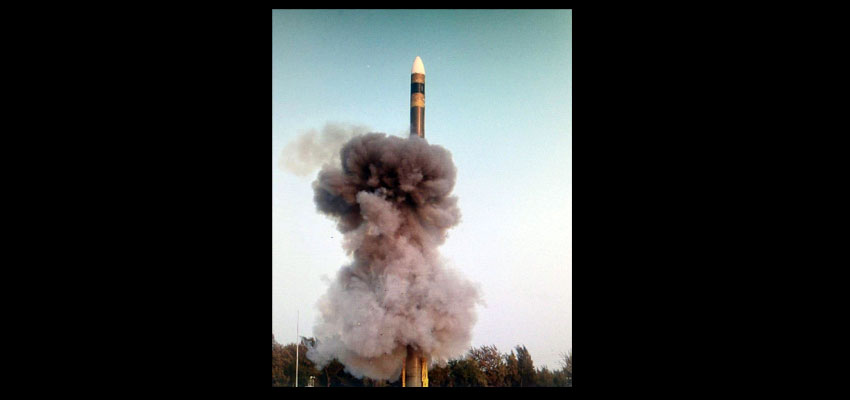
Agni-V ICBM (Intercontinental-range Ballistic Missile): On August 20, 2025, India successfully test-fired the Agni-V ICBM from the Integrated Test Range in Chandipur, Odisha. The test validated all operational and technical parameters under the Strategic Forces Command. The missile has a range of over 7000 km with a 1.5 tonne payload capacity and features a three-stage solid-fuel engine. With this test, the focus has now shifted towards the much-awaited launch of Agni-VI ICBM in 2026.
K-4 SLBM (Submarine-Launched Ballistic Missile): On December 23, 2025, India successfully tested the nuclear-capable K-4 submarine-launched ballistic missile from the nuclear-powered submarine- INS Arighaat off the coast of Visakhapatnam. Having a range of 3500 km and payload capacity of 2-tonnes, it provides a critical second-strike capability for India’s nuclear triad. The test also opened up the possibility of India testing the much-awaited K-5 and K-6 missiles with much more higher ranges and enhanced payload capabilities in the new year- 2026.
Agni-Prime ballistic missile: India conducted a successful test of the Agni-Prime around October 13, 2025, using a new rail-based mobile launcher. This canister-launched missile has a range of 2000 km and can potentially be used as an anti-ship ballistic missile (ASBM).
Pralay missile: DRDO completed two successful flight tests of this surface-to-surface tactical missile in July 2025.
MRSAM: The DRDO and Indian Army conducted four successful flight tests of the Medium-Range Surface-to-Air Missile system in April 2025 from Dr. APJ Abdul Kalam Island.
Integrated Air Defence (IADWS): The first flight test of this advanced system, combining QRSAM (Quick-Reaction Surface to Air Missile) and VSHORADS (Very Short-Range Air Defence System), along with new laser weapons, was conducted on August 23, 2025.
Navdurga missile testing range: In May 2025, the foundation stone was laid for a new test range at Nagayalanka, Andhra Pradesh, specifically to test India’s Phase-2 Ballistic Missile Defence (BMD) interceptors designed for tackling threats from enemy missiles having a range of up to 5000 km.
Boosting underwater deterrence.
The year- 2025 also saw the commissioning of INS Vagsheer- the last diesel-electric attack submarine of Kalvari-class. Moreover, India’s third Arihant-class nuclear submarine- INS Aridhaman completed final sea trials during the year and the vessel may soon be commissioned into the Indian Navy. The fourth Arihant-class submarine was also launched into the sea for trials.
Structural reforms
Year of tech absorption: The Indian armed forces transitioned from just adopting technology to full integration. This included the induction of roughly 3000 remotely piloted aircraft (RPAs), swarm drones, and kamikaze drones.
New battlefield units: The Indian Army operationalised Bhairav Battalions (light commando) and Ashni Drone Platoons to enhance ISR (Intelligence, Surveillance, Reconnaissance) and precision strike capabilities.
Theaterisation: Landmark structural reforms focused on establishing Integrated Theatre Commands to improve tri-service synergy.
Indigenous production: India’s ammunition indigenisation reached 91 percent. Total defence production hit a record Rs. 1.54 lakh crore, while Indian exports grew to Rs. 24,000 crore. The nation’s military industrial complex underwent a significant transformation with many of the factories in Uttar Pradesh and Tamil Nadu defence industrial corridors fully functional.

By AMARTYA SINHA
(The content of this article reflects the views of writer and contributor, not necessarily those of the publisher and editor. All disputes are subject to the exclusive jurisdiction of competent courts and forums in Delhi/New Delhi only)














Leave Your Comment