


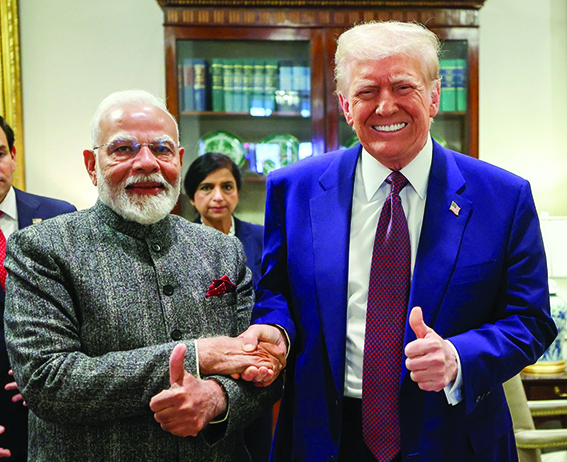
After nearly a year of seesaw negotiations, India and US have finally arrived at an interim framework for a trade agreement that is expected to be formalized by March this year. While the deal has sharply brought down tariffs from a prohibitive 50% to 18% for India, the US has gained increased but selective access to Indian markets, as also a commitment from the Indian side to purchase worth $500 billion of US goods in the coming years. Although a brief Joint Statement has been put out, in the absence of a concrete pact, the finer details with respect to individual tariff lines and schedules have been unavailable. As such, a section of the commentariat has sought to downplay the importance of the deal with some even terming it as a unilateral arrangement thrust on India by a rampaging Trump administration, and being potentially inimical to Indian farmers and other domestic producers.
However, even without a final agreement, the framework deal counts for many reasons, not least of all, for the broader and long-term India-US strategic relationship.
Keeping the big picture in mind with strategic patience
First, the deal has steadied and reset one of the most critical bilateral relationships relevant to global order today, somewhat gone astray owing to the overly hard-headed negotiating and pressure tactics of the Trump administration on the trade deal. Despite periodic rhetoric from elements in Trump’s team, the Indian side maintained its composure and didn’t fall for the bait. In other words, the Indian trade and foreign policy establishment didn’t lose sight of the big picture. The US is a $30 trillion market and remains a leader in terms of several high technology-intensive sectors including defence, energy, environment, AI, semi-conductors and quantum computing, to name a few. Noone can forget how China has made its storied transformation into an economic and trading powerhouse exporting to the US and Europe. Knowing fully well that strategic patience pays off in the long run, India did not get mired in any direct confrontation with anyone from Trump administration, nor was dispirited by the high tariffs of 50 percent. Maintaining its strategic autonomy even in the face of 50% tariffs, it refused to back down on Trump’s exhortations to cease purchasing of Russian oil. India has maintained all along that its energy purchase decisions from Russia are guided purely by cost considerations and a discounted Russian oil was in its balance of payment account interests. Simultaneously, it had continued to explore alternative preferential agreements with other trading nations and entities – finalizing trade agreements with the UK, Oman, New Zealand, and the most recent ‘the mother of all deals’ with the EU. Incidentally, an agreement signed in March 2024 with another European economic bloc, EFTA (comprising Iceland, Norway, Liechtenstein and Switzerland), came into force in October 2025.
Need for a pivot in a disruptive Trumpian world of trade
Second, the argument that the 18% tariffs were way too high as compared to the average 2-3% in the pre-Trump tariff times is plainly overlooking the obvious. With a disruptive US President at the helm resolved to rewrite the global trade rules, the practice of low tariffs, granting of Most Favoured Nation (MFN) status, and extending of Special and Differential Treatment (SDT) to partner trading nations is gradually losing currency. As global institutions such as WTO recede in the background and bilateral or multilateral preferential trade agreements increasingly become the order of the day, India needed to suitably pivot for its own sake. So, rather than choosing to be left outside the US market, India has agreed to come to an understanding with the US affording itself unprecedented market access as well as other benefits à la if you can’t beat ‘em, join ‘em. Apart from the fact that high tariffs as compared to earlier have been levied on all countries including some of the closest US allies, India’s 18% is still lower in comparison to nearly all its peer competitor exporting countries in South Asia and Southeast Asia including Bangladesh, Sri Lanka, Vietnam and China, among others. This has allowed a clear competitive edge to Indian exporters in the vast US market in products in which they have a comparative advantage. Comparative advantage for a country in a given product is not only relative to others but also a function of time. So, if US tariffs for India have gone up now, so have they for others. For critics who view the difference in tariff percentage relative to neighbouring competitors as marginal, the small numbers could very well translate into tens of thousands of dollars of savings or even more for Indian exporters. Effectively, of the total of $86 billion worth Indian exports to the US, there has been a reduction from 50% to 18% on USD 30.94 billion of these exports, and from 50% to zero on another USD 10.03 billion.
Sensitive agriculture and allied sectors remain protected
Third, the criticism that India has succumbed to Trump’s pressure allowing zero tariffs on US’s exports in exchange for 18% on its own products including opening up of sensitive agricultural, dairy and fisheries sectors suggests a lack of nuanced understanding of the dynamics of this deal. The government has repeatedly reaffirmed its continued protection of these sensitive sectors critical for employment as well as food security in the country. In fact, the commerce minister has listed out names of specific agricultural commodities including maize, wheat, rice, soya, poultry, milk, cheese, ethanol (fuel), tobacco, certain vegetables and meat, all of which have been completely safeguarded from any opening up. Further in India’s favour, a range of agricultural products including tea, spices, coffee, coconut oil, vegetable wax, areca nuts, chestnuts, avocado, guava, mango, kiwi, papaya, pineapple, mushrooms, vegetable roots, barley, bakery products, cocoa products, sesame seeds, and poppy – would be allowed entry into the US market at zero additional tariffs. In fact, in deference to Indian sensitivities, the joint statement makes no mention of the dairy sector at all. For India’s part, the Joint Statement has cited its commitment to eliminate or reduce tariffs on specific agricultural items such as dried distillers’ grains (DDGs), red sorghum for animal feed, tree nuts, fresh and processed fruit, soybean oil, wine and spirits. For most of these products, India is either a relatively modest producer, or is already an importer. Yet, India not only enjoys an agricultural trade surplus with the US, at nearly $4 billion, it has consistently been a net exporter of agriculture globally for many years. However, as agricultural trade surplus has tended to increasingly come down over this decade – a sharp decline from $27.7 billion in 2013-14 to $14.91 billion by 2024-25 – a renewed push for reforming agriculture becomes imperative. Protection is a double-edged sword. Until now, while it has ensured security of livelihoods and price stability, it has also impeded productivity, efficiency and India’s global competitiveness in agriculture and allied sectors in the long run. From a trade economist’s lens, it has also narrowed choices for Indian consumers forcing them to opt for possibly high-cost low-quality products. American products flooding the market argument completely overlooks the benefits coming the way of Indian consumers. Therefore, the trade deal with the US as well as with others should be leveraged to import relevant agricultural machinery and equipment, and invite competition, albeit incrementally, with a view to spur innovation and domestic capacity building. This should be pursued in tandem with domestic policy revisions disincentivizing subsidy-driven farming of limited range of crops while encouraging diversification of cropping also accounting for shifting consumption patterns.
Instant resuscitation of suffering labour-intensive sectors
Fourth, the trade deal has instantly reversed the damaging impact on India’s labour-intensive sectors such as textiles and apparel, leather and footwear, gems and jewelry and marine foods, all of which were most severely jolted by Trump’s enormously increased tariffs. With most of these industries being vertically integrated in themselves, the reduced tariffs as a consequence of the announcement of the deal would greatly galvanize their competitiveness and access in the US markets boosting their exports and revenue.
Huge impetus for domestic manufacturing
Fifth, the deal envisages greater access for Indian manufacturing companies especially relevant to those dealing with machinery and parts and intermediate goods. With tariff on machinery exports decreasing from 50% to 18%, the $477 billion US machinery market would be a huge draw for Indian exporters. The zero percent duty on incoming industrial goods would in addition to catalyzing competition would also fuel in-bound investment in the medium and long term. This would foster the development of domestic value chains, facilitate technology transfer and strengthen domestic manufacturing base and self-reliance – since exports are often followed by investment by foreign businesses into an economy. The exemptions for aircraft and aircraft parts under Section 232 tariffs coupled with the preferential tariff-rate quotas on auto components would also bolster indigenous manufacturing and innovation within the country. Remember that in terms of manufacturing, India is not really competing with the US on capital-intensive items, just as the US is not looking to export labour-intensive products such as textiles and leather etc. underlining the complementary nature of their relationship.
$500 billion not an impossible target, trade surplus reduction can be a trade-off
Sixth, the assessment that $500 billion worth of prospective purchase by India is far-fetched and too ambitious is again being unnecessarily cynical. Besides the fact that India ‘intends’ to purchase and not definitively ‘commits’ to do so as clearly spelled out in the Joint Statement, the figure is merely indicative and has a five-year horizon. Regardless, estimates including the Boeing deal and other potential aerospace orders for aircraft, engines and spare parts from Indian airline companies when combined with the country’s need for high quality ICT products and chips for an imminent AI-driven ecosystem including data centres within the country can easily surge to a substantive import order value. With India looking to accelerate its development journey towards a $30 trillion economy by 2047, the need for enormous amounts of energy and coking coal imports for steel – where the US could step up – would certainly outstrip the $500 billion value in the coming five years. If reducing trade surplus with the US allows India not only access to high technology but also preferential market access in a $30 trillion economy, the trade-off is definitely worth it.
Trade just one component of broader relationship
Seventh, even amid the high decibel ‘tariff war’ between the two countries that was underway through most of last year, India and US had continued to engage with each other on other fronts. The India US 2+2 intersessional dialogue had gone ahead with participation from defence and foreign affairs ministries from both sides in August last year. Then in October, India’s defence minister and US Secretary of War inked a landmark 10-year framework for US-India major defence partnership on the sidelines of ADMM Plus meet in Kuala Lumpur, a testament to the long term and broader strategic alignment between the two countries. Sometime around December, US tech giants such as Amazon, Google and Microsoft had pledged fresh investment of about Rs 67.5 billion into India continuing to place their bets in the Indian growth story.
Therefore, even in the absence of a final and concrete trade pact, the framework deal holds tremendous promise for both countries. For India long accustomed to autarky and import substitution, the liberalization of the economy in 1991 with accompanying reforms was nothing short of historic. The recent tide of FTAs including the one with the EU and others along with the US deal is again an inflection point for India’s trade and foreign policy. It is possible that the country faces a second 1991 moment. We can’t let go of this golden opportunity.

Dr. Vishal Ranjan
(The author PhD (School of International Studies, JNU), is an independent Foreign Affairs and International Relations analyst based in Pune. He also serves as an Adjunct Senior Fellow at the AusInd Bridge Foundation, Melbourne.)
(The content of this article reflects the views of writer and contributor, not necessarily those of the publisher and editor. All disputes are subject to the exclusive jurisdiction of competent courts and forums in Delhi/New Delhi only)















Leave Your Comment