


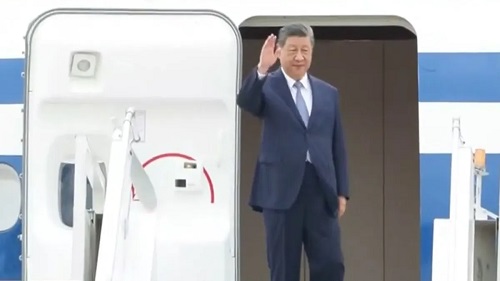
Chinese President Xi Jinping arrived in New Delhi on Saturday for the 18th BRICS Leaders’ Summit, making his first visit to India in nearly seven years and adding fresh momentum to efforts aimed at stabilising bilateral ties. His arrival comes at a crucial juncture, with New Delhi and Beijing seeking to move beyond the tensions triggered by the 2020 Eastern Ladakh border standoff. Xi’s meeting with Prime Minister Narendra Modi on the sidelines of the summit is expected to be closely watched, as the two sides seek greater stability along the Line of Actual Control while also exploring opportunities to revive trade and broader engagement.
Xi’s return to India carries considerable diplomatic significance. The relationship between the two Asian powers has undergone a difficult phase since 2020, when the border confrontation sharply affected political, military and economic ties. Although sustained negotiations between the two countries have helped ease some tensions, the boundary issue remains central to the relationship.
Against this backdrop, Xi and Modi are expected to discuss the overall state of bilateral relations, including border management, peace and tranquillity along the LAC, economic engagement and areas where cooperation can gradually be expanded.
For Xi, the visit also marks a return to a country he has not visited since October 2019, when he met Modi for an informal summit in Mamallapuram near Chennai. That meeting was aimed at strengthening strategic communication between the two leaders and followed their first informal summit in Wuhan in 2018.
Before Mamallapuram, Xi had travelled to Goa in 2016 to attend the BRICS Summit. His first visit to India as Chinese President came in September 2014, when he held extensive talks with Modi during the early years of their respective leaderships.
The nearly seven-year gap between Xi’s India visits reflects the turbulent phase that followed the 2020 border crisis. His presence in New Delhi now, therefore, has significance beyond the BRICS forum and is being viewed as an opportunity for the two sides to consolidate the recent improvement in relations.
Xi has arrived with a high-level delegation comprising senior figures from the Chinese Communist Party and government.
Among those accompanying him is Cai Qi, one of Xi’s closest political associates and a member of the Standing Committee of the Political Bureau of the Communist Party of China. Cai also heads the General Office of the CPC Central Committee, making him an influential figure in China’s political establishment.
Chinese Foreign Minister Wang Yi is another key member of the delegation. A member of the Political Bureau of the CPC Central Committee, Wang has been closely involved in India-China diplomatic discussions, particularly negotiations concerning the boundary question.
His presence assumes added importance given the recent efforts by New Delhi and Beijing to strengthen diplomatic communication and prevent a return to the tensions witnessed after the Ladakh standoff.




















Leave Your Comment