


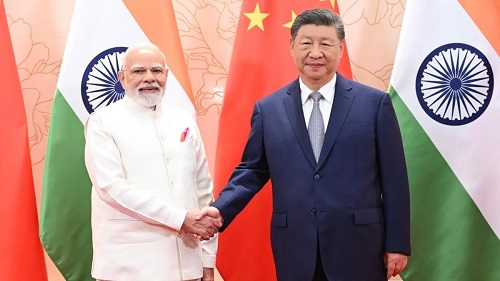
The India-China relationship is poised for a potentially significant diplomatic moment as Prime Minister Narendra Modi and Chinese President Xi Jinping meet in New Delhi on the sidelines of the BRICS Summit today. Xi’s first visit to India in seven years, coupled with Beijing’s conciliatory messaging and the resumption of direct air connectivity, signals a cautious effort to stabilise ties that were severely strained by the 2020 Ladakh crisis. The meeting could provide an opportunity for both sides to strengthen communication, expand cooperation and manage differences without allowing them to derail the broader relationship.
The meeting between Modi and Xi carries significance far beyond the symbolism of a high-level diplomatic engagement. For years, the relationship between the two Asian powers has been overshadowed by the military confrontation in eastern Ladakh, which fundamentally altered the strategic environment along the Line of Actual Control and created a deep trust deficit.
Against this backdrop, Beijing’s latest messaging appears designed to project a more constructive approach. Chinese Ambassador to India Xu Feihong said China would work with India to implement the strategic guidance of the two leaders, strengthen communication, expand cooperation and properly manage differences.
Xu described the forthcoming Modi-Xi interaction as the third consecutive year in which the two leaders have met, following their encounters in Kazan and Tianjin. He stressed that Beijing wants the relationship to be viewed from a strategic and long-term perspective, while portraying China and India as neighbours capable of cooperating despite disagreements.
The language is notable because it acknowledges the existence of differences while placing emphasis on managing them rather than allowing them to dominate the entire bilateral relationship. For New Delhi, however, the real test will remain whether diplomatic assurances are matched by sustained progress on the ground.
Xi’s arrival in India is itself an important development. His last visit was in 2019, when he travelled to India for the second informal summit with Modi. The subsequent military confrontation in Ladakh pushed relations to their lowest point in decades, with border tensions affecting political engagement, economic ties, people-to-people exchanges and the wider strategic relationship.
The latest meeting therefore comes at a time when both countries have strong reasons to prevent another deterioration. India and China are major economic powers, important members of BRICS and influential actors in the emerging multipolar global order. While competition between them is unlikely to disappear, maintaining stable channels of communication has become increasingly important.
One of the clearest indications of a possible thaw is in civil aviation. China Southern Airlines has announced that it will restart regular passenger flights between Guangzhou and New Delhi from September 21. The route had remained suspended for six years, making its revival a significant practical development after the prolonged disruption in bilateral travel.
China Southern said the resumption would form part of a broader expansion of its South Asian operations, with more than 100 weekly flights planned across eight round-trip routes in the region. The restoration of direct connectivity could gradually revive business travel, tourism, educational exchanges and family links that suffered during the prolonged period of strained relations.
Yet, the road towards a comprehensive reset remains complicated. The border question continues to be the central strategic challenge. India has consistently maintained that peace and tranquillity along the border are essential for the overall development of bilateral relations. China, meanwhile, has repeatedly called for differences to be handled through dialogue and for the relationship not to be defined solely by the boundary dispute.
The Modi-Xi meeting could therefore be less about announcing a dramatic transformation and more about establishing a framework for sustained engagement. Both sides may seek to reinforce existing mechanisms, improve strategic communication and prevent disagreements from escalating into crises.
The broader international environment also gives the meeting added importance. BRICS has emerged as an increasingly influential platform for developing and emerging economies, while India and China are both seeking greater influence in shaping global economic and political institutions. Cooperation within multilateral groupings can coexist with bilateral competition, provided the two countries maintain sufficient diplomatic space.
Xi’s delegation includes senior Chinese officials, including Cai Qi, a member of the Standing Committee of the Political Bureau of the Communist Party of China Central Committee and director of its General Office, as well as Wang Yi, a member of the Political Bureau and Chinese foreign minister. Their presence underlines the importance Beijing attaches to the engagement.
For India, the principle will remain clear: dialogue can move forward, but stability along the border cannot be separated from the larger relationship. Economic and people-to-people engagement can provide positive momentum, but durable improvement will ultimately depend on mutual trust and predictable behaviour.
The New Delhi meeting may not erase the accumulated tensions of the past six years. However, it can provide both governments with an opportunity to move from crisis management towards structured engagement. If Beijing’s call for communication, cooperation and responsible handling of differences is followed by concrete action, the Modi-Xi meeting could become an important step towards rebuilding stability.
The significance of the encounter, therefore, lies not simply in the fact that the two leaders are meeting again. It lies in whether their latest engagement can create enough political space for India and China to compete where they must, cooperate where they can, and prevent their differences from becoming a permanent obstacle to regional stability.
(The main photo is courtesy: @China_Amb_India)




















Leave Your Comment