


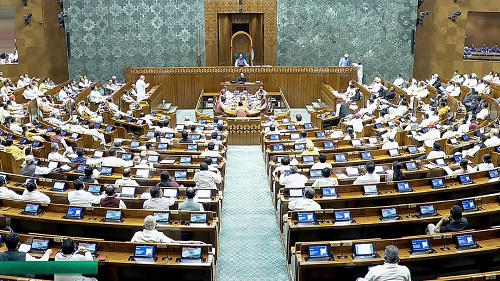
The three-day parliamentary session from April 16 to 18 has commenced amid intense political activity, with the government tabling a series of significant legislations, including the Women’s Reservation Bill and the Constitution (131st Amendment) Bill in the Lok Sabha. The session has quickly turned into a battleground of both ideological debate and arithmetic calculations, as parties weigh in on one of the most consequential reforms in recent years.
Union Law Minister Arjun Ram Meghwal formally opened the debate in the Lok Sabha, presenting the Women’s Reservation Bill alongside the Union Territories Laws (Amendment) Bill and the Delimitation Bill. The proposed legislation aims to reserve a substantial proportion of seats in legislatures for women, a move the government has positioned as a milestone in strengthening gender representation in Indian politics.
However, beyond the rhetoric of empowerment, the focus has sharply shifted to the numbers. With the NDA holding 292 seats and the Opposition tallying 233, the requirement of a two-thirds majority for constitutional amendments has placed the spotlight on cross-party support. The margin leaves little room for complacency, making every vote crucial in determining the Bill’s fate.
Prime Minister Narendra Modi has described the initiative as a “historic step” towards women’s empowerment, urging all parties to rise above political differences and support the measure. He is scheduled to address the Lok Sabha at around 3:30 pm, a speech that is expected to play a pivotal role in shaping the final outcome of the debate.
Despite broad agreement on the principle of women’s reservation, the Opposition has raised strong objections to the accompanying delimitation provisions. Parties within the INDIA bloc have argued that the delimitation process could be used for political advantage, terming it “politically motivated.” This disagreement has not only intensified debates inside Parliament but has also spilled onto the streets.
In Tamil Nadu, protests led by Chief Minister M. K. Stalin have underscored the growing resistance to the delimitation aspect of the Bill. Simultaneously, Opposition members have continued their demonstrations within Parliament, signalling that consensus, while possible, is far from guaranteed.
As discussions progress, the Women’s Reservation Bill stands at the intersection of reform and राजनीति, with both sides claiming to champion women’s rights while contesting the framework of implementation. The coming hours, particularly the Prime Minister’s address and subsequent voting patterns, will determine whether this long-debated reform finally crosses the legislative finish line or remains entangled in political contention.



















Leave Your Comment