


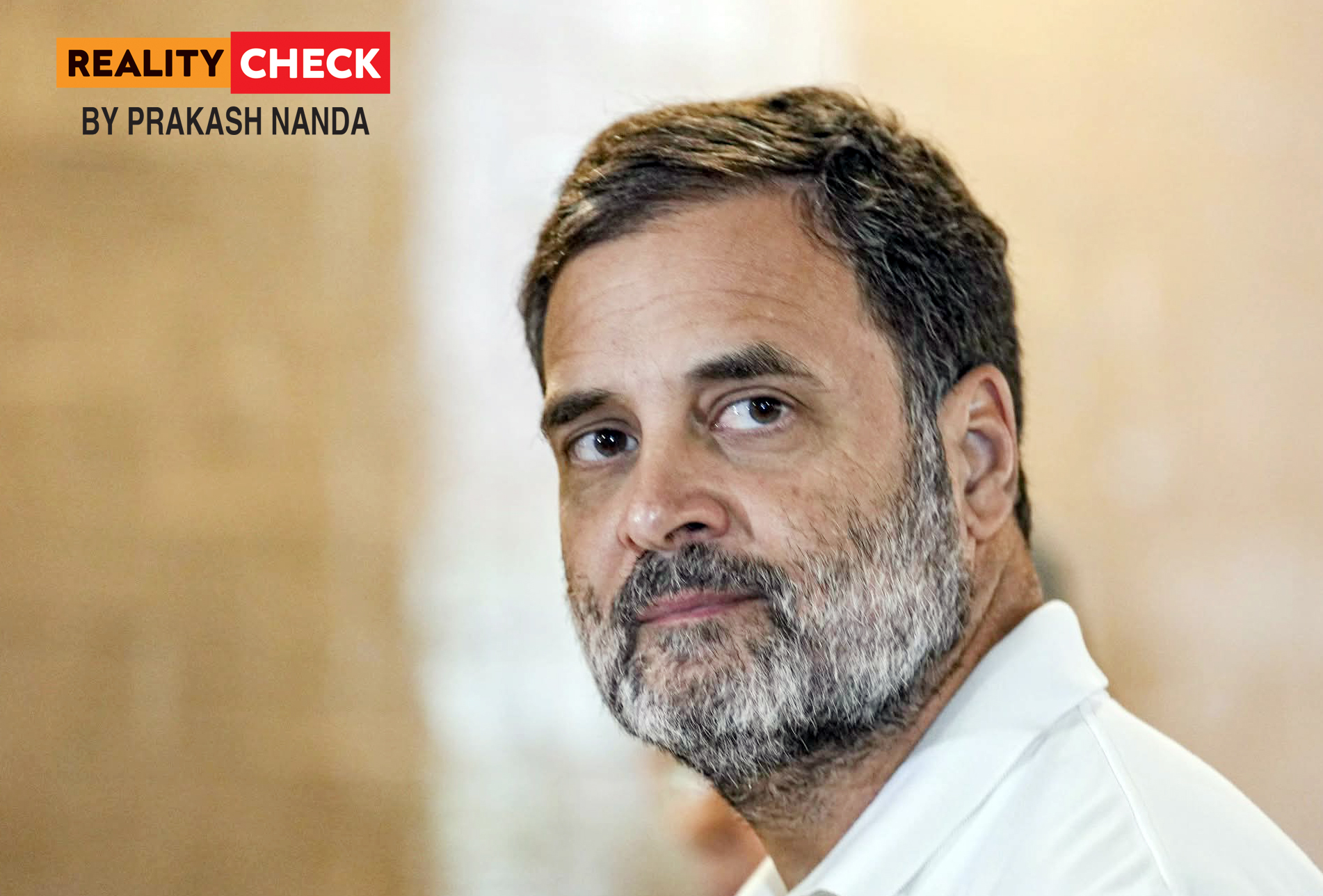
Predictably, Rahul Gandhi, the supremo of the Congress, who also happens to be the Leader of Opposition in the Lok Sabha, has reacted Prime Minister Narendra Modi’s “Nation First, Duty Above Com-fort” message to the nation, saying that Modi “compromised” amid mounting economic pressure, saying the public was being asked, “to sacrifice due to govern-ment failures.”
“Yesterday, Modi ji asked the public to make sacrifices -- don’t buy gold, don’t travel abroad, use less petrol, cut down on fertiliser and edible oil, use the metro, and work from home. These are not advi-sories -- they are proof of failure," he tweeted.
One is not sure whether Gandhi’s reaction is based on the real feedback from the Indian peo-ple. After all, people all over the world realise that the ongoing con-flicts in West Asia have disturbed the global economy as a whole, and here the governments, even those who are not in-volved in the war, have to take some hard decisions.
However, one should understand why Rahul Gandhi has reacted the way he has, because, unlike our other leaders, he is one who cannot control his addiction to foreign travel.
As it is, true to his nature, Rahul does not give a damn about the criticisms that he has faced recurring political attention over his trips abroad. The debate centres on three things: frequen-cy of travel, purpose of the visits, and who bears the costs.
Since 2015, Rahul Gandhi’s foreign travel has often coincided with Parliament ses-sions. Re-ports allege Gandhi has made over 260 foreign trips since 2015, with many lacking public dis-closure or prior no-tification. In Lok Sabha speeches, Home Minister Amit Shah listed several instanc-es: Germany during the Winter Session of 2025, Vietnam in the Budget Session of 2025, England in the Budget Session of 2023, Singapore and Malaysia in the Budget Session of 2018, travel abroad in the Monsoon Session of 2020, and a 60-day absence in the Budget Session of 2015. BJP spokesperson G.V.L. Narasimha Rao claimed in 2019 that Gandhi had travelled abroad 16 times in the previous five years, and that details for nine of those trips were not publicly known. Con-gress has responded that the trips were personal, meditational, or for engaging the Indian diaspora, such as a December 2025 visit to Germany to meet dias-pora groups and German ministers.
Secondly, the BJP has tied the travel to parliamentary participation. Shah cited Lok Sabha attendance figures for Gandhi: 51% in the 17th Lok Sabha against a na-tional average of 67%, 52% in the 16th against 80%, and 43% in the 15th against 76%. Parliamentary Affairs Minis-ter Pralhad Joshi wrote to MPs in July 2019 asking them to disclose details of overseas trips in advance, even for pri-vate visits, so the MEA and Indian mis-sions could be informed. The BJP argues that as a public representative, Gandhi should disclose the purpose and fi-nancing of “luxurious trips abroad”.
Thirdly, unlike the Prime Minister and Un-ion ministers, there is no centralised pub-lic disclo-sure of expenses for an individual MP’s private foreign travel. RTI replies and government statements routinely de-tail PM and cabinet travel costs. For ex-ample, nearly Rs 295 crore was spent on the PM’s foreign visits during 2021-2024, and ministries spent over Rs 1,500 crore on foreign tours from 2012-2015.
For Rahul Gandhi, verifiable cost data is limited. When similar questions were raised about UPA Chairperson Sonia Gan-dhi, the PMO clarified in 2012 that the government incurred no expenses on her visits abroad except one ICCR-paid trip to Belgium costing under Rs 3 lakh, and that SPG security costs were separate. For MPs on personal travel, the Lok Sabha Secre-tariat has stated that it does not re-ceive or maintain information on such vis-its. BJP has raised questions about “who footed the bill” for Gandhi’s air tickets and five-star stays, but no official audit or RTI has put a consolidated figure in the public domain.
Publicly available breakdowns, such as a YouTube analysis cited in search results, rely on “re-ports, public records, and dis-cussions” and carry disclaimers that they do not intend to make unverified claims. As of 2026, there is no government white paper or parliamentary statement giving a total cost figure for Rahul Gandhi’s foreign trips.
Against this background, there have been demands for transparency on who foots the bills for Gandhi’s "luxurious" air tickets and stays in five-star hotels. Besides, since he is a protected person, every trip involves "shadow travel costs" including Intelligence coordination and dip-lomatic security cover.
Some unverified claims suggest local costs for specific academic tours are covered by host institutions or international organisa-tions.
But the point is that not everyone is as fortunate as Gandhi. And the issue, there-fore, sits at the intersection of privacy and public accountability. MPs are not barred from private travel; however, the pur-pose, destination, and financing of per-sonal trips should be disclosed. There should not be an “information gap” for our elected representatives, including the Lead-er of the Opposition.
Of course, if any past actions are any in-dication, Gandhi does not seem to be a believer in the concepts like responsibility and accountability. So we should not be surprised by his irrespon-sible criticism of the prime Minister’s advice on austerity measures.




















Leave Your Comment