


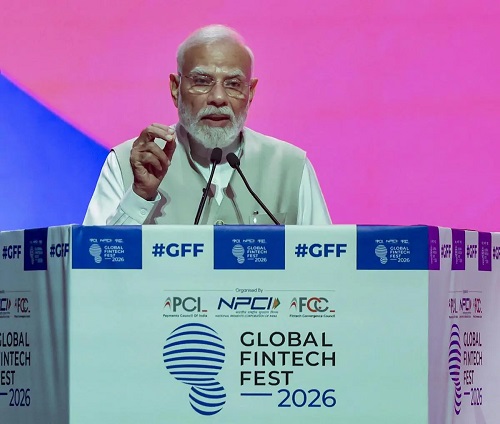
India’s fintech transformation has reached a scale that few could have imagined a decade ago, with the Unified Payments Interface (UPI) emerging as its most powerful symbol. Prime Minister Narendra Modi, inaugurating the Global Fintech Fest 2026 in Mumbai, described UPI as the “undisputed champion” of India’s fintech success story and said any discussion on the country’s digital-finance journey would remain incomplete without it.
Modi said UPI represents much more than a technological innovation. It has fundamentally changed how millions of Indians access and use financial services, particularly in places where traditional banking infrastructure struggled to reach. By making digital payments quick, accessible and largely seamless, UPI has become a major instrument of financial inclusion.
The scale of its adoption is reflected in the numbers. More than 24 billion UPI transactions were recorded in August alone, underscoring the extraordinary pace at which digital payments have become embedded in everyday economic activity.
The Prime Minister also highlighted the international recognition that India’s payment revolution has received. Referring to French President Emmanuel Macron’s remarks, Modi said UPI was not merely a technology story but a “civilizational story”—a reflection of how technology can reshape economic behaviour and expand access to financial services.
India is now taking UPI beyond its domestic success. Modi said the payment system is live in 11 countries, turning what once appeared to be an ambitious technological possibility into an increasingly routine feature of international payments.
The next challenge, however, is to move from simply making UPI available overseas to creating deeper connections between India's payment infrastructure and the domestic systems of partner countries.
Modi stressed the importance of integrating UPI with local payment networks, citing the seamless connectivity established with Singapore as an example of what could be achieved. He called for financial networks to be linked in countries where there are significant Indian communities or substantial trade with India.
Such integration could have consequences well beyond convenience at shops and restaurants. It could transform the way money moves across borders, particularly for Indian workers and families dependent on remittances.
India remains one of the world's largest recipients of overseas remittances, making the cost and speed of international money transfers a significant economic issue. Modi argued that lowering transaction costs for Indians sending money home should be treated as a priority.
Greater interoperability between payment systems could allow funds to reach families in India more quickly while reducing the friction and costs traditionally associated with cross-border transfers. For millions of households, this could translate into more money reaching beneficiaries rather than being absorbed by transaction charges.
The broader vision is therefore not simply to export an Indian payment application. It is to build interconnected digital payment ecosystems in which national platforms can communicate with one another with minimal friction.
UPI's journey illustrates how India has moved from being primarily a consumer of financial technology to becoming an important innovator in the global digital-payments landscape. Its next chapter will depend on how effectively that domestic success can be converted into international connectivity.
If that ambition succeeds, UPI could become more than India's fintech success story—it could emerge as a key building block of a faster, cheaper and more inclusive global payments architecture.





















Leave Your Comment