


Elections in Bengal, Tamil Nadu, Kerala, Assam and Puducherry may well turn out to be a big "agni pariksha" for Mamata Banerjee, M K Stalin, Pinarayi Vijayan, Himanta Biswas Sarma and N Rangasamy-- than for Prime Minister Narendra Modi at the national level.
The stakes for victory, therefore, are both enormous and symbolic.
Mamata is seeking a fourth term in office as the sole pride of Bengal. M K Stalin wants a hat-trick to remain TN's Dravidian model's icon to vanquish an emerging threat from super film star Vijay's fledgling party. A buoyant AIADMK under Edapaddi K Palanisamy is seeking to return as CM under an alliance in which the BJP is a major stakeholder.
In Kerala, as the only remaining Marxist top guard, Pinarayi Vijayan, is hopeful of a third term as CM in "God's own country", where the Congress is hoping to break its cycle of defeats, even as the BJP should be content with winning a handful of seats as the third player.
In Assam, Himanta Biswas Sarma is confident of steering the BJP to a third successive term and his own second term. He has literally pulverised the Congress's organisational base, which has reeled under Rahul Gandhi's preference for Gaurav Gogoi as the sole arbiter of its fortunes in a state where illegal migration has triggered anxieties for the indigenous population.
In Puducherry, a union territory, it is about Natesan Krishnasamy Gounder Rangaswamy or "NR" as he is popularly known, who has been serving as the CM since May 2021. He has previously served as CM from 2001 to 2008 and from 2011 to 2016. He is the founding president of his own party, the All India N.R. Congress (AINRC), which was formed after a 2011 breakaway from the Congress. He has headed the National Democratic Alliance (NDA), of which the BJP is an important member. His challengers, both the parent Congress and the DMK, have stitched up a poll pact that looks torn apart because of their rivalry over who should lead the opposition alliance.
As we see, firstly, these elections are crucial for regional parties and issues. West Bengal and Tamil Nadu are governed by regional parties, and the CPM, the incumbent in Kerala, is almost a regional party.
Even in the only state where the contest is between national parties, Assam, the issues and campaign will have a decidedly regional impact.
Over the past 10 years, regional parties have often had more success than the Congress in resisting the BJP, thanks to personal charisma, regional dynamics, and welfare handouts.
Therefore, the spotlight is on Mamata Banerjee (Bengal), MK Stalin (Tamil Nadu) and Pinarayi Vijayan (Kerala).
Secondly, after a good performance in the 2024 general elections, the Congress messed up in Haryana and lost big in Maharashtra, Delhi and Bihar. Therefore, these five assembly polls appear to be the best opportunity for it to retrieve some ground.
Five years ago, victories in Kerala, Tamil Nadu and Bengal boosted the Opposition and carried it through two subsequent years of electoral drubbing.
After seeing its Lok Sabha numbers fall to 240 in the 2024 general election, the lowest since 2014, the BJP was buoyed by victories in five of the eight states that went to the polls that year.
It won in Odisha, Haryana, Maharashtra and Arunachal Pradesh, and its ally, the TDP, won in Andhra Pradesh (the Odisha and Andhra assembly polls were held along with the 2024 general elections).
The opposition won in Jharkhand, Jammu and Kashmir and Sikkim. Last year, the BJP won in Delhi and, along with the Janata Dal (United), retained power in Bihar.
That is why retaining control of Bengal, Tamil Nadu, and Kerala will be key for an Opposition struggling with a shrinking footprint.
With polling spanning 824 constituencies and roughly 17.4 crore eligible voters casting their vote at 2.18 lakh polling booths, these elections hold greater significance for the Opposition parties than for the BJP.
Also, the BJP’s bid to script a victory in states where it has traditionally lacked support will be put to the test in West Bengal, Kerala, Tamil Nadu and Puducherry, where elections will be held between April 9 and April 29. The results will be out on May 4.
Lastly, these elections are also about revising the voters' list through Special Intensive Revision (SIR). Questions hang over the fate of millions of voters whose franchise is still under adjudication in West Bengal. This is the first set of elections held after the SIR of electoral rolls, completed in 10 states.
Bengal scenario:Mamata search for victimhood in SIR?
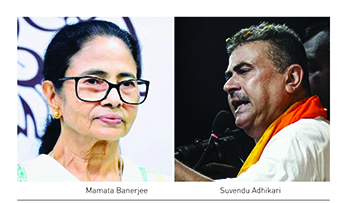
Therefore, the upcoming elections in Bengal are poised for a contentious showdown. The BJP has put up prominent leader Suvendu Adhikari from Bhabanipur, the home seat of Mamata. This sets the stage for a rematch of their 2021 clash in Nandigram. Adhikari, a former aide of Mamata in the TMC, is also running in Nandigram, where he had defeated Mamata in the last assembly elections. As the BJP is the main opposition, it has pitched its election narrative primarily on national security and on Mamata's administrative lapses. It has been careful not to repeat the aggression seen in the 2021 elections, when it was branded as a North Indian challenge to Bengal's daughter. Of course, the BJP’s election narrative enabled it to win 77 of the 294 seats on offer.
Mamata has been in power since 2011. This time, the BJP is hoping that anti-incumbency factors will bring more Bengal voters to the polls and give it a chance.
Assam: Congress's blunders make it easy for Himanta?
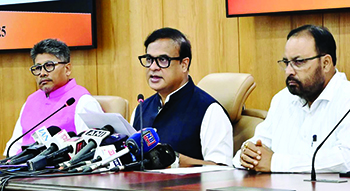
Assam is gearing up for a heated battle. As CM, Himanta has delivered on the ground through developmental progress on many fronts, including cash handouts for the weaker sections, especially women. The Congress has been in the opposition for the past decade, while the BJP has enjoyed two consecutive terms in power. During the first term, Sarbananda Sonowal served as CM, followed by Himanta in the second term. Of the 126 Assembly seats, nine have been reserved for Schedule Castes and 19 for Scheduled Tribes. Around 2.50 crore electors are set to cast their franchise in the 2026 assembly polls, said the notification. As the election narrative is again on ideological concerns, such as demographic changes and illegal settlers, the Congress has been unable to appreciate the need to address the concerns of the Assamese majority.
The illegal migration into Assam from Bangladesh cannot be brushed aside by the Congress without electoral consequences. In 2021, the BJP contested 93 seats and won 60 seats to form a government. Assam. On account of this big issue, the BJP has not lost a national or state election in the state since 2014 and is looking to form its third consecutive government.
Significantly, Congress leader Gaurav Gogoi’s father, Tarun Gogoi, revived the Congress party in the state and served as the chief minister from 2001-2016, making him the longest-serving chief minister in the state's history. One of his protegees, Himanta, is now the BJP’s face, who has made the challenge so difficult for Gaurav who has failed to woo the Assamese majority.
Will TN people fall for DMK's goodies?
In Tamil Nadu, with its so-called Dravidian model clouded by dynastic politics at all levels, a lack of security for women, and rampant corruption, M K Stalin has realised it is not easy to confront the AIADMK, now supported by the BJP. The entry of actor-politician Vijay’s Tamilaga Vettri Kazhagam (TVK) into electoral politics, and the incursion of Seeman's Naam Tamizhar Katchi (NTK), will also play a significant role in deciding the DMK's fortunes. Of course, Stalin is counting on the bounties he announced on the eve of the elections and the DMK's "scientific formula" to woo voters to the polls and bail out the DMK.
True, the AIADMK itself faces intense pressure, as the party has been riven by differences and splits since the death of its leader and former CM, J Jayalalithaa. In the 2021 assembly polls, the AIADMK won 66 of the 234 seats, while the BJP won four and the PMK won 5, taking the NDA’s tally to 75, while the DMK-led alliance won 159 seats.
Will Pinarayi's last battle be CPM's too?
The Kerala elections are seeing major political battles between the three parties: the Left Democratic Front (LDF), the United Democratic Front (UDF), and the BJP.
Under Pinarayi, the ruling Left is struggling to maintain its position following the lacklustre performance in recent local body elections. Kerala is seen as the Communists’ last bastion after they were completely marginalised (not even an MLA) in their erstwhile stronghold of West Bengal.
The Congress-led UDF is focusing on regaining power, while the BJP is keen to emerge as the third power. The question of the Congress’ CM face has sparked tensions within the party. The debate has surfaced even as the party maintains it does not declare a CM nominee ahead of elections. Senior leader and former Rajya Sabha deputy chairman P J Kurian said Ramesh Chennithala would be chief minister. The issue quickly turned contentious, heating up the Congress campaign. At a UDF convention in Kozhikode, attended by party president Kharge, some workers wore hats featuring photographs of Rahul Gandhi and Chennithala. A few others tore away Chennithala’s image, telling TV channels the party mattered more than individual leaders.
Chennithala and Leader of Opposition V D Satheesan, however, have declined to engage in the debate, both stressing that winning the election was the top priority.
A Congress Working Committee member, Chennithala served as Leader of Opposition from 2016 to 2021 before being replaced by Satheesan after the party’s 2021 Assembly poll defeat. Alongside the two, AICC general secretary (organisation) K C Venugopal is also seen as a contender. Being close to Rahul Gandhi, Venugopal who is the Alappuzha MP, wields significant influence. Many legislators and candidates are said to be aligning with him.
All three leaders belong to the upper-caste Hindu Nair community. Chennithala was close to the late K Karunakaran. Many believe the Congress high command may favour him on grounds of seniority. It remains to be seen whether the party will opt for a post-poll consensus among legislators if it wins a majority.
The BJP’s best-case scenario is to get enough seats to emerge as the main opposition to the ruling LDF and Pinarayi. Most analysts say that it is unlikely.
The BJP has been actively building networks with the Christian community in the state and has firmed up alliances with a bunch of smaller parties, such as the Bharath Dharma Jana Sena (BDJS), which wields clout among the Ezhava community and the Twenty20 Party, launched by industrialist Sabu M Jacob. Other allies include the Kerala Congress (Democratic), a breakaway faction of the Kerala Congress led by Saji Manjakadambil, the Kerala Kamaraj Congress, and the Lok Jan Shakti Party. (end)

Shekhar Iyer
(The content of this article reflects the views of writer and contributor, not necessarily those of the publisher and editor. All disputes are subject to the exclusive jurisdiction of competent courts and forums in Delhi/New Delhi only)

















Leave Your Comment