


When the assembly elections were announced in Bihar, most of us thought the key questions before voters were: will JD(U) leader Nitish Kumar secure another third consecutive term as CM?
Could the Bharatiya Janata Party (BJP) announce a new chief ministerial face if the National Democratic Alliance (NDA) wins?
Or will the people of Bihar be trapped by an amnesia of sorts and vote for the Opposition, and make Lalu Prasad Yadav's son, Tejashwi Yadav, new CM?
After a month-long campaign, Nitish is still the subject of discussion among all parties, proving his detractors wrong. The BJP has been forced, or otherwise, to acknowledge Nitish's preeminence on the battlefield and rally all caste combinations behind his leadership.
Not far behind is Tejashwi Yadav, who appears to be trying to break free from the legacy of misrule of his parents, Lalu Prasad Yadav and Rabri Devi, even as he courts voters beyond the Muslim-Yadav stronghold.
The most influential among the voters -- the youth of Bihar are dazed by the plethora of promises made by Nitish-led National Democratic Alliance (NDA) and Tejashwi's Mahagatbandhan.
However, the women of Bihar, who have emerged as powerful game changers in the state, appear still solid behind the aura of empowerment created by Nitish.
The common perception is also that Nitish still commands Extremely Backward Caste (EBC) and dominant caste votes.
Since this combination made him invincible over the past 20 years, his victory this time appears still closer at hand than Tejashwi's catapulting to power.
At the same time, political pundits remind us that, even if Nitish remains the most significant factor, Tejashwi has managed to generate considerable interest to rock the NDA's boat in the ever-changing political and social landscape of Bihar.
The election will decide whether the ruling NDA, comprising the BJP and the Janata Dal (United) among others, retains power or makes way for the Mahagathbandhan (MGB), comprising the Rashtriya Janata Dal (RJD), the Congress, the Communist Party of India-Marxist Leninist and smaller regional parties.
This time around, the NDA versus Mahagatbandhan contest has also been contrasted by the foray of political strategist-turned-politician Prashant Kishor’s Jan Suraaj party.
Prashant Kishor, or PK, as he is known, has projected his party as “an alternative to the BJP’s Hindutva agenda” and the dynastic politics of Lalu, presenting a new narrative that could make the battle a triangular one. That is, if PK has persuaded Gen Z to give his fledgling party a chance.
Kishor has been touring Bihar for the last two and a half years, claiming to introduce "issue-based politics" into the state’s elections. Drawing on his experience as an election strategist for several leaders, including Prime Minister Narendra Modi, Rahul Gandhi, Mamata Banerjee, and M.K. Stalin, Kishor is seeking a "kingmaker's role" in the post-poll scenario.
However, his decision not to contest the elections has dampened the mood of his followers. Some even say that Jan Suraaj’s presence has gradually lost relevance in many of the 236 seats it has fielded nominees. At best, his outfit could damage the NDA's prospects in many places by attracting the dominant caste and urban middle-class vote. It could also leave Tejashwi's nominees in a tight spot in a few seats.
Of the 243 Assembly seats, Tejaswhi's Rashtriya Janata Dal (RJD) has fielded candidates in 143, leaving 100 to its alliance partners. Of the 143 seats the RJD is contesting, one is a reserved seat for Scheduled Tribes, while 20 seats are reserved for Scheduled Castes. The party has fielded Muslim candidates in 18 seats. Of the remaining 104 general seats, 52 have been given 52 to Yadavs.
The NDA has also adopted similar tactics. Of the 243 seats, 39 are reserved for Scheduled Castes and Scheduled Tribes. In the remaining 204 general seats, the NDA (led by the JD-U) has fielded Muslim candidates in just five seats, with 86 of the remaining 199 seats allotted to dominant-caste Hindu candidates, who make up just over 10 per cent of Bihar’s population.
Within the NDA, the BJP has fielded 101 candidates, of which 12 are Dalits in constitutionally reserved seats. Of its 89 general category candidates, 49 belong to dominant castes. Among these, Rajputs top the list, followed by Bhumihars. This falls precisely in the BJP's traditional support base.
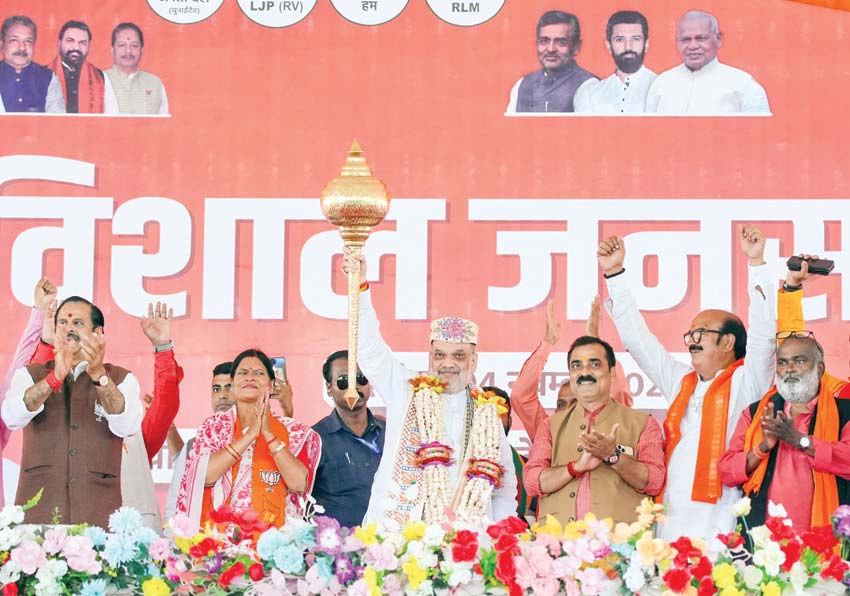
Overall, the Bihar challenge is also a fundamental driver of national politics. One can gauge the pressure on all players. The entire top echelon of the BJP, including Modi, Home Minister Amit Shah, BJP chief ministers, and cabinet ministers, has been campaigning extensively, leaving nothing to chance.
In the 2020 Assembly polls, the NDA came to power, securing 132 of the 243 seats. The MGB finished a close second with 111 seats.
In August 2022, Nitish Kumar left the BJP in a lurch and allied with the MGB. However, in January 2024, Nitish jumped ship once again and aligned with the BJP for the Lok Sabha elections. As of today, the NDA alliance is presenting a united front, but the speculation about the future has never ceased among the leaders.
If the numbers don't add up, will Nitish be wooed by the MGP again? Is the BJP, under Modi, not keen on having Nitish return as chief minister? Or, will Chirag Paswan, as the face of the Dalits, eventually replace Nitish after some months if the NDA returns to power?
Nitish's advantage is that, due to his strong social base, he has consistently overcome the anti-incumbency sentiment.
Apart from the caste factor, unemployment, outmigration, corruption, and the decline of education and healthcare are the primary concerns dominating the discourse. In Bihar, where many seek opportunities beyond its borders, the promise of jobs is not just a campaign promise, but a lifeline.
That is why the NDA rolled out its slew of promises – one crore jobs, seven expressways, and medical colleges - to woo voters into choosing Nitish once again. The NDA has promised freebies in power, ration, education, medical treatment and a hike in stipend to farmers, fishermen and women running self-help groups (SHGs).
Countering NDA’s promises, the MGB has offered the moon. It has pledged to provide one job to every family in Bihar, eliminate contract employment in government jobs, conduct a skill census, offer jobs, provide loan waivers, establish medical colleges, and offer freebies in power, education, agriculture, and to all women.
In its manifesto, marketed as ‘Tejashwi Pran’, the MGB has also promised new laws against exam paper leaks, financial harassment, increasing the reservation cap, and a relook at the ‘liquor ban’ currently imposed in Bihar.
Even before the manifesto was out, Tejashwi promised to issue an official order giving one government job per family within 20 days of becoming CM. Within twenty months, the job process will start.
What is on offer to women voters underscores the real battle. With promises like creating one crore ‘lakhpati’ Didis and financial aid up to ₹2 lakhs, NDA has focused on economic empowerment without direct benefit transfers (DBT). On the other hand, the MGB has promised to make all self-help group (SHG) workers under the ‘Jeevika Didi’ scheme government employees with a ₹30,000 salary per month, total loan waiver and a monthly stipend of ₹2000 for women-led SHGs. It has also offered a monthly stipend of ₹2,500 to all women from December, totalling ₹30,000 yearly, and a law against harassment by microfinance companies for loan/interest repayment.
Both Modi and Nitish have, in their campaign meetings, sought to convince the voters why only a ‘double-engine’ sarkar can deliver on poll promises.
If the social-economic surveys have to be taken seriously, the Bihar polls could be witnessing a sharp generational and gender divide. Apparently, male youth voters (18–30 years) show a clear preference for the MGB, with 41% support.
Women voters, across all age groups, remain firmly behind the NDA, with 44% choosing the ruling alliance. Among young educated men, Jan Suraaj, led by Prashant Kishor, can be a third force, securing 18% of the youth vote.
These surveys underscore that issues of gender empowerment, employment, and aspirations are driving voter behaviour. With over three crore women voters and nearly one-third of the electorate under 30, both Nitish Kumar and Tejashwi Yadav are recalibrating their campaigns to appeal to these groups.
As any voter in Bihar tells you, politics remains a battleground of aspirations. The MGB is poised to tap on the electorate's yearning for change.
However, PM Modi's presence and the NDA's organised campaign system cannot be underestimated. Nitish rests his hopes in the glory of 20 years of his stewardship, with sympathy votes from women who care about his health, and from lakhs of women who have benefited from his various welfare initiatives and prohibition.
Of course, despite facing a serious health challenge, Nitish must contend with the task of retaining his 'Sushasan babu' image among the voters while fending off anti-incumbency, particularly among job-seeking youth.
For Tejashwi, the task is not only to counter the NDA's advantage and convert his youth appeal into votes, but also to win over women voters from Nitish. As someone said, the old M-Y (Muslim-Yadav) formula may have defined Bihar's past as far as elections go, but the new Mahila-Youth equation could well determine its political future.
Of the 7.42 crore voters in Bihar, 3.92 crore are men and 3.5 crore are women. There are 14 lakh first-time voters and 4 lakh senior citizen voters. Polling will be held at 90,712 polling stations that are being set up in Bihar.

By Shekhar Iyer
(The content of this article reflects the views of writer and contributor, not necessarily those of the publisher and editor. All disputes are subject to the exclusive jurisdiction of competent courts and forums in Delhi/New Delhi only)




















Leave Your Comment