



Dr Vikas Bhardwaj
On 29 August 2026 some five thousand people filled a theatre at Madison Square Garden to hear the head of the Rashtriya Swayamsevak Sangh (RSS) speak on ‘universal oneness’. Opponents had lobbied to cancel the event, and three days earlier a United States commission had urged sanctions on RSS members and revocation of his visa (Bharath 2026). In December 2025 UNESCO had inscribed Deepavali on its intangible heritage list at Delhi’s Red Fort (UNESCO 2025). Recognition and suspicion now arrive together, and the stakes reach sanctions debates, campus programmes and diaspora politics. This article asks why Hindu civilisation has become a site of sustained contest, and how historical narrative, political institutions, advocacy networks and the media shape its representation. Its thesis is that the dispute concerns interpretive authority, and that India’s answer is civilisational sovereignty: the historical, intellectual, institutional and international capacity to research, protect and present its inheritance.
Historical Memory
The contest has a colonial pedigree. James Mill’s History of British India arranged the subcontinent’s past into Hindu, Muslim and British periods (Mill 1817). Romila Thapar, a critic of Hindutva, argues that this scheme served colonial dominance and encouraged Hindu and Muslim religious nationalisms alike (Thapar 2014), a reminder that disputing colonial misreadings is not a partisan act and that not every Marxist historian is an adversary. The sharper quarrels concern what post-independence textbooks stressed and omitted, and evidence has sometimes disciplined both camps. The Supreme Court’s Ayodhya judgment of 2019 accepted the Archaeological Survey of India’s finding of an earlier non-Islamic structure, yet refused to rest title on archaeology alone (Supreme Court of India 2019). NCERT’s 2022–23 ‘rationalisation’, defended as pandemic-era relief and condemned by historians as sanitised history, shows textbooks remain contested ground (Press Trust of India 2023; Careers360 2023).
Domestic Contestation
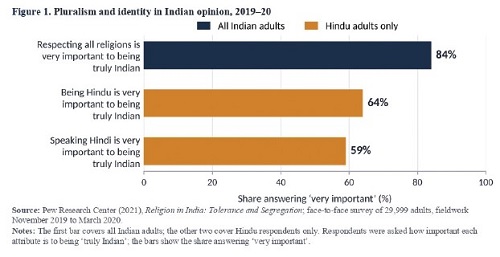
Secularism is the fault line. In November 2024 the Supreme Court dismissed challenges to the words ‘secular’ and ‘socialist’, added to the Preamble in 1976 (Balram Singh v. Union of India 2024); seven months later the RSS general secretary asked for a review, and Congress and the Left objected (Press Trust of India 2025). Congress’s leaders declined the Ayodhya consecration invitation in January 2024, calling it an RSS–BJP event (The Quint 2024), yet Karnataka’s Congress government had ordered prayers in its state-run temples (Deccan Herald 2024a). The RSS chief has said a Hindutva that excluded Muslims would cease to be Hindutva (The Quint 2018), repeating it in New York (The Week 2026); in December 2024 he also warned against raising fresh temple–mosque disputes, and some seers rebuked him (Deccan Herald 2024b). Pew shows the tension: 84 per cent of Indians call respect for all religions essential to being truly Indian, and 64 per cent of Hindus say being Hindu is too (Pew Research Center 2021; Figure 1).
The Global Contest
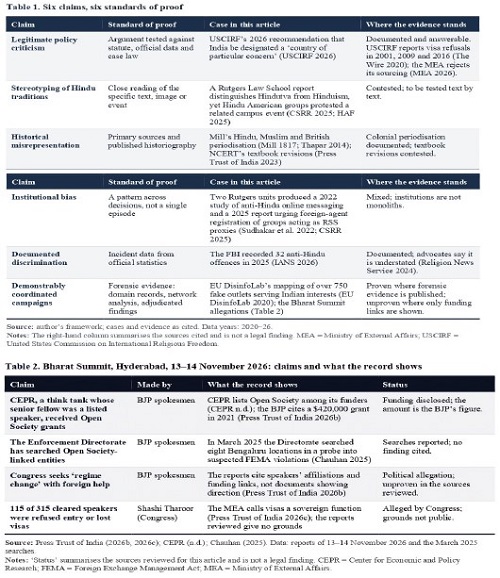
Six claims travel under the banner of ‘anti-Hindu bias’ and need different proof: legitimate policy criticism, stereotyping, historical misrepresentation, institutional bias, documented discrimination and demonstrably coordinated campaigns (Table 1). USCIRF’s 2026 recommendation that India be designated a ‘country of particular concern’ is the first kind (USCIRF 2026). It is advisory, and its fact-finding is remote: the commission says India refused it visas in 2001, 2009 and 2016 (The Wire 2020), and the Ministry of External Affairs calls its picture selective and reliant on questionable sources (MEA 2026). Institutions are not monoliths. In 2022 Rutgers University’s Network Contagion Lab reported anti-Hindu online messaging (Sudhakar et al. 2022), which Hindus for Human Rights (2022) contested; in 2025 its Law School’s Center for Security, Race and Rights proposed that US groups acting as RSS proxies register as foreign agents, distinguishing Hindutva from Hinduism, though Hindu American groups protested a related campus event (CSRR 2025; HAF 2025). Discrimination is measurable: the FBI recorded 32 anti-Hindu offences in 2025 (IANS 2026), a count advocates consider understated (Religion News Service 2024). Hindus themselves disagree: the New York event’s organiser cited more than 200 Hindu American groups, while Hindus for Human Rights joined sixty other organisations in urging cancellation (Bharath 2026).
Digital Narratives
Social media compresses these tests into hours. On 14 November BJP spokesmen noted that the think tank CEPR, whose senior fellow was a listed speaker at Telangana’s Bharat Summit, had received Open Society grants, and cited the Enforcement Directorate’s 2025 searches of Open Society-linked entities over suspected foreign-exchange violations; they alleged a bid for ‘regime change’ with foreign help (Press Trust of India 2026b; Chauhan 2025; Table 2). CEPR lists Open Society among its funders (CEPR n.d.): funding is fact, direction inference. Congress’s Shashi Tharoor says 115 of 315 cleared speakers lost visas; the Ministry of External Affairs calls visas a sovereign matter (Press Trust of India 2026c). A state may rightly ask who funds political advocacy on its soil, but proof is forensic, as EU DisinfoLab’s 2020 mapping of over 750 fake outlets serving Indian interests showed (EU DisinfoLab 2020). Open archives and sourced fact-checking supply it.
India’s Response
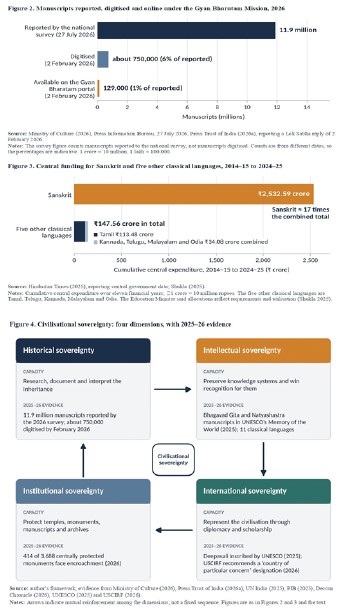
The record is stronger than critics concede, thinner than supporters claim. The Ayodhya temple, built after the 2019 verdict, is the most visible restoration. UNESCO has inscribed Deepavali and registered the Bhagavad Gita and Natyashastra manuscripts in its Memory of the World (UNESCO 2025; UN India 2025); the General Assembly adopted International Yoga Day by consensus (United Nations 2015); eleven languages hold classical status (PIB 2025); and over 640 antiquities have been repatriated since 2014, against 13 between 1955 and 2014 (IANS 2025). Yet the Gyan Bharatam survey has reported over 11.9 million manuscripts (Ministry of Culture 2026), while by February 2026 about 750,000 were digitised and 129,000 online (Press Trust of India 2026a; Figure 2); 414 of 3,688 protected monuments face encroachment (Deccan Chronicle 2026); and Sanskrit received about seventeen times the central funding of five other classical languages combined, a gap the Education Minister attributes to requirements and utilisation (Hindustan Times 2025; Shukla 2025; Figure 3).
The Way Forward
The four sovereignties reinforce one another (Figure 4): archives feed scholarship, scholarship legitimises institutions, institutions give diplomacy substance, and recognition abroad sustains funding at home. Fund critical editions and translations with international peer review rather than counting digitised pages. Publish digitisation and access data annually. Build a few civilisation-studies centres able to withstand scrutiny, with reciprocal chairs abroad. Answer contested claims with documents, including grant records, adjudicated findings and, where security permits, the grounds for visa decisions. Throughout, protect Hindu traditions within constitutional equality and India’s plural heritage.
Conclusion
India’s civilisational confidence will rest on knowledge, institutional excellence, historical integrity and cultural preservation. Competing global narratives are answered by communicating India’s contributions with authority and evidence, and by welcoming criticism that can be tested. Hindu civilisation has little to fear from description; its custodians should fear only an archive too thin to answer with. A civilisation sure of its sources welcomes the sceptic, because it can reply.
(The content of this article reflects the views of writer and contributor, not necessarily those of the publisher and editor. All disputes are subject to the exclusive jurisdiction of competent courts and forums in Delhi/New Delhi only)














Leave Your Comment