


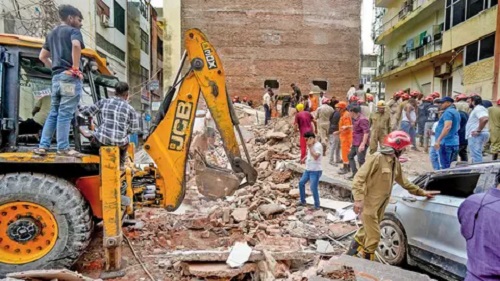
October 2021. Mobs swept through seven Bangladeshi districts in 72 hours — temples torched in Noakhali, homes ransacked in Chittagong, a pandal in Comilla set ablaze over a fabricated photograph of a Quran placed near a Hindu idol. Reuters and the BBC documented over 70 temples damaged within four days. Ain o Salish Kendra (ASK), Bangladesh's foremost civil society monitor, recorded more than 1,000 incidents that year alone.
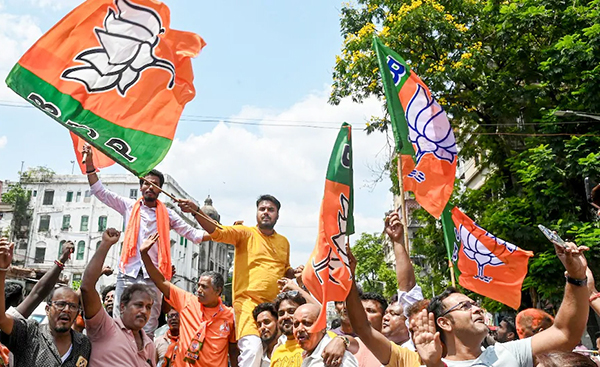
Across the border in West Bengal, the footage was on every phone screen within hours. The BJP did not need to manufacture outrage — it only needed to name what voters were already feeling. While Trinamool Congress stayed silent and the national opposition debated the optics of response, the BJP called it what documented data confirmed it to be: a pattern of organized anti-Hindu violence met with systemic impunity.
Bangladesh's tragedy is not only the violence — it is the silence that follows. Roy, Singh, and Kamruzzaman (2023) document a near-zero conviction rate for communal mob attacks. ASK found that in the Nasirnagar case, local Awami League councillors facilitated the mob; prosecutions never materialized. The 2021 Comilla attackers were arrested in large numbers — and largely released.
For the BJP, this institutional failure was geopolitical gold. Every unpunished arson in Noakhali became evidence for a narrative the party had been building since 2014: that secular governments — in Dhaka and in Kolkata — are structurally incapable of protecting Hindus. The Citizenship Amendment Act, passed in December 2019, was the legislative culmination of this argument. It told persecuted Hindus from Bangladesh that India — specifically BJP-governed India — would not abandon them.
The electoral data is unambiguous. In West Bengal, the BJP was a fringe party with 4.1% of the Assembly vote in 2011. By 2019 — after Nasirnagar, after Rangpur, after the CAA — it captured 40.6% of the General Election vote and 18 of 42 Lok Sabha seats. In 2021, it won 77 Assembly seats with 38.1% of the vote, an achievement unimaginable a decade earlier. In Assam, the party consolidated power in 2016 on an explicit anti-infiltration platform and has held it since.
The opposition's preferred framework — dismissing the Bangladesh factor as communal fearmongering — has been dismantled by the voters themselves. The BJP's vote share in border districts like Nadia and Cooch Behar consistently exceeds 45%, compared to 30–38% in interior districts. In these constituencies, the party is not selling abstract Hindu nationalism; it is speaking directly to communities whose grandparents fled 1947 or 1971, whose relatives still live across a border where temples burn.
What this data establishes is not that the BJP manufactured a crisis, but that it was the only major political force willing to acknowledge one that was real, documented, and ongoing. The 'Bangladesh factor' — verified violence, institutional impunity in Dhaka, and relentless digital amplification — functions as a durable political accelerant in Eastern India. It reinforces, rather than creates, a Hindu political consciousness that secular parties consistently underestimated and continue to misread. The ballots of West Bengal and Assam have delivered their verdict on that miscalculation, election after election.
Al-Zaman, M. S., & Alimi, M. Y. (2021). Islam, Religious Confrontation and Hoaxes in the Digital Public Sphere. Digital Journalism, 9(7), 943–961.
Bijukumar, V. (2023). Transforming Ethno-Regional Parties in Northeast India. Routledge.
Maitra, P., Menon, N., Mookherjee, D., & Saha, S. (2024). Declining Clientelism of Welfare Benefits? Journal of Development Economics, 167.
Mahmood, Z. (2017). Politics sans economics. Revista Conjuntura Austral, 8(43).
Mayilvaganan, M. (2019). Illegal Migration and Strategic Challenges. Strategic Analysis, 43(2), 131–145.
Nath, S., & Ray, A. (2022). West Bengal's Communal Turn. Economic and Political Weekly, 57(14), 38–47.
Roy, P., Singh, A., & Kamruzzaman, M. (2023). Anti-Hindu Violence in Bangladesh: A Systematic Review. Journal of Minority and Group Rights, 30(3).
Sadia, F. (2023). Minority Rights in Bangladesh. Third World Quarterly, 44(8), 1789–1808.
Sarma, J., & Bhattacharyya, H. (2021). Electoral Politics in Assam. Studies in Indian Politics, 9(2), 178–195.
(Author’s Bio: Vikas Bhardwaj is a scholar of international political economy, holding a Ph.D.



















Leave Your Comment