


As India celebrated its Navy Day on 4th December at Puri, one heard many experts saying that given the budgetary constraints, India should give more emphasis on pursuing a sea-denial strategy. The point that has been made is that India should not go for a third aircraft carrier, christened INS VIshal, and work, instead, towards having a powerful fleet of submarines, both conventional and nuclear-powered, to deal with the adversaries who challenge our maritime security.
Such views do seem to carry weight these days among the strategic policy makers of the country as one does not hear much about INS Vishal, the third planned third aircraft carrier of the country, for which every Nava Chief was advocating eloquently until recently. The point they were making is that as a Blue-water force, considering the vast area of operations, operational philosophy centered on sea control and growing threat in the Indian Ocean Region (IOR), the Indian Navy has a requirement of three operational aircraft carriers.
A third carrier was considered important for sustaining our maritime dominance in all three geographical expanses of the IOR. In fact, the requirement of a third Aircraft Carrier for the Indian Navy has also been acknowledged by the Parliament’s Standing Committee on Defence.
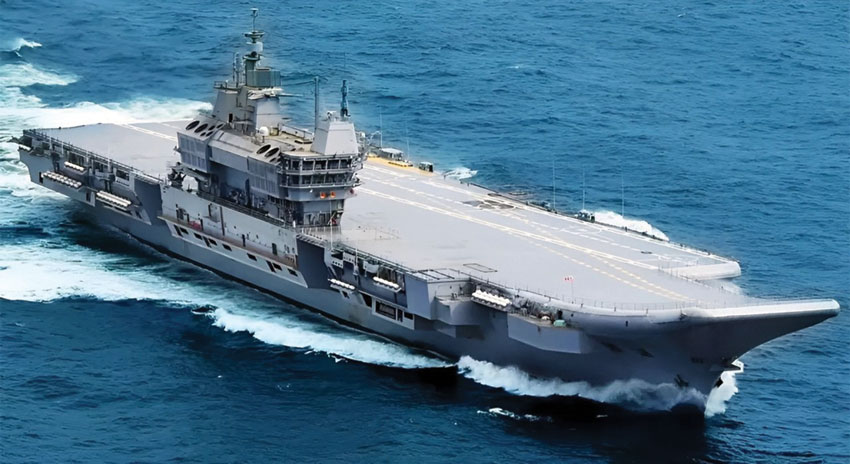
The successful indigenous production of the INS Vikrant, the second carrier, had generated a lot of confidence to the Indian Navy that India, now part of the elite group of nations possessing the niche capability to indigenously design and build an Aircraft Carrier, will have its third one to project maritime power “at sea and from the sea”, sooner rather than later.
Aircraft Carrier is the central entity of a Carrier Battle Group (CBG), which is a self-contained and composite force capable of undertaking an entire range of tasks that no other platform/shore-based aircraft can undertake. The CBG is capable of providing “persistent air power” in a region at extremely short notice and has the inherent flexibility and mobility to shift to a new theatre of operations in 48 to 72 hours.
Of course, there were debates whether or not the third carrier should be nuclear-powered, and for this, countries like France had shown interest to collaborate. But the Indian Navy was very clear on its necessity. After all, the first carrier, INS Vikramaditya ( procured from Russia in 2014 at a huge cost - it was the old Russian carrier, Admiral Gorshkov, that got renovated ) is ageing and INS Vikrant has limited range and power compared to its counterparts from China, India’s principal adversary in the IOR.
However, critics of the idea to have a new one point out that carriers are becoming rarer given the fact that the number of countries possessing active aircraft careers and developing new ones has become fewer and fewer over the years.
Obviously, one of the important reasons behind countries forgoing carriers is the growing economic pressure. For instance, when India acquired the remodelled Gorshkov in Admiral January 2014 from Russia and rechristened it as INS Vikramaditya, it cost $2.3 billion. But that was not all. India had to pay Russia another $2 billion for 45 MiG-29K fighters that are operating from the carrier.
In fact, the cost becomes all the more higher, when one takes into account the helicopters, bombers, supporting ships, missiles, bombers and highly sophisticated electronic equipment that accompany a carrier at all times. In other words, a carrier is simply not a big platform on the sea, it is a highly integrated ‘floating town’ having short runways from which the fighter aircraft can land and take off. It is a ubiquitous fighting system that has enhanced combat power, with extended reach and rapid response capability.
However, critics point out that the “leviathan” that a carrier is has a very soft underbelly, that is becoming increasingly vulnerable to attacks from missiles and submarines, with little chances of sustaining the damage and surviving. In other words, there are doubts over an aircraft carrier’s relevance in the ever changing battle-space of modern warfare.
Is it then not a helpless ‘prima donna’, occupying the centre-stage at sea, that needs protection at all times? This is a familiar question one often encounters from Air Force officers, who suggest that more investments in the country’s Air wing, instead of spending billions on carriers, will yield better results in providing air-protection to the Navy’s assets in the sea.
However, both the above arguments against the aircraft carriers need to be taken with a pinch of salt. All told, India is a major maritime power having lots of stakes in the IOR. An aircraft carrier is the most effective means available today of ensuring sea control, stakes that are not only military in nature (threats from China and Pakistan and dangers of piracy, particularly in the region stretching from the Horn of Africa in the west to the Straits of Malacca in the east) but also economic-driven (keeping sea-lanes free and open as our trade is essentially sea-driven; there are maritime resources under the sea in our exclusive economic zone; protecting the interests of Indians working in almost all the important countries in Australasia, Southeast Asia, West Asia and Africa).
In other words, a rapidly rising India must have peaceful and secure seas around it by projecting its ‘power’. In military parlance, it is called “sea control”. And nothing ensures sea control better than an aircraft carrier. In fact, India’s 2009 Maritime Doctrine clearly stipulates that, “sea control is the central concept around which the Indian Navy is structured, and aircraft carriers are decidedly the most substantial contributors to it.’’
The carriers, with a group of accompanying frigates, destroyers and submarines, provide an image of absolute naval dominance of the high seas and thus projects the overall power of the country. And this power projection cannot be quantified in terms of money; the overall accrual to the national power far outweighs the monetary costs.
Even when one talks of the costs, the issue needs to be seen in a larger perspective. It is perhaps not realised by the critics that building a carrier at home gives a significant boost to economic activity by creating employment opportunities for MSMEs and other industries. For instance, INS Vikrant alone engaged approximately 500 MSMEs, 12,000 employees from ancillary industries, and 2,000 shipyard employees.
Building a carrier, like any other ship-building, has its links to other ancillary industries, including steel, engineering equipment, port infrastructure, trade and shipping services has the potential to create a collaborative production ecosystem. With the development of these ancillary industries, the sector generates opportunities for smaller businesses and strengthens supply chain networks.
In regard to the factor of vulnerability, no weapon-system or platform has ever been immune to challenges in human history. And yet, the fact remains that aircraft carriers, with improved technologies, have not only survived but also remained a step or two ahead of threats of ballistic missiles, counter-measures and obsolescence.
In fact, the last carrier that was sunk was way back in 1945 – the USS Bismarck Sea (US Navy) that sank with 318 men onboard when it was hit by two Japanese kamikazes. Carriers today are capable of neutralising hostile ships, aircraft and submarines before they become a threat.
A launch of a weapon against any carrier can be instantly detected, intercepted and destroyed at some point in its ballistic trajectory. As it is, an aircraft carrier can move over 600 km a day, which translates to over one million square nautical miles of ocean area which an adversary has to search. By every means, it is a Herculean task. In any case, given its sheer size, build philosophy and damage control features, an aircraft carrier has an amazing capacity to absorb damage.
That is why the Indian Navy has a point when it points out that it cannot remain behind its comparable friends, allies and rivals with aircraft carriers.

By Prakash Nanda
(prakash.nanda@hotmail.com)




















Leave Your Comment