



Prakash Nanda
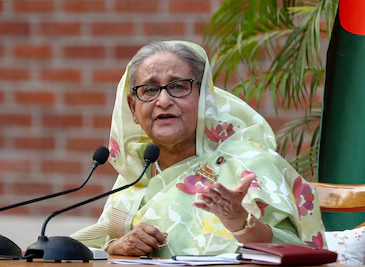
A few days ago, Bangladesh’s unfairly ousted Prime Minister Sheikh Hasina ad-dressed a virtual press conference at the Foreign Correspondents’ Club of South Asia, of which I happen to be the Secre-tary, announcing that she would return to Bangladesh in December.
But this piece is not about the geopolitical implications of Hasina’s decision - she has been living in India since August 5, 2024, when the coup ( in the form of street pro-tests), with the help of the Bangladesh Army Chief, forced her to flee to our coun-try.
It is about what led to the street protests that were orchestrated and exploited by the American Deep State and its collabo-ration with the Bangladesh military.
The 2024 crisis in Bangladesh is a text-book example of how an unprompted ju-dicial directive can ignite explosive geopo-litical and social instability. Here, the Court issued orders on a highly sensitive social engineering topic, which Hasina’s government had either deliberately set aside or chosen not to pursue, that acted as the ultimate catalyst for national-level unrest.
This incident, which was highlighted by Hasina, made me realise that the same thing - the judicial intervention and the resultant national crisis - happened in our Manipur, too.
Before explaining the point, let me make it clear that in a democracy, the three pillars — legislature, executive, and judiciary — are meant to check and balance each oth-er. The government makes policy, the leg-islature makes law, and the judiciary in-terprets both. In theory, this division keeps the system stable.
But in practice, some of the most disrup-tive national protests and political crises in recent years have not begun with a new government law or an executive order. They began with a court judgment.
A court verdict carries a unique moral and legal weight. Unlike a government notifi-cation that can be amended, debated, or rolled back in parliament, a judgment is seen as final, constitutional, and above politics. That very authority is why a sin-gle pronouncement can ignite streets fast-er than any cabinet decision. When people feel a judgment directly threatens their identity, livelihood, or sense of fairness, and when they see no immediate political avenue to reverse it, protest becomes the only available language.
This is exactly what happened in Bangla-desh. A judicial order completely re-versed a stable policy equilibrium that Hasina’s government had established six years prior. Important points in this re-gard to remember are :
Now, let us see what happened in Mani-pur. Here, a single-judge bench disrupted a delicate ethnic balance by imposing an administrative timeline that the state gov-ernment had been intentionally avoiding.
The following points are relevant:
Here again, as was the case in Bangla-desh, the executive did not announce a new policy. It was responding to a court timeline. Yet because the judiciary’s words were read as legitimizing a major change in the state’s social contract, the streets responded before the legislature or gov-ernment could debate, consult, or build consensus. The judgment compressed a decades-long political issue into a 4-week deadline, and the pressure cooker burst.
In fact, I would like to add that the emer-gence of the Cockroach Party, which the Modi government’s critics are terming the giant-killer, given the way Modi literally surrendered to it last fortnight, is an illus-tration of the same phenomenon.
In fact, here, the crisis did not require a full judgment to emerge. An oral observa-tion from the Chief Justice of India, Jus-tice Surya Kanth, was enough to have na-tional ripple effects. The subsequent clari-fication by him that his observation that there are many unemployable cockroach-es was meant for the fake lawyers roaming in the courts did not change the course.
The phrase was widely quoted, clipped, and circulated. It sparked anger among sections of civil society and the bar, who felt the court was abdicating its role as a protector of citizens’ rights. The term "cockroach party" later emerged online as a sarcastic reaction by critics who felt the judiciary was being too deferential.
No order was passed. No law was struck down. But the remark itself became a symbol and a rallying point. This shows that in an era of instant media, the judici-ary’s pronouncements are not read only as legal texts. They are read as moral signals. When the signal appears to be out of sync with public suffering, it can itself become a provocation.
Why Judicial Pronouncements Hit Harder Than Government Actions
Government actions are expected to be political. Parties negotiate, oppose, amend, and reverse them. But a judgment is different for three reasons:
Should the Judiciary Be More Care-ful?
The question is not whether courts should stop deciding sensitive cases. An inde-pendent judiciary must do its job, even when decisions are unpopular. Judicial timidity in the face of possible protests would itself damage the rule of law.
But "careful" can mean three things:
First is processual care. Courts can use their power to seek broader consultation before issuing directions on socially explo-sive issues. In the Manipur case, for ex-ample, the High Court could have asked the state to consult tribal bodies before setting a deadline. In Bangladesh, the High Court could have considered the po-litical settlement of 2018.
Second is contextual awareness. Judg-es are not politicians, but they operate in a social context. A legal principle applied without acknowledging ground realities — of ethnicity, jobs, or historical grievance — can have unintended combustion.
Third is communication. Judgments are not just for lawyers. In an age of WhatsApp and TV debates, how a verdict is reasoned and explained matters. A well-reasoned judgment that anticipates con-cerns and explains safeguards can reduce misinterpretation.
None of this means the judiciary should avoid controversy. It means it should rec-ognise that its authority is so high that its words carry the power to both resolve and to inflame.
Conclusion
Democracies do not just die by executive overreach. They can also convulse when institutions meant to calm instead spark. The Bangladesh quota verdict, the Mani-pur High Court direction, and even heated reactions to judicial observations show a pattern: in societies with deep social fault lines, a court pronouncement can act as the detonator.
Government actions are part of everyday politics. Judicial pronouncements feel like constitutional fate. That is why they can lead directly to national protests and cri-ses.
The answer is not a weaker judiciary. The answer is a judiciary that is both bold in upholding law and wise in understanding consequence. Because in the 21st century, the gavel does not just echo in the court-room. It echoes on the street.



















Comments (1)
S
Well said Judicial pronouncement should be in a very calculated manner Eplained parallelism in Bangl Desh and India