


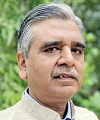
Rakesh Kumar
In Indian civilisation, Satya—truth—has been accorded the highest moral reverence. The story of King Harishchandra, who accepted extraordinary suffering rather than compromise with truth, represents one of the strongest expressions of this ideal. Independent India carried this civilisational principle into its national identity by adopting “Satyameva Jayate” — “Truth Alone Triumphs” — as the national motto.
Yet, ironically, the commitment to ensuring that truth can be spoken freely came under pressure almost at the very beginning of the Republic.
Often projected as the most liberal of India's first generation of Prime Ministers, Jawaharlal Nehru struck one of the earliest and most consequential blows to constitutional freedom of speech when his government introduced the Constitution (First Amendment) Act, 1951—barely sixteen months after the Constitution came into force.
The amendment was, in significant part, a response to early Supreme Court and High Court judgments that had struck down government attempts to restrict publications, including Cross Roads and Organizer. Rather than accepting the courts' interpretation as a necessary protection of fundamental rights, the government chose to amend the Constitution itself to give the State greater powers to restrict speech.
The First Amendment expanded Article 19(2), adding grounds such as “public order,” “security of the State,” and “friendly relations with foreign states” as bases for restricting freedom of speech and expression. It also introduced the word “reasonable” in relation to such restrictions.
The significance of the amendment went beyond the individual words inserted into the Constitution. A young democracy had barely begun its journey when its government chose to expand the constitutional power of the State to restrict what citizens could say, publish or circulate. The precedent was deeply consequential: when governments find constitutional protection inconvenient, they can seek to change the constitutional protection itself.
And Nehru was not without opposition.
For the first time, a disparate group of political voices—socialists, old-school liberals, Gandhians and others—came together to oppose the amendment. Outside Parliament, sections of the legal fraternity criticised the move as undemocratic and contrary to the spirit of fundamental rights. Former judges, including S. P. Sinha and N. C. Chatterjee, spoke against it publicly. Gandhian and former Congress president Acharya J. B. Kripalani, who had broken with the Congress, and socialist leader Jayaprakash Narayan also held Nehru responsible for what they regarded as an assault on civil liberties.
The parliamentary criticism was equally severe. Shyama Prasad Mukherjee attacked Nehru's approach in uncompromising terms, accusing him of intolerance and authoritarian tendencies. His warning was not merely about one amendment; it was about the danger of giving a government greater power to determine the limits of permissible speech.
The irony becomes even sharper when we remember that Nehru himself had been a founder of the English-language newspaper National Herald.
When National Herald was launched, Nehru made it clear that the newspaper would broadly represent the policy and programme of the Indian National Congress, while not being an official Congress organ. Yet he simultaneously insisted that news should be reported faithfully and that facts should not be suppressed or distorted merely because they were inconvenient to the political cause the newspaper supported.
Here lies the contradiction
Nehru understood the power of an independent press when he was fighting colonial rule. But once in government, his administration was prepared to strengthen the State's constitutional power to restrict speech.
The lesson is uncomfortable but important. The test of commitment to freedom of speech is not how strongly one defends it when in opposition; it is how much freedom one is willing to tolerate when in power.
Despite being the motto Satya cannot triumph if the State is given increasing power to decide which truths may be spoken, published or circulated.
The consequences
The leadership which was responsible to run National Herald, found it more profitable to shut it down. It has found innovative ways and means to exploit the benefits. The moral compass which used to run the editorial boards has lost direction. If this is the case with a newspaper which has the support of three prime minister and a ruling party of more than six decades, one can think of the fate of smaller newspaper managed by honest journalists.
As a result, today more than 60% of Indian media organisations are owned by diversified industrial and business houses or political party ownership. While the first has the deep pockets and the second has access to secret information as well as the power of the state. Before we delve further, it will be useful to know the role of media in a democracy.
What a democratic press is supposed to do?
A democratic press should act as an additional check on power:
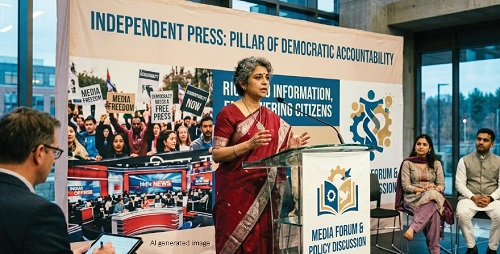
Government → Parliament → Courts → Press → Citizens
The press should investigate all of them—not simply whichever political party happens to be in government.
The problem arises when media ownership becomes concentrated and closely connected with political or commercial power. ‘Freedom House’ specifically identifies concentrated ownership, political connections of owners, and relationships between politicians, business executives and media organisations as factors that can reduce media independence, diversity and crdibility.
That creates a fundamental paradox:
• A newspaper can be legally free to criticise the government, yet economically or institutionally reluctant to investigate powerful interests connected to its ownership.
• Democracy must create environment for free and responsible press.
as stated above government, parliament and courts, the other three pillars need the critical investigative journalism to get true feedback. A true democracy should ensure that these three pillars respect the autonomy of press.
What US did to empower media
The author was amazed to see Thomas Jefferson Memorial Washington. Foundational principles championed by Jefferson in his drafting of the Declaration of Independence and his subsequent political writings, laid the ideological groundwork that permanently empowered the American press. Its declaration of unalienable rights and the principle that governments derive their power solely from the consent of the governed fundamentally reshaped the media's role in American society.
Jefferson's philosophy empowered the American press in several profound ways:
Establishing the Press as the "Fourth Estate"
Jefferson firmly believed that an informed citizenry was the only true safeguard against tyranny. By arguing in the Declaration that citizens have a right to alter or abolish an unjust government, he implicitly created the need for an independent mechanism to monitor that government. Jefferson famously elevated the press above government itself in an 1787 letter to Edward Carrington, writing: "Were it left to me to decide whether we should have a government without newspapers, or newspapers without a government, I should not hesitate a moment to prefer the latter."
Informing the Sovereign Citizen: Under Jeffersonian philosophy, because the "governed" hold the ultimate power, they require aggressive, uncensored information to cast votes and judge their leaders effectively.
The Shift from Subservience to Adversarial Journalism: Jefferson’s focus on liberty helped shift the definition of a journalist's role. By framing dissent against a king as a moral obligation, the Declaration normalized the idea that the press should be inherently adversarial to those in power, rather than a tool to validate the ruling class.
Codifying Press Freedom into Law
The rhetoric of the Declaration directly inspired the later legal frameworks that protect journalists today. The spirit of Jeffersonian liberty heavily influenced the drafting of the First Amendment to the U.S. Constitution, which explicitly prohibits Congress from abridging the freedom of the press.
India chose a path detrimental to freedom of press
Critics, independent commentators, and political opponents have a belief that previous Indian governments, particularly the Congress-led UPA regimes, utilized state patronage—including the Padma Shri awards and prime government housing—to cultivate a pliant and compliant press. Cherry on the cake was, international trips with prime minister to a chosen few.
This systemic nexus, often colloquially referred to by critics as the ecosystem of "Lutyens' Delhi," is viewed as a mechanism that incentivized media narrative alignment with the ruling establishment.
The non-compliant genuine investigative journalists have endangered their lives.
India ranks 140 out of 180 countries in Reporters Without Borders’ (RSF) 2019 World Press Freedom Index. India is considered among the deadliest countries in the world for journalists. Even the Bollywood masala films acknowledge this fact in their story line.
Where, the media has reached today?
There is little evidence that the Indian media industry, as a whole, has a specific economic incentive to “protect Indian democracy.” Its immediate incentives are more straightforward: attracting audiences, securing advertising and subscriptions, maintaining profitability, gaining access to influential people, and ensuring institutional survival. Reuters Institute has described India’s legacy media as predominantly commercial and heavily dependent on advertising.
This creates a structural problem. What attracts attention is not necessarily what strengthens democracy. Sensationalism, confrontation, polarization and virality can be more commercially rewarding than patient investigation, institutional scrutiny and fact-based public debate. The result is a media environment that can be loud without necessarily being informative, influential without necessarily being trustworthy, and highly visible without always being accountable.
Sensationalism over substance
Mainstream television news frequently gives greater space to high-decibel political confrontation, personality-driven debates and controversy than to original investigative journalism or sustained foreign-policy reporting. Complex international developments are often reduced to studio battles, competing nationalist claims and dramatic headlines.
The consequences can be serious. The Nupur Sharma controversy, for instance, demonstrated how a domestic television debate can rapidly acquire an international dimension in the age of social media and 24-hour news. The problem is not that the media should avoid controversial subjects; it is that the manner in which controversy is produced, amplified and repeatedly replayed can itself become part of the problem.
The same weakness is visible in coverage of conflicts with Pakistan and tensions with China. Television debates often ask, in effect, “What does India think?”—the familiar “Poochhta Hai Bharat” format—rather than asking the more difficult questions: What actually happened? What evidence exists? What are the strategic implications? What does the other side know? What are we missing? And who should be held accountable for failures?
The issue is therefore not a lack of patriotism. It is a lack of investigative depth.
The irony is particularly striking when compared with an earlier generation of Indian public life. In 1957, Feroze Gandhi, a sitting Congress MP and Jawaharlal Nehru’s son-in-law, exposed the ‘Haridas Mundhra scam’ from the floor of Parliament. He did not hesitate to challenge his own government. The subsequent inquiry led to the resignation of Finance Minister T. T. Krishnamachari.
Today, such scrutiny increasingly comes from outside India. Indian media routinely follows and amplifies investigative stories produced by international organisations and foreign media, rather than consistently investing in the painstaking reporting required to uncover them itself.
One of my readers wrote, “Investigative journalism is dead and needs resurrection”, courageous reporters, investigative organisations and regional publications doing important work. The problem is structural: their incentives are weaker, their resources are smaller, and their reach is often dwarfed by commercial television and digital platforms built around attention.
The 26/11 Mumbai attacks offer a disturbing illustration of the danger.
Terror handlers were reported to have monitored Indian television coverage and used information being broadcasted to track developments during the attacks. When live journalism becomes operational information for those conducting an attack, the distinction between informing the public and inadvertently assisting the adversary becomes critically important.
There is another uncomfortable irony. During conflicts, Indian television coverage and political statements have sometimes been cited by Pakistani political and media actors as evidence supporting their own narrative of events. That should prompt a basic question: Are we reporting facts for our citizens, or are we producing ammunition for competing narratives?
A democracy does not need a media industry that is uniformly patriotic, anti-government or pro-government. It needs a media that is willing to scrutinize everyone—the government, opposition, corporations, security establishment and even its own owners.
That is the real test of a free press.
And if the commercial incentives of the media do not consistently reward that function, democracy cannot afford to assume that the market will automatically produce it.
It is high time that the government, courts, media and the press council work together to build an environment where it pays to protect democracy.
(The content of this article reflects the views of writer and contributor, not necessarily those of the publisher and editor. All disputes are subject to the exclusive jurisdiction of competent courts and forums in Delhi/New Delhi only)




















Leave Your Comment