


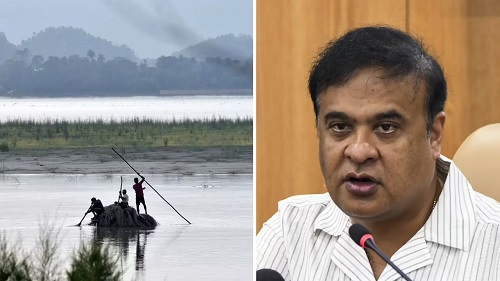
In a recent development, the geopolitical landscape concerning water resources has sparked fresh tensions between India, Pakistan, and now China. Assam Chief Minister Himanta Biswa Sarma has responded sharply to a Pakistani official's suggestion that China could halt the flow of the Brahmaputra River into India, dismissing it as a baseless scare tactic.
The controversy arose when Rana Ihsaan Afzal, a senior aide to Pakistan Prime Minister Shehbaz Sharif, reportedly hinted that China might mimic India's move regarding the Indus Waters Treaty by impeding the Brahmaputra's flow. This provocative statement prompted Sarma to debunk what he termed as Pakistan's "manufactured threat."
Himanta Biswa Sarma emphasized that the Brahmaputra, once it enters India, undergoes significant growth due to torrential monsoon rains in regions like Arunachal Pradesh, Assam, Nagaland, and Meghalaya. Contrary to misconceptions, Sarma clarified that China contributes only 30-35% of the river's total flow, primarily through glacial melt and limited Tibetan rainfall.
"The remaining 65-70% of the Brahmaputra's flow is generated within India," Sarma explained, citing major tributaries like Subansiri, Lohit, Kameng, Manas, Dhansiri, Jia-Bharali, Kopili, and additional inflows from regions such as the Khasi, Garo, and Jaintia Hills.
Sarma underscored that the Brahmaputra is a rain-fed river system within India's control, bolstered by indigenous monsoon patterns and a robust network of tributaries. He pointed out that even if China were hypothetically to reduce water flow — an unlikely scenario backed by no official indication — India's natural infrastructure could potentially mitigate annual floods in Assam, which annually displace thousands and devastate livelihoods.
The Indus Waters Treaty, which governs water distribution from India to Pakistan, was suspended by India following the Pahalgam terror attack in April. Prime Minister Narendra Modi recently highlighted the strategic impact of halting water flow to Pakistan, noting its significant geopolitical ramifications.
In response, Pakistan's military leadership has adamantly defended water rights as a national imperative, declaring "water is Pakistan's red line" and refusing any compromise on what they deem as a fundamental right for millions of Pakistanis.
As tensions over water resources escalate, Assam's Chief Minister has steadfastly reaffirmed India's sovereignty over the Brahmaputra River, stressing its resilience and self-sufficiency in the face of external speculation. While diplomatic maneuvers continue to shape regional dynamics, the robustness of India's natural water systems stands as a testament to national security and resilience against external pressures.
In summary, while rhetoric may fluctuate, the factual basis remains clear: the Brahmaputra flows as a lifeline through India, reinforced by natural forces that transcend geopolitical maneuvering.






















Leave Your Comment