


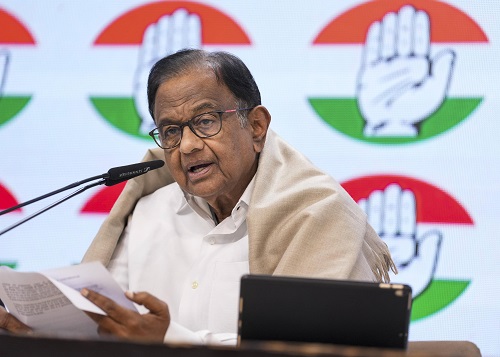
As New Delhi prepares to welcome leaders of the BRICS grouping for a high-profile summit on September 12 and 13, a political debate has emerged over a question that goes beyond the optics of flags, motorcades and diplomatic meetings: what does India actually gain from its membership of the expanding global bloc? Congress veteran and Rajya Sabha MP P Chidambaram has questioned whether recent BRICS summits have delivered tangible benefits for India, prompting a sharp political response from the BJP and reopening a larger debate over the purpose and value of multilateral diplomacy.
Chidambaram’s intervention comes at a politically significant moment. India is hosting the BRICS Summit 2026 after assuming the grouping’s chairship on January 1. Under its presidency, New Delhi has placed “Resilience, Innovation, Cooperation and Sustainability” at the centre of its agenda. The summit is therefore being watched not merely as another international gathering but as an opportunity for India to shape conversations on global governance, economic cooperation and the concerns of emerging economies.
Yet Chidambaram has questioned whether such diplomatic engagements are translating into concrete gains.
Speaking about the forthcoming summit, the former Union minister pointed to India’s participation in several influential multilateral platforms, including BRICS, the Shanghai Cooperation Organisation, the G20 and the QUAD. His argument was straightforward: if India is investing diplomatic energy in so many international forums, citizens should be able to identify the practical outcomes.
He said he had not seen “tangible benefits” from the last two or three BRICS summits, while suggesting that earlier meetings had produced more visible results.
The criticism immediately provided political ammunition to the BJP. Senior party leader Nalin Kohli questioned the Congress leader’s understanding of diplomacy and argued that international engagement cannot be judged exclusively through an immediate “give-and-take” calculation.
That counterargument points to an important reality of modern diplomacy. Multilateral organisations rarely function like commercial transactions in which every summit ends with an identifiable financial or strategic return. Their value often lies in creating negotiating platforms, building coalitions, keeping communication channels open and shaping international rules over a longer period.
BRICS itself has evolved considerably from the original grouping of Brazil, Russia, India and China. With the inclusion of Egypt, Ethiopia, Indonesia, Iran, Saudi Arabia and the United Arab Emirates, the grouping now represents a much wider cross-section of the developing world. Its growing membership has also made it more politically diverse, which simultaneously increases its global weight and makes consensus more complicated.




















Leave Your Comment